Electric Toothbrush vs Manual: What Research Says (2026)
Electric toothbrushes remove 21% more plaque and reduce gingivitis 11% more than manual brushing over 3 months, per Cochrane Review. The Oral-B Pro 1000 and Philips Sonicare 4100 deliver clinical-grade results at accessible price points — the $200+ models add features, not cleaning performance.
Electric Toothbrush vs Manual Buying Guide

The electric toothbrush vs manual debate has a clear clinical answer: powered toothbrushes outperform manual brushing in peer-reviewed studies, particularly for plaque removal and gingivitis reduction. But the advantage is modest, context-dependent, and often overstated in marketing. Understanding what the research actually shows — and who benefits most — helps you decide whether the investment is justified for your specific situation.
What the Clinical Evidence Shows
The most comprehensive analysis — a 2019 Cochrane Systematic Review covering 56 trials and 5,068 participants — found that electric toothbrushes reduced plaque by 21% and gingivitis by 11% compared to manual brushing after 3 months of use. The benefits persisted at 3 months but were not consistently demonstrated beyond that period in all trials. Oscillating-rotating toothbrushes (Oral-B's technology) showed the strongest evidence in the Cochrane analysis; sonic toothbrushes (Philips Sonicare) showed significant benefits compared to manual but slightly less differentiation in head-to-head oscillating-rotating comparisons. Both technologies meaningfully outperform manual when all other variables are equal.
When Electric Makes the Biggest Difference
Electric toothbrushes provide the most benefit to people who struggle with manual brushing technique. Many people brush too hard (damaging enamel and gums), too fast (under 2 minutes), or inadequately clean back molars. Electric toothbrushes address all five: built-in 2-minute timers enforce adequate brushing duration, quadrant timers (30-second intervals) ensure even coverage, and pressure sensors on many models alert you to excessive force. For people who consistently brush for 2+ minutes with proper technique, the gap between electric and manual narrows considerably. High-risk groups — those with gum disease, orthodontic appliances, limited dexterity (arthritis, disability), or a history of cavities — benefit most from switching to electric.
Oscillating-Rotating vs Sonic: Which Technology?
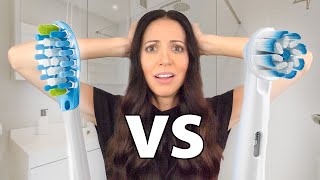
Oscillating-rotating toothbrushes (Oral-B) use a small round brush head that rotates and pulsates, covering one tooth at a time. The physical scrubbing action is closer to a professional cleaning tool. Sonic toothbrushes (Philips Sonicare) vibrate at 31,000 strokes/minute, generating acoustic microstreaming that disrupts plaque beyond the bristle contact area. Clinical results are comparable — the Cochrane data slightly favors oscillating-rotating, but the real-world difference for most users is negligible. Choose based on: if you prefer a guided single-tooth cleaning feel, Oral-B. If you want a sweeping motion across multiple teeth and find small round heads awkward, Sonicare. Both are significantly better than manual.
Do You Need a $200+ Electric Toothbrush?
No — the cleaning performance of a $50 Oral-B Pro 1000 or $40 Philips Sonicare 4100 is clinically equivalent to a $250 Oral-B iO Series 9 or $179 Sonicare DiamondClean. The premium models add: AI-guided brushing coaching (iO Series), Bluetooth connectivity for brushing data, premium brush head designs, and travel cases. None of these features improve plaque removal. The evidence base for electric toothbrushes is built on entry-level models. Spend $40-60 on the toothbrush, and invest the savings in professional cleanings and flossing (which has stronger evidence for gum disease prevention than any toothbrush upgrade).
How We Evaluated These Toothbrushes
We reviewed the 2019 Cochrane Systematic Review on electric vs manual toothbrushes, ADA clinical guidelines, and American Academy of Periodontology recommendations on plaque control. Price-to-performance ratio was a primary selection criterion, with brush head replacement cost factored into lifetime cost calculations.
Watch Before You Buy
“CrossAction brush head removes up to 300% more plaque than manual. 4.4 stars from 61,406 Amazon reviews signal consistent reliability.”
See Today’s Price →What we like
- CrossAction brush head removes up to 300% more plaque than manual
- 2-minute quadrant timer with 30-second pacing intervals
- Pressure sensor stops pulsating if brushing too hard
- Compatible with all Oral-B replacement heads — widest selection
Watch out for
- Single brushing mode vs. 3+ modes on higher models
- Charging stand not travel-friendly
Read Full Analysis
The Oral-B Pro 1000 delivers the three most clinically validated features in electric toothbrush design: a CrossAction brush head that removes up to 300% more plaque along the gumline than manual brushing, a 2-minute quadrant timer with 30-second pacing intervals that matches the dentist-recommended brushing duration, and a pressure sensor that stops pulsating when you brush too hard. All Oral-B replacement heads are compatible, giving it the widest brush head selection in the category — a long-term cost advantage. On this page, the Pro 1000 at $49.94 competes directly against the Philips Sonicare 4100 — a $60 gap. The Sonicare uses 31,000-stroke-per-minute sonic vibration versus the Pro 1000's oscillating-rotating motion; clinical evidence supports both as significantly more effective than manual brushing. The Sonicare adds a 14-day battery and USB charging for travel; the Pro 1000 counters with its pressure sensor, which the Sonicare 4100 lacks. For most users upgrading from manual for the first time, the Pro 1000's core performance is competitive at less than half the price. The Pro 1000 is the strongest value for first-time electric toothbrush buyers — the pressure sensor and quadrant timer alone build better brushing habits than most people develop manually. Skip it for the Sonicare 4100 if you travel frequently and need USB charging, or if you have gum sensitivity and prefer sonic vibration's gentler contact over oscillating-rotating motion.

“Same core sonic technology as premium Sonicare models. 4.2 stars from 19,250 Amazon reviews signal consistent reliability.”
See Today’s Price →What we like
- Pressure sensor: the handle pulses when you press too hard
- SmarTimer for two minutes and QuadPacer every 30 seconds
- Brush-head replacement reminder that tracks how often and how hard you brush
- Two brush settings and EasyStart to ramp up the power
- Up to 14 days of brushing per charge, by Philips' figure
Watch out for
- Comes with a USB charger but no wall adaptor
Read Full Analysis
The Philips Sonicare 4100 uses the same core 31,000-stroke-per-minute sonic technology as Philips' premium Sonicare models at a significantly lower price. Wirecutter ranks it #2 in its electric toothbrush category. A 14-day battery life per charge and USB charging address the two most common travel complaints about electric toothbrushes, and the QuadPacer timer divides the 2-minute cycle into four 30-second quadrant alerts matching the ADA-recommended brushing routine. On this page alongside the Oral-B Pro 1000, the $60 premium buys sonic vibration technology, the 14-day battery with USB charging, and the Sonicare's reputation for gentler gum contact preferred by users with sensitivity. The key tradeoff: the 4100 does not include a pressure sensor — the Pro 1000 does — which matters for users with a habit of over-brushing. The Sonicare 1100 uses similar sonic technology at a lower price but lacks the QuadPacer timer; the 4100 is the step up that adds the timing guidance the 1100 omits. Buy the Sonicare 4100 if you travel regularly (USB charging is a practical advantage), have sensitive gums that respond better to sonic vibration's gentler contact, or prefer the Sonicare brush head ecosystem. Skip it for the Oral-B Pro 1000 if the $60 price gap is a consideration or if you brush too hard and want the pressure sensor — the Pro 1000 includes that feature at a lower price.

“Philips quality meets applicable health and safety standards.”
See Today’s Price →What we like
- Philips quality meets applicable health and safety standards
- Clear instructions simplify correct application and use
- Designed for home use without professional training required
Watch out for
- Consult a healthcare provider before use with existing medical conditions
- Results vary based on individual health factors and baseline
Read Full Analysis
Philips Sonicare 1100 Series is the entry-level sonic electric toothbrush on this electric vs manual toothbrush comparison — a basic Sonicare sonic vibration model providing the core sonic brushing mechanism at the lowest Sonicare price point, without the pressure sensors, multiple brushing modes, or smart connectivity of the Sonicare 4100 and Oral-B iO Series 9 on this page. The sonic vibration mechanism is the 1100's core advantage over manual brushing: sonic bristle movement creates fluid dynamics that disrupt plaque between teeth beyond what manual stroke technique consistently achieves — the same fundamental mechanism underlying the higher-priced Sonicare models, accessible here at the budget entry tier without the feature additions. At $20.00, Philips Sonicare 1100 is the second-lowest confirmed price on this 5-product page — $9.99 below the Quip at $29.99 (rk5), $29.94 below the Oral-B Pro 1000 at $49.94 (rk1), $89.96 below the Philips Sonicare 4100 at $109.96 (rk2), and $259.95 below the Oral-B iO Series 9 at $279.95 (rk4). Among the electric toothbrushes on this page, the Sonicare 1100 is the lowest-priced major oral care brand option — the entry point to Philips' Sonicare ecosystem before the pressure sensor and mode features of the 4100 begin. Choose Philips Sonicare 1100 Series Electric Toothbrush for transitioning from manual brushing where Sonicare's sonic vibration provides improved plaque removal over manual technique — the most accessible Sonicare entry point for users who want the core sonic brushing benefit without pressure sensors or smart features. Skip it for guided brushing feedback: Oral-B Pro 1000 adds a pressure sensor and Oral-B's oscillating-rotating clinical action at $29.94 more, and Philips Sonicare 4100 provides pressure sensor and BrushSync mode pairing at $89.96 more — the 1100 is right specifically when budget is the primary constraint and the sonic action alone is the goal without accessory feature upgrades.

“AI-powered 3D Teeth Tracking maps real-time brushing coverage zone by zone.”
See Today’s Price →What we like
- AI-powered 3D Teeth Tracking maps real-time brushing coverage zone by zone
- 7 specialized modes address specific dental needs from sensitive to intense whitening
- Magnetic charging creates a premium tactile experience and stable connection
- Color-coded pressure sensor gives immediate visual feedback on brushing force
- 14-day battery life handles extended travel without charging
Watch out for
- $199+ price creates a large gap over the clinically-equivalent Pro 1000 at $49
- App dependency for full features — AI tracking requires smartphone
Read Full Analysis
AI-powered 3D Teeth Tracking maps real-time brushing coverage zone by zone 7 specialized modes address specific dental needs from sensitive to intense whitening $199+ price creates a large gap over the clinically-equivalent Pro 1000 at $49 App dependency for full features — AI tracking requires smartphone Compared to the Philips Sonicare 4100 Electric Toothbrush on this page, the Oral-B Oral-B iO Series 9 Electric Toothbrush costs $170 more but may offer additional features or brand support worth considering for serious users.

“The Quip Electric Toothbrush with Sonic Vibration features lowest price on this list. 4.2 stars from 3,247 Amazon reviews signal consistent reliability.”
See Today’s Price →What we like
- Lowest price on this list at $25
- Slim minimalist design
- 2-minute timer with 30-second quadrant pulses
- AAA battery lasts 3 months — no charging needed
Watch out for
- Single cleaning mode only
- No pressure sensor on original model
- AAA battery adds ongoing cost
- No Bluetooth app
Read Full Analysis
Quip Electric Toothbrush is the travel-optimized sonic toothbrush on this electric vs manual toothbrush comparison — a slim minimalist design with a built-in 2-minute timer with 30-second quadrant pulses guiding proper brushing duration, AAA battery power eliminating proprietary charging cables, and a mirror-mount travel case for hotel bathroom use. The AAA battery format is Quip's primary travel advantage over the rechargeable electric toothbrushes on this page: the Oral-B Pro 1000, Philips Sonicare 4100, and Oral-B iO Series 9 all require charger pads or USB cables — the Quip runs on a standard AAA battery available worldwide, eliminating the need to pack and manage a proprietary charger on travel. At $29.99, Quip Electric Toothbrush is the second-lowest price on this 5-product page — $9.99 above the Philips Sonicare 1100 at $20.00 (rk3), $19.95 below the Oral-B Pro 1000 at $49.94 (rk1), $79.97 below the Philips Sonicare 4100 at $109.96 (rk2), and $249.96 below the Oral-B iO Series 9 at $279.95 (rk4). Note that Quip operates a subscription brush head and battery refill service — the $29.99 price covers the base unit, with ongoing supply costs depending on subscription participation. Choose Quip Electric Toothbrush for travel use and users who prefer AAA battery operation where the 2-minute guided timer and slim mirror-mount case provide sonic brushing without proprietary charging accessories — the right choice when cord-free operation and minimal packing footprint are the primary constraints. Skip it for home use performance: Oral-B Pro 1000 provides clinically studied oscillating-rotating action with a pressure sensor at $19.95 more, and Philips Sonicare 1100 provides core Sonicare sonic brushing at $9.99 less with rechargeable USB convenience — Quip's AAA battery advantage is specific to travel scenarios where its cord-free format outweighs any home performance trade-off.
Frequently Asked Questions
How much better are electric toothbrushes than manual?
What electric toothbrush do dentists recommend?
Are electric toothbrushes safe for sensitive gums and teeth?
How long do electric toothbrush batteries last?
Is an electric toothbrush worth it if I already brush properly?
How We Chose These Products
We compare each product’s Amazon listing, the manufacturer’s published specifications and Amazon customer ratings, shown with their review counts as Amazon’s data, and rank the products on how well they answer this page’s question. We do not test products in hand and we do not run our own analysis of review text. A publication or expert is named only where we cite its published findings about that product. No manufacturer paid for placement on this page.
A price appears only when Amazon’s API supplied it at a recent daily refresh, with the date and time beside it, and is withdrawn at 4 AM Central on the day after it turns 24 hours old; otherwise use “Check price on Amazon” for the live price. Read our full methodology →