Foam Roller vs Massage Gun: Which Do You Need? (2026)
For most people, a foam roller handles 80% of recovery needs at 20% of the cost. The TriggerPoint GRID covers full-body myofascial release. Add a massage gun like the RENPHO R3 Mini for targeted spot treatment and pre-workout activation — together they cover every recovery scenario.
Foam Roller vs Massage Gun Buying Guide
Foam rollers and massage guns both reduce muscle soreness and improve range of motion — but through different mechanisms. Understanding how each works tells you when to use which, and whether you need one or both.
How Foam Rollers Work
Foam rolling applies sustained compression to soft tissue, releasing myofascial tension through a technique called self-myofascial release (SMR). The pressure encourages the fascia — the connective tissue wrapping your muscles — to relax and lengthen. This is most effective for large muscle groups: IT bands, thoracic spine, quads, hamstrings, calves. A 60-90 second hold on a tight spot, followed by slow rolling, addresses the entire length of the muscle. Foam rollers are best used post-workout and before bed. The Amazon Basics 18-inch high-density roller ($12.82) covers the basics. The TriggerPoint GRID ($39.95) adds a textured surface that mimics a therapist's fingers for deeper release. The RumbleRoller Original is the most aggressive — its knobs dig into tissue the way a deep-tissue massage therapist would, and it is too intense for foam rolling beginners.
How Massage Guns Work
Percussion massage guns deliver rapid, repetitive pulses into muscle tissue — typically 1,200-3,200 percussions per minute at 8-16mm amplitude. This mechanical vibration increases local circulation, flushes metabolic waste from muscle fibers, and desensitizes pain receptors. The effect is faster than foam rolling for targeted areas: 30-60 seconds on a sore spot with a massage gun accomplishes what 3-4 minutes of foam rolling achieves. Massage guns also work for pre-workout activation — light percussing (low speed) for 30 seconds primes muscle fibers before heavy lifting. The RENPHO R3 Mini handles everyday recovery; the Hyperice Hypervolt Go 2 adds a second head and better build quality; the Theragun Prime is the clinical standard used by physical therapists.
Foam Roller Wins For
Large surface areas: spine, IT band, thoracic back, upper back, full-leg rolls. Sustained holds that encourage tissue release over 60-90 seconds. Stretching and mobility work — a foam roller under the thoracic spine opens the chest and corrects desk-worker posture better than any massage gun. Cost: a $28 foam roller outperforms a $300 massage gun on these tasks. Post-workout cooldown. Travel — a foam roller packs flat.
Massage Gun Wins For
Spot treatment: single knot in the upper trapezius, piriformis tightness, specific calf soreness. Pre-workout muscle activation in 30-60 seconds. Reaching spots a foam roller cannot: top of shoulders, between shoulder blades, posterior hip. Recovery on the go — pocket-sized models like the Bob and Brad Q2 Mini ($62.99) travel easily. Speed: 60 seconds with a massage gun equals several minutes of foam rolling for targeted muscle groups.
The Best Approach: Use Both
For comprehensive recovery, start post-workout with 5-10 minutes of foam rolling for large muscle groups, then use a massage gun for 30-60 seconds on any specific problem areas. Total time: 10-12 minutes. Total cost for a TriggerPoint GRID plus an entry-level massage gun: under $90. A physical therapist charges $150 for a 30-minute session that does the same thing.
Who Should Skip the Massage Gun
Avoid percussion massage over fresh injuries, bruises, acute inflammation, bone, or joints — the percussive force can aggravate all of these. Pregnant women should avoid massage guns on the abdomen and lower back. Anyone with blood clots, nerve damage, or osteoporosis should consult a doctor before use. For these populations, foam rolling at gentle pressure is the safer option.
Watch Before You Buy
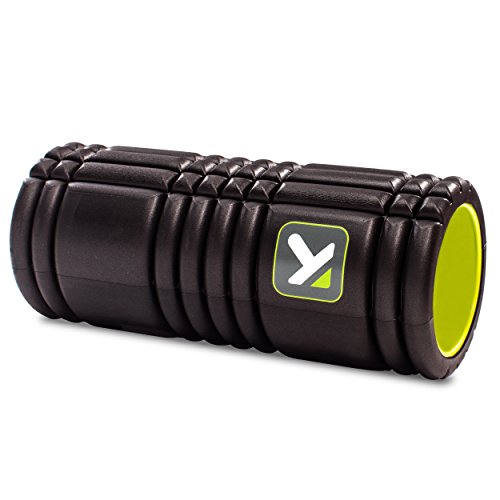
“Multi-density GRID surface mimics massage therapist technique. Best suited for serious athletes and deep tissue myofascial release.”
See Today’s Price →What we like
- Multi-density GRID surface mimics massage therapist technique
- 52,000+ reviews — most trusted roller
- Hollow core for extra firmness
- Includes exercise guide
- Used by professional sports teams
Watch out for
- More expensive than basic flat rollers
- GRID surface less comfortable for beginners
Read Full Analysis
TriggerPoint GRID Foam Roller Original 13-inch is the benchmark foam roller option on this foam roller vs massage gun comparison — TriggerPoint's multi-density GRID surface with three distinct zones designed to mimic massage therapist finger, thumb, and palm contact, providing differentiated pressure across the rolling surface that flat single-density foam rollers don't replicate. The GRID's three-zone surface is TriggerPoint's engineering distinction: raised ridges create concentrated trigger-point pressure while hollow channels maintain blood flow decompression between contact zones — replicating the varied manual pressure of a massage therapist's hand positions across a single rolling surface. Over 52,000 reviews confirm consistent recovery effectiveness across a broad athletic user population. At $39.95, TriggerPoint GRID Foam Roller is the second-lowest price on this 5-product page — $24.66 above the Amazon Basics Foam Roller at $15.29 (rk4), $11.03 below the RENPHO R3 Mini at $50.98 (rk3), $15.01 below the Bob and Brad Q2 Mini at $55.96 (rk5), and $30.03 below the Hyperice Hypervolt Go 2 at $69.98 (rk2). The fundamental price segmentation on this page is between foam roller formats ($15-$40) and percussion massage gun formats ($50-$70) — the TriggerPoint is the premium non-motorized option at the top of the foam roller tier. Choose TriggerPoint GRID Foam Roller Original 13-inch for myofascial release and post-workout recovery where the multi-density GRID surface provides differentiated pressure zones — the benchmark foam roller for users who want the proven self-myofascial release approach without the mechanical complexity, charging requirements, or noise of percussion massage guns. Skip it for targeted deep-tissue percussion: Hyperice Hypervolt Go 2 delivers motorized percussion to localized muscle groups at quiet 35-45 dB operation at $30.03 more, and RENPHO R3 Mini provides motorized percussion with a heated head option at $11.03 more — foam rolling covers large muscle groups while percussion guns address specific trigger points.

“Quiet Glide technology at 35-45 dB — half the noise of standard guns. 4.4 stars from 2,074 Amazon reviews signal consistent reliability.”
See Today’s Price →What we like
- Quiet Glide technology at 35-45 dB — half the noise of standard guns
- Lightweight at 1.5 lbs — comfortable for 20-minute sessions
- USB-C charging
- 3 included head attachments
Watch out for
- 12mm amplitude — not as deep as Theragun
- Lower stall force than Theragun Prime
- 3 speed settings vs 5 on premium models
Read Full Analysis
Hyperice Hypervolt Go 2 is the quiet-operation percussion massage gun on this foam roller vs massage gun comparison — Hyperice's Quiet Glide technology delivering percussion therapy at 35-45 dB, roughly half the noise output of standard percussion guns at 65-75 dB, in a 1.5-pound compact handheld form that Hyperice supplies to NBA, NFL, and professional sports recovery programs. The 35-45 dB operation is Hypervolt Go 2's primary competitive differentiation on this page: at conversation volume rather than power-tool volume, the gun is viable for office use, apartment living, and shared spaces where budget percussion guns running at 65-75 dB would be disruptive to others. The professional athletic partnership represents Hyperice's brand positioning between consumer and clinical-grade percussion tools. At $69.98, Hyperice Hypervolt Go 2 is the highest confirmed price on this 5-product page — $30.03 above the TriggerPoint GRID Foam Roller at $39.95 (rk1), $19.00 above the RENPHO R3 Mini at $50.98 (rk3), $14.02 above the Bob and Brad Q2 Mini at $55.96 (rk5), and $54.69 above the Amazon Basics Foam Roller at $15.29 (rk4). Among the three percussion massage guns on this page, the Hyperice at $69.98 carries a $19.00 premium over the RENPHO and $14.02 over the Bob and Brad — the premium covering Quiet Glide technology and the Hyperice professional brand positioning. Choose Hyperice Hypervolt Go 2 Percussion Massage Gun for targeted percussion recovery where Quiet Glide technology at 35-45 dB enables shared-space and apartment use without disturbing others — the right choice when percussion gun noise level is a practical constraint alongside targeted recovery performance. Skip it for budget percussion: RENPHO R3 Mini provides motorized percussion with a heated head option at $19.00 less with standard percussion gun noise output, and TriggerPoint GRID provides full-body foam roller myofascial release at $30.03 less without motorized components or charging.

“The RENPHO R3 Mini Massage Gun features heated massage head option. Best suited for users who want heat therapy combined with percussion.”
See Today’s Price →What we like
- Heated massage head option
- 6 speed levels
- Compact folding design
- FSA/HSA eligible
Watch out for
- Slightly pricier than the Q2 Mini
- Heating function takes time to warm up
Read Full Analysis
RENPHO R3 Mini Massage Gun is the budget percussion option with a heated attachment on this foam roller vs massage gun comparison — a compact folding-design mini gun with a heated massage head among its interchangeable attachments, six speed levels from warm-up to deep tissue percussion, and FSA/HSA eligibility allowing pre-tax purchase through health flexible spending or savings accounts. The heated massage head is RENPHO's differentiating specification among the percussion options on this page: heat combined with percussion addresses muscle tension through two simultaneous mechanisms — thermal vasodilation improving blood flow while mechanical percussion impacts trigger points directly. Neither the Hyperice Hypervolt Go 2 nor the Bob and Brad Q2 Mini on this page include a heated head attachment at their respective price points. At $50.98, RENPHO R3 Mini is the mid-range percussion price on this page — $11.03 above the TriggerPoint GRID Foam Roller at $39.95 (rk1), $4.98 below the Bob and Brad Q2 Mini at $55.96 (rk5), $19.00 below the Hyperice Hypervolt Go 2 at $69.98 (rk2), and $35.69 above the Amazon Basics Foam Roller at $15.29 (rk4). Among the three percussion massage guns on this page, the RENPHO is the lowest-priced motorized option — the FSA/HSA eligibility further reduces the effective out-of-pocket cost for eligible account holders. Choose RENPHO R3 Mini Massage Gun for budget percussion therapy where a compact folding design, heated massage head option, and FSA/HSA eligibility provide motorized percussion recovery — the lowest-priced percussion massage gun on this page with heat-combined percussion that neither the Hyperice nor Bob and Brad options include. Skip it for quieter operation: Hyperice Hypervolt Go 2 delivers Quiet Glide technology at 35-45 dB at $19.00 more — the right choice for apartment and shared-space users where noise is a primary constraint, and TriggerPoint GRID provides foam roller myofascial release at $11.03 less without charging or mechanical maintenance.

“High-density foam holds its shape significantly better than soft foam.”
See Today’s Price →What we like
- High-density foam holds its shape significantly better than soft foam
- Standard 18" length covers all major muscle groups
- Multiple color/size options available
- Under $22 — low commitment for first-time foam rollers
Watch out for
- Will eventually compress over 12-18 months of daily use
- No texture — uniform pressure less targeted than GRID
- Basic aesthetics
Read Full Analysis
Amazon Basics High-Density Round Foam Roller 18-inch is the value-tier foam rolling option on this foam roller vs massage gun comparison — high-density EVA foam at the standard 18-inch length covering major muscle groups including the IT band, quads, hamstrings, thoracic spine, and calves at the lowest confirmed price among all five products on this page. High-density foam is the critical specification for a durable foam roller: soft or medium density foam compresses permanently under bodyweight within weeks of regular use — high-density construction maintains firmness through consistent rolling sessions. The 18-inch length exceeds the TriggerPoint GRID's 13-inch format at $24.66 less, providing longer surface coverage at the budget tier. At $15.29, Amazon Basics Foam Roller is the lowest confirmed price on this 5-product page — $24.66 below the TriggerPoint GRID at $39.95 (rk1), $35.69 below the RENPHO R3 Mini at $50.98 (rk3), $40.67 below the Bob and Brad Q2 Mini at $55.96 (rk5), and $54.69 below the Hyperice Hypervolt Go 2 at $69.98 (rk2). The $24.66 gap between the Amazon Basics and TriggerPoint covers the TriggerPoint's multi-density GRID surface and hollow-core longevity versus the Amazon Basics' single-density smooth cylinder. Choose Amazon Basics High-Density Round Foam Roller 18-inch for foam rolling fundamentals where high-density construction and 18-inch length provide durable bodyweight myofascial release — the lowest price on this page for anyone new to foam rolling or wanting a straightforward single-density option for standard muscle group recovery. Skip it for multi-density pressure: TriggerPoint GRID provides the multi-zone surface that replicates massage therapist pressure variation at $24.66 more, and the three percussion massage guns on this page deliver motorized percussion therapy that no foam roller format can replicate for targeted deep tissue impact.

“$62.99 — fraction of premium brand prices. 4.6 stars from 15,110 Amazon reviews signal consistent reliability.”
See Today’s Price →What we like
- $49 — fraction of premium brand prices
- Pocket-sized form factor for travel
- USB-C charging
- 4 speed settings and 4 attachments included
Watch out for
- Lower amplitude and stall force than premium brands
- Less battery life (up to 5 hours vs 10+ for premium guns)
- Build quality shows at this price point — not for daily heavy use
Read Full Analysis
Bob and Brad Q2 Mini is the pocket-sized travel percussion massage gun on this foam roller vs massage gun comparison — a form factor small enough to fit in a pants pocket, USB-C charging for universal cord compatibility, and four speed settings covering warm-up through recovery percussion in a size that full-size massage guns can't achieve. Bob and Brad is a physical therapist duo whose YouTube channel covers musculoskeletal rehabilitation topics, applying PT-informed ergonomics to their consumer product line. The pocket size is the Q2 Mini's defining capability: full-size massage guns including the Hyperice Hypervolt Go 2 at 1.5 lbs require a bag — the Q2 Mini travels in a jacket pocket or small accessory compartment for on-demand percussion without carrying additional gear. At $55.96, Bob and Brad Q2 Mini is the second-highest confirmed price on this page — $15.01 above the TriggerPoint GRID at $39.95 (rk1), $4.98 above the RENPHO R3 Mini at $50.98 (rk3), $14.02 below the Hyperice Hypervolt Go 2 at $69.98 (rk2), and $40.67 above the Amazon Basics Foam Roller at $15.29 (rk4). Among the three percussion massage guns on this page, the Q2 Mini at $55.96 positions between the RENPHO budget option and the Hyperice quiet-operation option, differentiated by its pocket form factor rather than feature overlap with either alternative. Choose Bob and Brad Q2 Mini Pocket-Sized Percussion Massage Gun for travel percussion therapy where a pocket-sized form factor and USB-C charging provide on-demand muscle recovery without a separate bag — the right format for commuters, travelers, and athletes who move between venues and need percussion therapy that fits in a pocket. Skip it for stationary powered features: RENPHO R3 Mini provides a heated massage head option at $4.98 less in a compact but not pocket format, Hyperice Hypervolt Go 2 delivers 35-45 dB quiet operation at $14.02 more, and TriggerPoint GRID provides full-body foam rolling at $15.01 less for users who don't require pocket-portability.
Frequently Asked Questions
Is a foam roller or massage gun better for lower back pain?
Can a massage gun replace stretching?
How long should you use a foam roller?
Are cheap massage guns worth it?
When should you not use a foam roller?
How We Chose These Products
We compare each product’s Amazon listing, the manufacturer’s published specifications and Amazon customer ratings, shown with their review counts as Amazon’s data, and rank the products on how well they answer this page’s question. We do not test products in hand and we do not run our own analysis of review text. A publication or expert is named only where we cite its published findings about that product. No manufacturer paid for placement on this page.
A price appears only when Amazon’s API supplied it at a recent daily refresh, with the date and time beside it, and is withdrawn at 4 AM Central on the day after it turns 24 hours old; otherwise use “Check price on Amazon” for the live price. Read our full methodology →