Best Mixing Bowls for Bread Making 2026

The FineDine 6-Piece Stainless Steel Mixing Bowls Set is our pick for bread making: its six sizes run up to a 5-quart bowl for mixing and kneading dough, with wide rolled rims for a solid grip. Choose the KitchenAid 3-piece Stainless Steel Mixing Bowls if you want a nonslip base that keeps the bowl steady while you mix.
At a Glance
Mixing Bowls for Bread Making Buying Guide
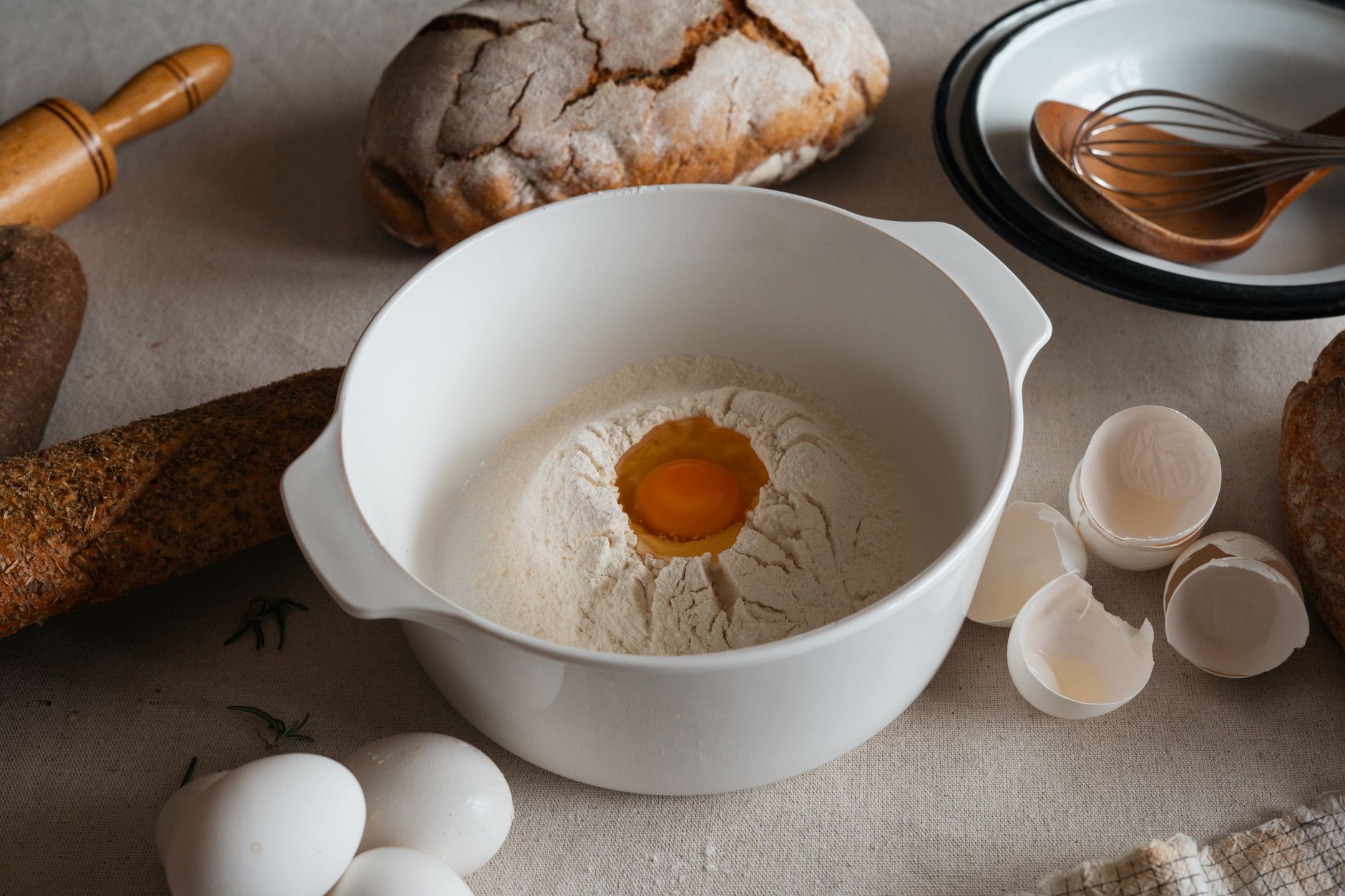 Photo by hello aesthe / Pexels
Bread making puts different demands on mixing bowls than everyday cooking. You need generous capacity for bulk fermentation, a stable base that won't slide during vigorous kneading, and a material that won't react with dough. Porcelain, stainless steel, and glass each have trade-offs worth understanding before you buy.
Capacity Requirements for Bread Dough
Bread dough doubles or triples during bulk fermentation. A one-pound loaf starts with about 16 oz of dough that will expand to fill a 4-quart bowl. The Sweese Porcelain Set includes bowls up to 4.5 quarts — enough for a standard two-loaf batch. The KitchenAid Stainless Set ($74.99) tops out at 5 quarts. The Pyrex Glass Set ($49.98) includes an 8-cup (2-quart) bowl as its largest — better for small batches or enriched doughs.
Stability During Kneading
Kneading pushes against the bowl with considerable force. Heavy porcelain bowls like the Sweese set stay put through vigorous hand-kneading without sliding across the counter. Stainless steel bowls like the KitchenAid set ($74.99) are lighter and may need a damp towel underneath to prevent sliding. Glass bowls from Pyrex ($49.98) are heavy but smooth-bottomed, so they also benefit from a stabilizing mat.
Proofing Compatibility
Bread dough is often proofed in the same bowl used for mixing. The Sweese Porcelain and Pyrex Glass ($49.98) are both microwave-safe, allowing you to use the microwave proofing method (30-second bursts of heat) to speed bulk fermentation. The KitchenAid Stainless Steel ($74.99) is not microwave-safe but excels for refrigerator proofing — cold fermentation in stainless steel keeps dough temperature even without condensation issues.
Cleaning and Durability
Porcelain and glass are dishwasher-safe and resist absorbing dough odors over time. Stainless steel is also dishwasher-safe and nearly indestructible. The Sweese Porcelain bowls are the most fragile of the three — they chip if dropped on hard floors. The KitchenAid Stainless ($74.99) handles kitchen abuse without concern. The Pyrex Glass ($49.98) is thermal shock resistant but can break if subjected to sudden temperature changes.
Which to Buy
The Sweese Porcelain Set is the best all-around choice for bread bakers — wide, stable, microwave-compatible for proofing, and attractive enough to go from counter to table. The KitchenAid Stainless Steel Set at $74.99 is better for serious bakers doing refrigerator proofing who want indestructible bowls. The Pyrex Glass Set at $49.98 is the pick if you want to monitor dough rise through the bowl walls and do not mind the premium price.
“Beautiful porcelain appearance — table-worthy for serving.”
See Today’s Price →What we like
- Beautiful porcelain appearance — table-worthy for serving
- 5-piece set covers a wide range of sizes
- Oven and microwave safe
- Non-reactive with all ingredients
- Multiple color options
Watch out for
- Heavy and breakable — not practical for rough use
- No non-slip bases
- Not the right choice for vigorous hand-mixing or bread dough

“The KitchenAid 3-Piece Stainless Steel Mixing Bowl set provides non-slip bases for countertop stability during vigorous dough mixing and brushed stainless construction that matches KitchenAid stand…”
See Today’s Price →What we like
- 1.5-, 3- and 5-quart bowls that nest for storage
- Nonslip base steadies the bowl while mixing
- Odor- and stain-resistant stainless steel
- Dishwasher safe
Watch out for
- No lids in the set
- Its listing names no pour spout
Read Full Analysis
KitchenAid's 3-piece stainless steel mixing bowl set is the functional workhorse choice on this page — not the lowest price, not the most bowls, but the best-engineered set for actual bread dough work. The non-slip base is the feature that earns it a distinct recommendation on a bread-making page: when working stiff enriched dough by hand, the bowl stays anchored to the counter rather than shifting across the work surface. That specific ergonomic advantage is something the Sweese porcelain set and the Pyrex glass collection cannot match in the same way. Stainless steel also handles high-torque mixing without flex, chip risk, or breakage — relevant if you run weekly bread batches. The three-size configuration covers what most bread bakers actually need: a large bowl for primary mixing and the first proof, a medium for secondary ingredients or smaller batches, and a small for prep work. Brushed stainless resists staining from flour, eggs, and oil in a way that porcelain requires more care to maintain, and the dishwasher-safe construction keeps cleanup straightforward. The price premium over the Sweese set is modest given the durability difference and the functional non-slip advantage. The honest limitations: three bowls is fewer than Sweese's five, which matters for multi-component baking sessions. There is no pour spout, which Pyrex glass bowls provide and which some bakers find useful for liquid batters. The review history on this specific configuration is newer than some KitchenAid lines. But for a baker whose priority is a bowl that stays put during kneading and can handle years of regular use, the KitchenAid 3-piece is the most purpose-built option on this page for actual bread-making technique and earns its place alongside the Sweese for bakers with heavier mixing needs.

“The Pyrex 8-Piece Glass Mixing Bowl Set includes lids that convert each bowl into a food storage container — a genuine advantage for bread bakers who proof dough and store leftovers in the same…”
See Today’s Price →What we like
- 8-piece set includes lids for storage
- Microwave, oven, freezer, and dishwasher safe
- Non-reactive glass for acidic ingredients
- Nested storage saves cabinet space
- Lids make them multi-purpose prep and storage bowls
Watch out for
- Glass is heavier than stainless or plastic
- Can shatter if dropped
- No non-slip base
- Rounded bottom can tip on countertops
Read Full Analysis
Pyrex is the most expensive option on this page — more than double the Sweese set and roughly twice the KitchenAid 3-piece. What justifies the premium is the combination of quantity and versatility: eight bowls with lids that convert each vessel into a covered storage container, making Pyrex uniquely suited to bakers who proof and store in the same bowl. The lids are not just convenient accessories — for bread making specifically, covering dough during bulk fermentation in the refrigerator overnight is a standard technique, and Pyrex with lids handles that step without plastic wrap or a separate container. The non-reactive glass surface is functionally similar to the Sweese porcelain for sourdough starter work and acidic dough ingredients. Both handle fermentation without absorbing odors or reacting with the dough. Where Pyrex separates from Sweese is oven compatibility at higher temperatures: glass is rated for baking while porcelain is generally limited to warming ranges, giving Pyrex more flexibility for bread bakers who also use their bowls for Dutch oven prep or other oven work. The honest limitations are real. Eight bowls of glass weigh significantly more than stainless steel, and the rounded bottom design can tip on flat countertops during active mixing. There is no non-slip base, which puts Pyrex behind the KitchenAid 3-piece for vigorous kneading. Glass shatters if dropped, whereas stainless steel and porcelain are more forgiving. At $86.08, Pyrex is the right investment for bakers who prize versatility and long-term storage integration; for pure mixing performance, the KitchenAid delivers more ergonomic value at lower cost.
Frequently Asked Questions
What size mixing bowl do I need for bread making?
Is stainless steel or glass better for proofing bread dough?
Can I use a plastic mixing bowl for bread making?
How We Chose These Products
We compare each product’s Amazon listing, the manufacturer’s published specifications and Amazon customer ratings, shown with their review counts as Amazon’s data, and rank the products on how well they answer this page’s question. We do not test products in hand and we do not run our own analysis of review text. A publication or expert is named only where we cite its published findings about that product. No manufacturer paid for placement on this page.
A price appears only when Amazon’s API supplied it at a recent daily refresh, with the date and time beside it, and is withdrawn at 4 AM Central on the day after it turns 24 hours old; otherwise use “Check price on Amazon” for the live price. Read our full methodology →