Bosch vs KitchenAid Stand Mixer: Which Should You Buy in 2026?

KitchenAid Artisan is the better all-around mixer for most home bakers — excellent for cakes, cookies, and occasional bread with a huge attachment ecosystem. Bosch Universal Plus wins for dedicated bread bakers who need sustained high-torque performance on large, stiff dough batches.
At a Glance
| # | Product | Award | Price |
|---|---|---|---|
| 1 | Best for Bread Baking | Check price on Amazon Buy → |
|
| 2 |  KitchenAid Artisan, 5-Qt Tilt Hea… KitchenAid |
Best Overall | $349.95 as of Nov 24, 12:08 PM CT details Buy → |
| 3 |  KitchenAid Artisan, 5-Qt Tilt Hea… KitchenAid |
$349.95 as of Nov 24, 12:23 PM CT details Buy → |
Bosch vs KitchenAid Stand Mixer Buying Guide
The Bosch Universal Plus and KitchenAid Artisan represent two very different approaches to the home stand mixer. KitchenAid is the cultural icon — available in 50+ colors and sitting on more kitchen counters than any other mixer brand. Bosch's MUM6N10UC is the professional baker's choice for high-volume dough work, commanding a different kind of respect.
Motor Power and Dough Capacity
Bosch's Universal Plus delivers 800 watts of motor power through its unique base motor design (the motor sits below the bowl rather than above), enabling significantly more torque for stiff bread doughs. The 6.5-quart bowl handles double batches of dense whole-grain doughs without straining. KitchenAid's 5-quart Artisan uses a 325-watt motor that handles standard baking tasks but can struggle with triple batches of heavy dough or sustained high-volume mixing.
Bowl Size and Design
Bosch uses a unique "planetary mixing" system where the bowl rotates around a center hub rather than KitchenAid's planetary head-tilt design. This means Bosch handles larger batches differently — ingredients need to be added more carefully to the center. KitchenAid's tilt-head or bowl-lift design is more intuitive for most home bakers. Both 5-quart capacities are sufficient for most household recipes.
Attachment Ecosystem
KitchenAid's attachment ecosystem is massive — 15+ attachments including pasta rollers, meat grinders, ice cream makers, and vegetable spiralizers. All attach to the same power hub. Bosch has a solid attachment lineup (pasta rollers, meat grinder, blender) but smaller than KitchenAid's and less universally available in retail stores.
Price Comparison
Bosch Universal Plus retails at $499 — more expensive than KitchenAid's Classic but competitive with the Artisan. The Bosch premium pays for motor power rather than aesthetics. KitchenAid's Classic is the best value entry point into stand mixing for casual bakers.
Which Mixer Is Right for You
Choose Bosch if you bake bread in large batches, frequently work with stiff doughs, or want a motor that will genuinely outperform KitchenAid on high-volume tasks. Choose KitchenAid if you want versatility through attachments, a kitchen centerpiece with color options, and a broadly compatible ecosystem. Most occasional home bakers will be served equally well by either.
Watch Before You Buy
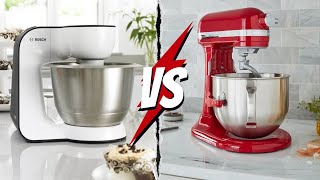
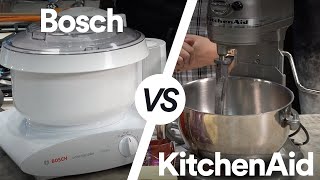
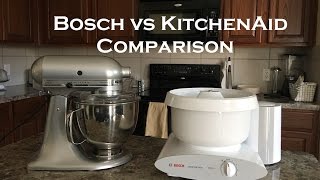
“4.6 stars from 1,096 Amazon reviews signal consistent reliability. Best suited for serious bakers who prioritize dough handling and capacity over attachment variety.”
See Today’s Price →Read Full Analysis
The Bosch MUM6N10UC Universal Plus Stand Mixer is the bread baker's choice in this Bosch vs KitchenAid comparison — a machine engineered specifically for the task where most home stand mixers have their greatest weakness: handling stiff bread dough without overheating or slowing down under load. America's Test Kitchen selected the Bosch Universal Plus over KitchenAid for bread and heavy dough applications, which is the most credible third-party validation the stand mixer category has. The case comes down to three engineering decisions. First, the 800W motor handles stiff high-hydration and whole-grain dough loads without the thermal protection shutoff that KitchenAid models can trigger during extended kneading sessions on maximum speed. Second, the 6.5-quart stainless bowl is the largest standard capacity in this comparison, accommodating double batches of most bread recipes. Third, the dual-action mixing mechanism — the bowl rotates while the planetary head rotates simultaneously — covers the bowl interior more completely than the single-axis planetary motion in KitchenAid models, reducing the need to stop and scrape during long kneading runs. The Bosch costs $100 more than the KitchenAid Artisan on this page. The premium pays back clearly in heavy bread baking: sourdough, whole grain loaves, dense enriched doughs like brioche and challah, and high-volume production. It costs value in other areas: the tilt-head design absent from Bosch makes bowl access less convenient during ingredient additions, and the attachment ecosystem is narrower — no pasta roller, meat grinder, or ice cream maker attachment. For buyers whose primary use is artisan bread, the Bosch is the right mixer; for buyers who want attachment versatility with occasional bread baking, KitchenAid's platform wins.
“Planetary mixing action ensures thorough ingredient contact around the entire bowl.”
See Today’s Price →What we like
- Planetary mixing action ensures thorough ingredient contact around the entire bowl
- 10+ compatible attachments transform it into a multi-function kitchen platform
- 14,000+ verified buyer reviews confirm exceptional long-term reliability
- 50+ color options available — unusual practicality for buyers who care about kitchen aesthetics
Watch out for
- $400 price requires real budget commitment
- 5-quart bowl limits single-batch capacity for large bread production
Read Full Analysis
Planetary mixing action ensures thorough ingredient contact around the entire bowl 10+ compatible attachments transform it into a multi-function kitchen platform $400 price requires real budget commitment 5-quart bowl limits single-batch capacity for large bread production
“The KitchenAid Artisan is the benchmark stand mixer with decades-proven reliability, 10 speed settings, and compatibility with 15+ optional attachments that extend its use well beyond baking. The…”
See Today’s Price →What we like
- Decades-proven reliability with 30+ year lifespans documented
- Compatible with 15+ optional attachments for extraordinary versatility
- 10 speed settings handle delicate meringue to stiff bread dough
- Available in over 50 colors to match any kitchen
Watch out for
- Premium price significantly above budget alternatives
- 325W motor can strain on very stiff high-volume bread dough
- Tilt-head design slightly less stable than bowl-lift under maximum load
Read Full Analysis
America's Test Kitchen named the KitchenAid Artisan their Best All-Around stand mixer, and Good Housekeeping awarded it Best Overall — both citing consistent dough development and the depth of the attachment ecosystem as the decisive factors. The 5-quart bowl handles batches up to 9 dozen cookies or 4 loaves of bread. The 10-speed motor produces repeatable results across baking tasks: whipping cream, kneading stiff pretzel dough, and emulsifying aioli all fall within the same bowl configuration. The attachment hub powers 15+ optional accessories from pasta extruders to food grinders, and owner lifespan data shows units routinely reaching 30 or more years of regular use. In a Bosch vs. KitchenAid comparison, the machines operate from different design philosophies. The Bosch MUM6N10UC outperforms the Artisan on large bread batches — its bowl-drive system distributes torque more evenly for stiff, high-hydration doughs — and runs quieter under sustained high-load mixing. The KitchenAid's planetary mixing action is more thorough at medium-complexity tasks: cakes, cookies, and frosting. Its compatible attachment library is roughly four times larger than Bosch's ecosystem. Buy if: you bake variety — cakes, cookies, pasta, occasional bread — and want an attachment platform with decades of longevity. ATK and Good Housekeeping both name the Artisan the better all-purpose choice. Skip if: bread is your primary use case, where the Bosch's bowl-drive handles stiff doughs more efficiently, or if counter depth is a constraint (the Artisan is taller than the Bosch).
Frequently Asked Questions
Is Bosch a good stand mixer?
Is KitchenAid worth the money?
Can Bosch and KitchenAid attachments be used interchangeably?
Which stand mixer is better for bread dough?
How loud are Bosch vs KitchenAid stand mixers?
How We Chose These Products
We compare each product’s Amazon listing, the manufacturer’s published specifications and Amazon customer ratings, shown with their review counts as Amazon’s data, and rank the products on how well they answer this page’s question. We do not test products in hand and we do not run our own analysis of review text. A publication or expert is named only where we cite its published findings about that product. No manufacturer paid for placement on this page.
A price appears only when Amazon’s API supplied it at a recent daily refresh, with the date and time beside it, and is withdrawn at 4 AM Central on the day after it turns 24 hours old; otherwise use “Check price on Amazon” for the live price. Read our full methodology →