KitchenAid vs Cuisinart Stand Mixer 2026

The KitchenAid Classic Series 4.5-Qt Tilt-Head is the best stand mixer for most home bakers—its attachment ecosystem, planetary mixing action, and 80-year reputation make it the gold standard. Budget-conscious bakers should consider the Cuisinart SM-55BK 5.5-Qt, which offers 500W power and 12 speeds at a lower price.
At a Glance
| # | Product | Award | Price |
|---|---|---|---|
| 1 | KitchenAid 7 Quart Bowl-Lift Stan… KitchenAid |
Best for Large Batches | $499.95 as of Nov 24, 12:32 PM CT details Buy → |
| 2 |  KitchenAid Classic Series 4.5 Qua… KitchenAid |
Best Overall | $279.99 as of Nov 24, 12:11 PM CT details Buy → |
| 3 |  Cuisinart SM-55BK 5-1/2-Quart 12-… Cuisinart |
Best Value | Check price on Amazon Buy → |
KitchenAid vs Cuisinart Stand Mixer Buying Guide
KitchenAid and Cuisinart are the two most trusted stand mixer brands in American home kitchens. KitchenAid has been the aspirational choice for 80+ years, while Cuisinart offers serious performance at a more accessible price point. Products were selected for real baking performance at each price tier.
The Core Difference
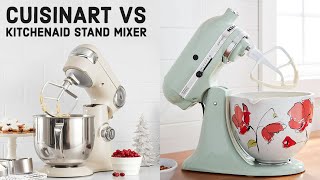
KitchenAid stand mixers are icons—they've been the gold standard in American kitchens since 1937, with a proprietary planetary mixing action (the bowl stays still, the attachment orbits). The brand supports a massive attachment ecosystem: pasta makers, meat grinders, ice cream makers, food grinders, and 80+ accessories. Cuisinart stand mixers offer solid motor power and a more contemporary design, but their attachment ecosystem is narrower and the brand has less cultural cachet. For serious bakers, KitchenAid's attachment compatibility is unmatched.
Where KitchenAid Wins
The KitchenAid attachment hub is the decisive advantage. Every tilt-head and bowl-lift KitchenAid accepts the same accessories—meaning a pasta attachment or meat grinder purchased today will work on a KitchenAid you buy 10 years from now. The 4.5-quart Classic Tilt-Head is the best-selling stand mixer ever made, trusted by professional bakers and home cooks alike. KitchenAid motors are built for decades of use; many owners report 20+ years of daily baking. The 7-quart Bowl-Lift is the go-to for high-volume baking (bread, double batches of cookies).
Where Cuisinart Wins
The Cuisinart SM-55BK 5.5-quart stand mixer typically retails $100–$150 less than a comparable KitchenAid Artisan while delivering a 500-watt motor and 12-speed range. For budget-conscious bakers who want stand mixer performance without the KitchenAid price premium, Cuisinart delivers genuine value. The SM-55 is quieter than many KitchenAid models at medium speeds. Cuisinart's bowl scraper attachment (included on some models) reduces the need to stop and manually scrape the bowl—a practical feature KitchenAid lacks.
Get KitchenAid If
You bake frequently and want a lifetime appliance; you plan to expand into pasta making, meat grinding, or other attachments; or you're giving this as a gift where the iconic look matters. The 4.5-Qt Tilt-Head is our top pick for most home bakers.

Get Cuisinart If
You want stand mixer performance at a lower price point; you primarily make cakes, cookies, and whipped cream (no pasta or meat grinding); or you're not sure how often you'll use a stand mixer. The SM-55BK is an excellent first stand mixer.
Price Comparison
Cuisinart SM-55BK: typically $250–$300. KitchenAid Classic 4.5-Qt: typically $350–$400. KitchenAid Artisan Mini 3.5-Qt: around $280. KitchenAid 7-Qt Bowl-Lift: $500–$600. For occasional bakers, Cuisinart offers the best cost-per-use value. For dedicated bakers who will use attachments, the KitchenAid ecosystem pays off over time.
Watch Before You Buy

“7-quart bowl handles double batches, bread dough, and large gatherings. Bowl-lift design more stable for heavy loads.”
See Today’s Price →What we like
- 11 distinct speeds for power and control
- Designed for folding, 1/2 speed gently adds delicate ingredients, like blueberries and egg whites, into recipes
- With 7 quart capacity, you can easily mix 13 dozen cookies per batch, knead over 8.5 lbs of bread, or mash over
- Double flex edge beater designed with a twist and two flexible edges to scrape the bowl, giving you thorough
Watch out for
- Premium pricing requires a meaningful budget commitment
- Hand-wash recommended for some parts to extend coating or surface lifespan
Read Full Analysis
The KitchenAid 7-Quart Bowl-Lift is the high-capacity argument on this KitchenAid vs. Cuisinart page — the bowl-lift design and 7-quart bowl combined address the specific limitation of the Cuisinart and smaller KitchenAid models: running out of capacity mid-batch. At 7 quarts, this mixer handles 13 dozen cookies in a single run, kneads over 8.5 pounds of bread dough, and manages double-batch recipes that would require splitting on a 5-quart machine. The bowl-lift mechanism anchors the bowl at two points while mixing, which is meaningfully more stable than the tilt-head design when running heavy bread dough at high volume. The 11-speed range gives fine-grained control between the folding speed (1/2 setting for egg whites, blueberries, and delicate additions) through full mixing power. The double flex edge beater with two flexible edges scrapes the bowl walls without interruption, which reduces the manual bowl-scraping cycle that tilt-head models require mid-recipe. Versus the Cuisinart SM-55BK on this page, the KitchenAid costs $206 more for 1.5 additional quarts of capacity, a bowl-lift mechanism, and the KitchenAid brand attachment ecosystem — a system of 80-plus attachments including pasta rollers, meat grinders, and ice cream makers that share the power hub. The Cuisinart does not have a comparable attachment ecosystem. For households that bake in large quantities regularly or who plan to invest in the attachment library, the $206 premium has clear payback. For standard home baking with occasional large batches, the Cuisinart's 5.5-quart capacity is sufficient and the $206 savings is the stronger argument.
Skip this if: You bake standard single-batch recipes—the 7-Qt is overkill and costs significantly more.
“The iconic tilt-head stand mixer. Planetary mixing action, 10 speeds, accepts 80+ attachments. Built to last decades.”
See Today’s Price →Watch out for
- Hand-wash recommended for some parts to extend coating or surface lifespan
- Counter space commitment may be challenging in very small kitchens
“500-watt motor, 12 speeds, 5.5-quart bowl. Delivers KitchenAid-level performance at a noticeably lower price.”
See Today’s Price →What we like
- 800-watt stand mixer housed in durable die-cast metal
- 12 speeds; 5-1/2-quart stainless-steel bowl; slow-start and gentle-fold functions
- 15-minute countdown timer
- Chef's whisk, flat mixing paddle, dough hook, and splashguard included
Watch out for
- Hand-wash recommended for some parts to extend coating or surface lifespan
- Counter space commitment may be challenging in very small kitchens
Read Full Analysis
The Cuisinart SM-55BK makes the most direct case against the KitchenAid premium on this VS page: an 800-watt motor in a die-cast metal housing with 12 speeds, a 5.5-quart stainless steel bowl, slow-start function, and a full accessory set — chef's whisk, flat mixing paddle, dough hook, and splashguard — for $206 less than the KitchenAid 7-Quart. For the majority of home bakers whose largest batch is a double recipe of cookies or a single loaf of bread, the 5.5-quart capacity never becomes a limiting factor. The 800-watt motor is stronger than KitchenAid's Classic series motor and handles bread dough without the labored sound that underpowered stand mixers produce when working stiff doughs. The 15-minute countdown timer is a practical addition for timed mixing steps like meringue — set the timer, walk away, and return when the cycle completes. The gentle fold function handles the same delicate-ingredient additions (egg whites, fruit) that KitchenAid promotes as a selling point for the flex edge beater. What the Cuisinart lacks compared to KitchenAid is the attachment ecosystem. KitchenAid's power hub works with 80-plus attachments from the KitchenAid lineup — pasta rollers, meat grinders, food processors, vegetable spiralizers. The Cuisinart attachment library is substantially smaller. For households where a stand mixer is exclusively a baking tool, this gap is irrelevant; for households who envision expanding into pasta-making or meat grinding using the mixer as a hub, the KitchenAid's attachment ecosystem is a legitimate long-term consideration. The Cuisinart is the better value for pure baking use.
Skip this if: You plan to expand into specialty attachments—Cuisinart's attachment ecosystem is smaller than KitchenAid's.
Frequently Asked Questions
Is KitchenAid worth the extra cost over Cuisinart?
Are KitchenAid attachments compatible with Cuisinart mixers?
What is the difference between tilt-head and bowl-lift KitchenAid?
How many quarts do I need in a stand mixer?
Can a stand mixer replace a food processor?
How We Chose These Products
We compare each product’s Amazon listing, the manufacturer’s published specifications and Amazon customer ratings, shown with their review counts as Amazon’s data, and rank the products on how well they answer this page’s question. We do not test products in hand and we do not run our own analysis of review text. A publication or expert is named only where we cite its published findings about that product. No manufacturer paid for placement on this page.
A price appears only when Amazon’s API supplied it at a recent daily refresh, with the date and time beside it, and is withdrawn at 4 AM Central on the day after it turns 24 hours old; otherwise use “Check price on Amazon” for the live price. Read our full methodology →