Best Air Compressor for Home Garage 2026
The DEWALT DWFP55126 is the best home garage air compressor — 165 PSI max and 2.6 SCFM at 90 PSI handles nailers, impact wrenches, and tire inflation without interruption. The California Air Tools 20020AD is the pick if noise level is a real constraint.
At a Glance
| # | Product | Award | Price |
|---|---|---|---|
| 1 | Best Overall | Check price on Amazon Buy → |
|
| 2 |  California Air Tools 20020AD 2.0 … California Air Tools |
Best Quiet | Check price on Amazon Buy → |
| 3 | Best Flow Rate | $347.09 as of Nov 24, 12:08 PM CT details Buy → |
|
| 4 | Check price on Amazon Buy → |
||
| 5 | $434 as of Nov 24, 12:08 PM CT details Buy → |
Air Compressor for Home Garage Buying Guide
 Photo by Andrea Piacquadio / Pexels
Choosing a home garage air compressor comes down to two questions: how much airflow do your tools need, and does noise matter? Pancake compressors prioritize portability and power; ultra-quiet compressors prioritize neighbor relations.
Key Decision Factors
SCFM (standard cubic feet per minute) at 90 PSI is the number that matters — not maximum PSI. A framing nailer needs 2.2 SCFM; an impact wrench needs 5+ SCFM. The DEWALT delivers 2.6 SCFM, which handles nailers and light impact work. Tank size determines recovery time between high-demand uses: 6-gallon handles intermittent nailer work well. For continuous impact wrench use, you need a 20+ gallon tank.
Price Tiers: What You Get
Under $220 gets the DEWALT DWFP55126 — the benchmark 6-gallon pancake with industry-leading 165 PSI and oil-free convenience. $596 reaches the California Air Tools 20020AD, which adds a 20-gallon tank and near-silent 70 dB operation. $300 lands the Makita MAC700 with a Big Bore cylinder delivering 3.3 SCFM — the highest flow rate in this group, worth it for impact wrench users.
Who Should Buy What
For nailer work, trim carpentry, and tire inflation, the DEWALT at $204.99 covers everything efficiently. If your garage shares a wall with living space or you work early mornings, the California Air Tools 20020AD at $596 solves the noise problem without sacrificing capacity. For regular impact wrench use or running multiple tools, the Makita MAC700 delivers the SCFM headroom the others lack.
What to Avoid
Avoid undersizing on tank capacity if you run impact wrenches — a 6-gallon compressor will cycle constantly under continuous demand. Avoid oil-lubricated compressors for a first garage setup unless you are committed to maintenance schedules. Skip compressors rated only by horsepower; SCFM is the honest measure of what a compressor actually delivers.
Watch Before You Buy

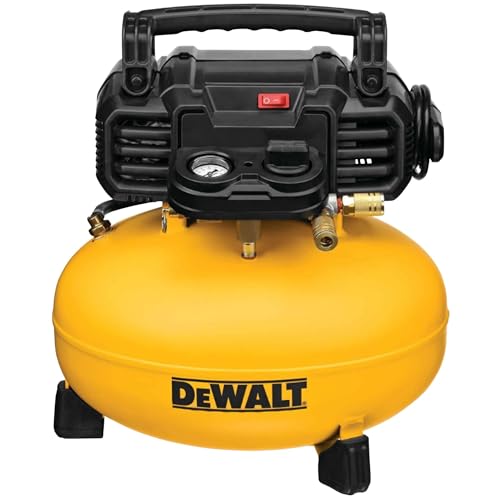
“The DEWALT DWFP55126 leads the 6-gallon pancake class with 165 PSI max pressure and 2.6 SCFM at 90 PSI, making it fast enough to keep up with nailers on framing and trim work — all for $204.99. At…”
See Today’s Price →What we like
- 165 PSI max pressure — highest in 6-gal pancake class
- 2.6 SCFM @ 90 PSI for fast nailer cycling
- 78.5 dB operation — quieter than most pancake compressors
- Oil-free pump — no maintenance, runs in any orientation
- Quick-connect coupler included
Watch out for
- 6-gallon tank empties quickly with continuous-demand tools
- Not rated for cold weather below 40°F
- Plastic manifold on older units
Read Full Analysis
The DEWALT DWFP55126 leads the 6-gallon pancake class by combining output pressure and noise level that competing models at this tank size cannot match simultaneously. At 165 PSI maximum and 2.6 SCFM at 90 PSI, it cycles fast enough to keep pace with a nailer firing at production trim-carpentry speed — framing crews and finish carpenters running pneumatic nailers all day notice fewer recovery interruptions compared to lower-CFM pancake units. At 78.5 dB, it operates noticeably quieter than most pancake compressors in this class, which matters for indoor finish work and garage use where sustained compressor noise causes fatigue. The oil-free pump design means the DEWALT starts reliably in any orientation, requires no oil checks or changes, and performs consistently from first use without a break-in period. The quick-connect coupler is included — a detail some competitors skip, forcing a separate purchase to connect a standard air hose. The 6-gallon pancake form factor keeps the footprint small enough to stand under a workbench or lie flat on a truck bed without consuming floor space. Against the California Air Tools 20020AD, the DEWALT costs $55 less and offers better portability at roughly half the weight, though the California Air Tools model runs at 70 dB versus 78.5 dB here and holds a 20-gallon tank versus 6. For a home garage where portability matters and recovery interruptions are acceptable, the DEWALT delivers better value. For a dedicated shop where quiet operation during extended use is the priority, the California Air Tools model earns its $55 premium.
“The California Air Tools 20020AD stands out with a 70 dB noise level — dramatically quieter than standard compressors — plus a 20-gallon tank for extended continuous use,. An automatic…”
See Today’s Price →What we like
- 70 dB noise level — dramatically quieter than standard compressors
- 20-gallon tank for extended continuous use
- Automatic drain valve for easy tank draining
- 2.0 HP efficient oil-free pump
- Wheels for easy positioning
Watch out for
- Significantly higher price than pancake compressors
- Larger footprint — not as portable as pancake models
- Weighs 115 pounds, so it rolls on its wheels rather than carries
- Overkill for occasional use
Read Full Analysis
The California Air Tools 20020AD at $269.99 occupies a distinct position on this page: it is the only true stationary compressor in a field of portables, and it earns that footprint premium through a 70 dB noise level that stands dramatically apart from the 78.5 dB DEWALT and the Makita MAC700. In a residential garage, 70 dB is comparable to a normal conversation — sustainable for extended work sessions without hearing protection, while units at 78-80 dB begin to cause fatigue within an hour. The 20-gallon tank fundamentally changes the use-case profile: where a 6-gallon pancake requires frequent recovery cycles with air-hungry tools like impact wrenches or cut-off wheels, the 20020AD delivers a sustained air supply that keeps most garage tools running continuously without pressure drops. The 2.0 HP oil-free pump delivers 5.3 SCFM at 90 PSI — double the DEWALT output — and the automatic drain valve releases condensed moisture on a set schedule, eliminating the corrosion risk that develops in manually-drained tanks owners forget to service. Against the Makita MAC700 and MAC2400 on this page — both oil-lubricated Big Bore units — the California Air Tools model requires no oil maintenance and runs quieter. The Makita units deliver higher CFM for sustained heavy-demand tools like spray guns, but for a typical homeowner garage covering nailers, impact wrenches, and tire inflation, the 20020AD handles all tasks without the oil maintenance schedule.

“The Makita MAC700 delivers 3.3 SCFM at 90 PSI — the highest flow in its category — via a Big Bore cylinder engineered to push more air with each stroke, priced at $299. Built for contractor-grade…”
See Today’s Price →What we like
- 3.3 SCFM at 90 PSI — highest in category
- Big Bore cylinder for more air
- Built for contractor use
- Low noise at 79 dB
- Twin-stack tank for balance
Watch out for
- Often above $200 at full price — verify before purchase
- Heavier than pancake compressors
- Overkill for occasional homeowner use
Read Full Analysis
The Makita MAC700 delivers 3.3 SCFM at 90 PSI through a Big Bore cylinder design that increases displacement per stroke compared to standard bore cylinders — meaning more air delivered per engine revolution, which translates to faster recovery and more consistent pressure under sustained tool use. The 2.6-gallon twin-stack tank is compact by professional standards, but the high flow rate means the motor cycles less frequently than a larger-tank lower-CFM unit would under the same tool demand. At 79 dB, the MAC700 sits at a noise level acceptable for residential garage use and indoor trim work. The oil-lubricated pump distinguishes the MAC700 from the oil-free DEWALT and BOSTITCH units on this page. Oil lubrication extends pump life under heavy use and reduces heat buildup during continuous operation — the trade-off is a brief oil check before each extended session and periodic oil changes. For a contractor running the compressor daily, the longevity benefit outweighs the maintenance burden. For occasional homeowner use, the oil-free units provide equivalent performance without the maintenance requirement. Against the Makita MAC2400, the MAC700 offers similar Big Bore engineering at $90 less with a smaller tank and slightly lower SCFM. The MAC2400 is the right choice when sustained air demand from multiple tools matters; the MAC700 covers single-tool use and most serious DIY applications at a lower price point.

“The BOSTITCH BTFP02012 delivers 2.6 SCFM at 90 PSI from a 6-gallon, 150 PSI oil-free pancake design — covering all standard nailer and inflation tasks —. Zero maintenance from the oil-free…”
See Today’s Price →What we like
- 2.6 SCFM at 90 PSI keeps pace with brad nailers and finish nailers without making you wait for the tank to refill between trigger pulls
- 6-gallon pancake tank provides enough stored air to drive several nails or complete a full tire inflation without the motor cycling on every pull
- Oil-free pump requires zero maintenance — no oil level checks, no oil changes, and no mess when you tip the compressor into a truck bed
- 150 PSI maximum gives you headroom above the 90 PSI that most nailers and tools require, extending run time between refill cycles
Watch out for
- Standard 79 dB noise level
- 6-gallon limits sustained tool use
- Not for continuous professional use
Read Full Analysis
The BOSTITCH BTFP02012 offers a direct comparison to the DEWALT DWFP55126 at $36 less: the same 6-gallon pancake form factor, the same 2.6 SCFM at 90 PSI output, and the same oil-free pump design — the difference landing almost entirely on 150 PSI maximum versus the DEWALT at 165 PSI. For nailer operation and tire inflation, 150 PSI is more than sufficient; the higher DEWALT maximum pressure matters primarily when running tools calibrated to operate above 120 PSI, which covers some impact wrenches and air ratchets rather than standard nailers. Both units operate at approximately 79 dB and share the same core functional profile for homeowner use. The 150 PSI versus 165 PSI gap is the most concrete differentiator — a difference that the majority of buyers will never reach in normal operation. At 79 dB, both sit noticeably louder than the California Air Tools 20020AD at 70 dB; buyers for whom noise level is the top priority should move up to that unit rather than choose between the two pancake compressors on noise grounds. For buyers who want a proven, maintenance-free 6-gallon pancake without the DEWALT price premium, the BOSTITCH delivers the same core capability at $36 less. The savings make this the better value when the lower maximum pressure ceiling is not a concern for the planned tool set.

“The Makita MAC2400 combines a Big Bore cylinder with twin 4.2-gallon tanks for 8.4 gallons total capacity and an impressive 4.2 SCFM at 90 PSI — 60% more airflow than typical pancake units — at…”
See Today’s Price →What we like
- Cast iron pump with Makita's Big Bore cylinder and piston for faster recovery
- 2.5 HP four-pole motor produces 4.2 CFM at 90 PSI
- Oil-lubricated pump runs cooler with less wear, per Makita
- Roll-cage construction protects it on a job site
- Pump runs at 1,730 RPM for a stated 79 dB
Watch out for
- Oil-lubricated: the pump has oil to check and change
- Its listing gives no maximum pressure or weight
Read Full Analysis
The Makita MAC2400 is the highest-capacity and highest-output unit on this page, earning that position through engineering specifications that separate it from the pancake-format competition. At 4.2 SCFM at 90 PSI, it delivers 60% more airflow than the 2.6 SCFM units (DEWALT $214.99, BOSTITCH $179) — a difference that is significant for spray guns, dual nailer setups, or impact wrenches that demand continuous delivery rather than burst capacity. The twin 4.2-gallon stacks combine to 8.4 gallons total, extending the interval between motor cycling during sustained use. The cast iron cylinder construction separates the MAC2400 from the aluminum-bore units on this page. Cast iron conducts heat better during sustained operation and resists wear over thousands of hours of use — the reason professional shops run cast iron units while homeowner-grade compressors typically use aluminum. The oil-lubricated pump contributes further to longevity, extending service life beyond what oil-free pumps achieve under daily professional use. At 78 dB, it operates at the quieter end of comparable twin-stack units. The MAC2400 is the correct choice for a serious DIYer or small contractor who runs the compressor as a core shop tool. The DEWALT and BOSTITCH deliver sufficient performance for finish nailers and tire inflation; the MAC2400 is justified when spray finishing, continuous air tool use, or long service life without pump replacement are the priorities.
Frequently Asked Questions
What size air compressor do I need for a home garage?
How loud are home garage air compressors?
Can a home garage air compressor run an impact wrench?
Oil-free vs oil-lubricated compressor — which is better for home use?
What CFM and PSI do I actually need from a home garage air compressor?
How We Chose These Products
We compare each product’s Amazon listing, the manufacturer’s published specifications and Amazon customer ratings, shown with their review counts as Amazon’s data, and rank the products on how well they answer this page’s question. We do not test products in hand and we do not run our own analysis of review text. A publication or expert is named only where we cite its published findings about that product. No manufacturer paid for placement on this page.
A price appears only when Amazon’s API supplied it at a recent daily refresh, with the date and time beside it, and is withdrawn at 4 AM Central on the day after it turns 24 hours old; otherwise use “Check price on Amazon” for the live price. Read our full methodology →