Best Box Joint Jigs (2026): Router Table and Table Saw Jigs Compared
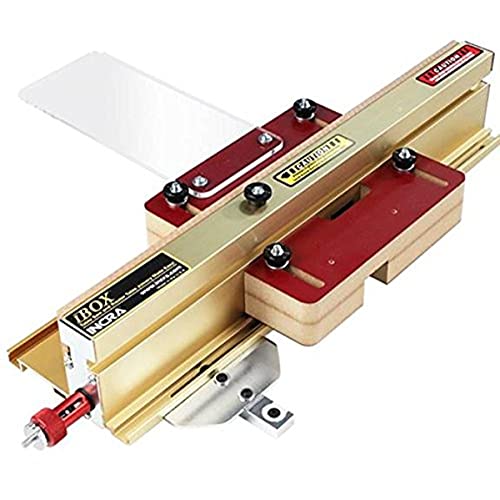
The INCRA I-BOX is the pick for most workshops: its listing says it works on a table saw or a router table, so it does not lock you into one machine, and a lead screw micro-adjusts pin widths from 1/8 to 3/4 inch. Choose the Rockler router table box joint jig if a router table is all you own: it comes with brass indexing keys for 1/4, 3/8 and 1/2-inch fingers.
At a Glance
| # | Product | Award | Price |
|---|---|---|---|
| 1 | Our Top Pick | $227.95 as of Nov 24, 3:27 PM CT details Buy → |
|
| 2 | Best for Router Tables | Check price on Amazon Used — not a new unit Buy → |
Box Joint Jigs Buying Guide
 Photo by Ivan S / Pexels
A box joint jig indexes your workpiece so each finger lands exactly one finger-width from the last. The differences that matter are which machine it mounts to, how many finger widths it can produce, and whether it micro-adjusts for a snug fit. The INCRA I-BOX and the Rockler router table jig here cover the dual-machine and router-table approaches.
Table Saw or Router Table
Box joint jigs run on either a table saw with a dado stack or a router table with a straight bit. Most hobby woodworkers with a router table prefer that route: it is quieter, the cut is cleaner, and it avoids buying a dado stack. The INCRA I-BOX is the one jig here that mounts to either machine, which is the reason to choose it if you own both.
Finger Width and What It Is For
Basic jigs produce one finger width, typically 1/4-inch or 1/2-inch. INCRA's listing gives the I-BOX a lead screw that micro-adjusts across a 1/8-inch to 3/4-inch range of pin widths, and the Rockler router table jig comes with brass indexing keys for 1/4-, 3/8- and 1/2-inch fingers. For drawer boxes, 1/4-inch or 3/8-inch fingers are standard. For jewelry boxes and small decorative work, 1/8-inch or smaller fingers create a more intricate pattern.
Box Size and Miter Slot
Check what size of work a jig is made for before buying. Rockler's listing describes its router table jig as great for small to medium-sized boxes. Both jigs ride in a 3/4-inch miter slot: the INCRA's GlideLOCK miter bar fits standard 3/4 by 3/8-inch slots, and the Rockler's knobs lock its platform into a 3/4-inch slot, so check that your saw or router table has one.
Fit and Micro-Adjustment
A box joint a few thousandths too tight will not close; a few thousandths too loose and the glue line shows. A jig with fixed keys, like the Rockler, relies on the key matching your bit; a micro-adjustable jig like the INCRA I-BOX lets you dial in the fit on a test piece. Either way, cut a test joint in scrap of the same thickness first.
How We Compared These
We compared these jigs on each one's own listing and published specifications for machine compatibility, finger widths and adjustment method. We did not conduct woodworking tests of our own.
Related Guides
Watch Before You Buy

“INCRA's I-BOX: a box joint jig for a table saw or a router table, reversible to either side of the cutter, with a one-hour instructional DVD.”
See Today’s Price →What we like
- Works on a table saw or a router table
- Reversible design works on either side of the cutter
- Dual-pitch lead screw for micro-adjusting, with a 1/8 to 3/4-inch range of pin widths
- GlideLOCK miter bar for standard 3/4 x 3/8-inch miter slots
- One-hour instructional DVD, from basic setup to decorative joinery
Watch out for
- No router bit or dado set: its listing details name the jig parts and a DVD
Read Full Analysis
The I-BOX is the jig to buy if you own both machines and want to keep the choice open. INCRA lists it for a table saw or a router table, and its reversible design works on either side of the cutter. Finger width is set by a dual-pitch lead screw for micro-adjusting, across a 1/8 to 3/4-inch range of pin widths, and the GlideLOCK miter bar fits standard 3/4 x 3/8-inch miter slots, adjusting from 0.740 to 0.762 inch. A reversible, reusable MDF sub fence reduces tear-out, by INCRA's description. INCRA says the design gives faster setup, greater versatility and improved user safety compared with traditional jigs; those are the maker's words, not a measurement of ours. The box holds the jig parts and a one-hour instructional DVD that runs from basic setup to advanced decorative joinery, which helps if this is your first box joint jig. Its listing details give the size as 21 x 15 x 4 inches and the warranty as one year. On a table saw you will need a dado blade set to cut the fingers; on a router table, a straight bit.
Skip this if: You want finger widths set by fixed keys - this one adjusts with a lead screw.

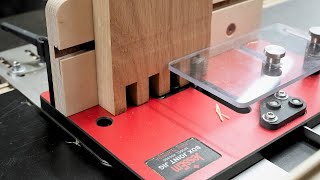
“Rockler's router table box joint jig: a squared sled in a 3/4-inch miter slot, with solid brass keys for 1/4, 3/8 and 1/2-inch fingers.”
See Today’s Price →What we like
- Solid brass indexing keys for 1/4, 3/8 and 1/2-inch fingers, stored in slots on the sled
- Sled with long skis that keep it square to the bit, and tabs that stop it at the end of the cut
- Knobs lock it into a 3/4-inch miter slot
- Melamine-coated MDF platform and a sacrificial fence face to control tear-out
Watch out for
- Router table only: it is not made for a table saw
Read Full Analysis
Rockler's jig is built around the router table you already own. The sled rides in a 3/4-inch miter slot, locked in with two soft-grip knobs, and long skis underneath keep it square to the bit while tabs stop it at the end of each cut. Finger spacing comes from solid brass indexing keys, one each for 1/4, 3/8 and 1/2-inch fingers, and the two you are not using store in slots on the sled. The platform is melamine-coated MDF for an easy slide, and a sacrificial fence face behind the cut controls tear-out. Rockler pitches it at small to medium-sized boxes.
Skip this if: You want to cut box joints on a table saw - it is made for a router table.
Frequently Asked Questions
Can I make box joints on a table saw?
What is the difference between box joints and dovetail joints?
What finger size should I use?
Do I need a router table, or can I use a handheld router?
Are box joints strong enough for drawers?
How We Chose These Products
We compared each jig's own listing and published specifications: which machines it is made for, how it indexes the fingers, what comes in the box and how it is set up. We have not tested these jigs in hand.
We compare each product’s Amazon listing, the manufacturer’s published specifications and Amazon customer ratings, shown with their review counts as Amazon’s data, and rank the products on how well they answer this page’s question. We do not test products in hand and we do not run our own analysis of review text. A publication or expert is named only where we cite its published findings about that product. No manufacturer paid for placement on this page.
A price appears only when Amazon’s API supplied it at a recent daily refresh, with the date and time beside it, and is withdrawn at 4 AM Central on the day after it turns 24 hours old; otherwise use “Check price on Amazon” for the live price. Read our full methodology →