Best Multimeters for Automotive Use (2026): True RMS Picks

The Fluke 117 is our top multimeter for automotive work: True RMS for accurate readings on sensor and charging-system signals, Min/Max/Average recording for intermittent faults, a low-impedance mode against ghost voltage and a bright backlight. The Klein MM420 is True RMS with temperature for far less.
At a Glance
Multimeters for Automotive Use Buying Guide
 Photo by www.kaboompics.com / Pexels
Diagnosing a car's electrical system means reading battery and charging voltages, sensor signals and the resistance of injectors, coils and wiring. Every meter on this page is True RMS, which reads the non-sinusoidal signals that alternators, sensors and pulse-width-modulated circuits produce, where a basic average-responding meter can mislead.
True RMS or average-responding
For DC battery voltage and simple continuity checks, any working meter is accurate. True RMS matters on AC and pulsed signals: alternator ripple, wheel-speed and crank sensors, injector and other PWM circuits. An average-responding meter assumes a pure sine wave and can be well off on these.
Measuring current
The Fluke 117 and the Klein MM420 measure current in series, through their test leads, up to 10 amps. The KAIWEETS HT206D is a clamp meter: it reads AC or DC current by closing its jaws around one wire, which is the easier way to find a parasitic drain or check a circuit's draw without disconnecting anything.
Features that help under the hood
The Fluke 117 records minimum, maximum and average readings, which helps catch an intermittent fault while you flex a harness, and its low-impedance mode stops ghost voltage - a phantom reading on an open wire - from passing for a live circuit. The Klein MM420 adds temperature and capacitance, lead-alert LEDs that show where the test leads belong, a kickstand and a 6.6-foot drop rating. The KAIWEETS HT206D adds a low-impedance mode, temperature and a flashlight.
Safety ratings
A car's 12-volt system is low-energy, but the same meter often ends up on household circuits. The Fluke 117 is rated CAT III 600V and the KAIWEETS HT206D lists CAT III 600V; the Klein MM420 ships with test leads carrying CAT III and CAT IV safety caps. Hybrid and electric-vehicle high-voltage systems need specialist training and equipment beyond any meter here.

Which one to buy
Choose the Fluke 117 for professional diagnostic work: True RMS, Min/Max/Average recording, a low-impedance mode and a CAT III rating. Choose the Klein MM420 for a True RMS meter with temperature and capacitance at a DIY price, and the KAIWEETS HT206D if you want to measure current with a clamp.
How we picked: we compared each product's own listing - what it is, what comes in the box, the specifications its maker states and the warranty - and checked each live Amazon offer for price, seller and condition on the day this page was updated. We have not tested these products in hand.
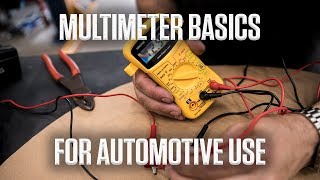
Watch Before You Buy
“An electrician's True RMS meter with VoltAlert non-contact detection, automatic AC/DC selection, a low-impedance mode for ghost voltage, a bright backlight and a CAT III 600 V rating.”
See Today’s Price →What we like
- True RMS for accurate readings on variable loads
- Non-contact voltage detection built in
- AutoVolt automatically selects AC/DC
- Large backlit display readable in dark panels
- CAT III 600V safety rating
Watch out for
- Expensive for casual DIY
- Overkill for simple continuity tests
Read Full Analysis
The Fluke 117 is built for electricians, and its extras are about working safely and quickly on live circuits. VoltAlert detects AC voltage without contact, so you can check that a wire is live before touching it; AutoVolt selects AC or DC automatically when you measure voltage; and the low-input-impedance mode stops ghost voltage - the phantom reading a disconnected wire can pick up from its neighbors - from making a dead circuit look live. It is True RMS, which keeps readings accurate on non-linear loads such as variable-speed motors and dimmers, it has a large white LED backlight for dark panels and engine bays, and Fluke rates it CAT III 600 V. It also measures resistance, continuity, frequency and capacitance and records minimum, maximum and average readings, which helps catch intermittent faults. Fluke lists about 400 hours of typical battery life without the backlight.
Skip this if: You only test batteries, outlets and fuses - a basic meter covers that for far less.

“An auto-ranging True RMS meter for 600V AC/DC, 10A and 50 megohms, plus temperature and capacitance, with lead-alert LEDs and a 6.6-foot drop rating.”
See Today’s Price →What we like
- Auto-ranging True RMS
- Temperature, capacitance, frequency/duty cycle and diode test as well as volts, amps and ohms
- Lead-alert LEDs, backlit display, kickstand; rated for a 6.6-foot drop
Watch out for
- No non-contact voltage detection or low-impedance mode, unlike the Fluke 117
Read Full Analysis
The Klein Tools MM420 is an auto-ranging True RMS multimeter, so you choose the function and it finds the range, and readings stay accurate on non-linear loads. It measures AC and DC voltage to 600V, AC and DC current to 10A and resistance to 50 megohms, and adds continuity, temperature (a thermocouple is included), capacitance, frequency, duty cycle and diode test. LEDs on the meter light up to show where the test leads belong for the selected function, the LCD is backlit, and test-lead holders, a kickstand and an optional magnetic hanger free up your hands. Klein builds it to survive a 6.6-foot drop and ships it with test leads carrying CAT III and CAT IV safety caps and two AAA batteries. It lacks the Fluke 117's non-contact detection and low-impedance mode.
Skip this if: You need non-contact voltage detection built into the meter - the Fluke 117 has it.

“A True RMS clamp meter for AC/DC current through the jaws, voltage, capacitance and temperature, with LoZ, a low-pass filter, NCV and CAT III 600V.”
See Today’s Price →What we like
- True RMS clamp meter: AC/DC current through the jaws, no need to break the circuit
- Capacitance and K-type thermocouple temperature, plus voltage and resistance
- Low-impedance mode, low-pass filter for drive signals and non-contact voltage detection
Watch out for
- Clamp body is bulkier than a pocket multimeter
Read Full Analysis
The KAIWEETS HT206D is a clamp meter: close its jaws around a single conductor and it reads AC or DC current without breaking the circuit, which is how you check a motor's amp draw or a car's parasitic drain. It is True RMS with 6000 counts and auto-ranging, and it also measures AC and DC voltage, resistance, capacitance, frequency and duty cycle, diodes, continuity and temperature with the included K-type thermocouple. A low-impedance mode stops ghost-voltage readings, a low-pass filter steadies readings on variable-frequency drives, and non-contact voltage detection sits under your thumb. The backlight turns red above 80V or 3A as a warning, there is a flashlight, and KAIWEETS lists IEC 61010-1 CAT III 600V with double insulation and 36 months of service.
Skip this if: You want a slim pocket meter - the clamp body is bulkier.
Frequently Asked Questions
Does my car's battery voltage require a True RMS multimeter?
What voltage should I see across a healthy car battery?
How do I test a fuel injector with a multimeter?
Can I test an alternator with a multimeter?
What is the LoZ or low-impedance mode on the Fluke 117?
How We Chose These Products
We compare each product’s Amazon listing, the manufacturer’s published specifications and Amazon customer ratings, shown with their review counts as Amazon’s data, and rank the products on how well they answer this page’s question. We do not test products in hand and we do not run our own analysis of review text. A publication or expert is named only where we cite its published findings about that product. No manufacturer paid for placement on this page.
A price appears only when Amazon’s API supplied it at a recent daily refresh, with the date and time beside it, and is withdrawn at 4 AM Central on the day after it turns 24 hours old; otherwise use “Check price on Amazon” for the live price. Read our full methodology →