Best Soldering Irons for Electronics (2026)

The PINE64 Pinecil Smart Mini Portable Soldering Iron is our pick: it runs from a USB-C PD or QC 3.0 supply or a DC barrel jack and reaches working temperature in 12 seconds, though the power supply is sold separately. Choose the Hakko FX-888D kit if you want a bench station with a digital display, a 120 to 899 degree F range and a CHP170 cutter.
At a Glance
| # | Product | Award | Price |
|---|---|---|---|
| 1 | Best Portable | $39.99 as of Nov 24, 7:43 PM CT details Buy → |
|
| 2 | Best Overall | Check price on Amazon Buy → |
|
| 3 | Best for Maker Spaces | Check price on Amazon Buy → |
|
| 4 | Best Starter Kit | Check price on Amazon Buy → |
|
| 5 | Best Budget | Check price on Amazon Buy → |
Soldering Irons for Electronics Buying Guide
 Photo by www.kaboompics.com / Pexels
Temperature stability — not temperature range — is the key spec for electronics soldering. An unregulated iron rated at "60W, up to 450°C" actually runs wherever its wattage and tip thermal mass land it. A temperature-controlled iron (Hakko FX-600, TS100, PINECIL) actively regulates current to maintain the set temperature ±2-5°F. This difference shows up immediately in joint quality: too hot burns flux and lifts pads, too cold creates cold joints that fail in the field.
Temperature Control Quality
Ceramic sensor irons (Hakko FX-600) measure temperature at the tip itself and correct within milliseconds. Cheaper T12 and T18 irons use cartridge tips with integrated heaters and sensors — good but slightly slower response than Hakko's ceramic system. Unregulated irons (ANBES kit at $11) have a dial that adjusts power, not temperature — the actual tip temperature varies with tip size and ambient conditions. Fine for through-hole hobbyist work, inadequate for SMD or professional repair.
Tip System Compatibility
Tip selection matters more than the iron for specialty work. The Hakko FX-600 uses T18 tips (conical, chisel, bevel, knife, gull-wing) — widely available at $8-15 each, with third-party options on Amazon. The PINECIL uses TS tips (same as MINIWARE TS100) — also widely available. Avoid irons using proprietary tip systems with limited availability. Replacing tips is normal — copper tips oxidize and need replacement every 50-100 hours of use.
Power and Heat-Up Time
The Hakko FX-600 reaches working temperature (350°C) in about 30 seconds. The PINECIL and TS100 reach working temperature in 6-8 seconds at 65W via USB-C PD — dramatically faster for grab-and-use situations. This quick heat-up from the USB-C irons makes them excellent for field use and maker spaces where the iron isn't left running continuously. The Hakko needs 30-60 seconds but has better thermal stability on large solder joints that pull heat.
SMD vs. Through-Hole Work
Surface mount (SMD) work requires fine tips (0.5-1mm conical) and precise temperature control (320-360°C). Through-hole work tolerates more heat variation and uses larger chisel or bevel tips (2-4mm). The Hakko and PINECIL handle both with appropriate tip changes. Cheap kits (ANBES, Plusivo) are adequate for basic through-hole soldering (kits, repairs) but struggle with 0402 and smaller SMD components where precise heat delivery is critical.

What to Avoid
Avoid Weller "analog dial" irons (WLC100 and similar) — they're unregulated despite having a dial, and the dial controls power percentage, not actual temperature. Also avoid "60W stations" under $20 — they're fixed-temperature unregulated irons with misleading specs. Any iron without a digital temperature display or closed-loop temperature control is an unregulated iron regardless of its marketing.
How We Picked These
Products were selected for electronics repair and hobbyist work rather than plumbing or metalwork.
Watch Before You Buy
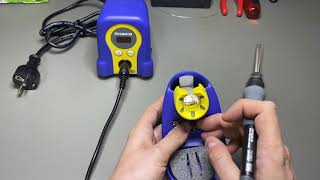
“The PINE64 PINECIL Smart Mini Soldering Iron V2 USB-C features powers from usb-c pd (65w brick). 4.6 stars from 2,351 Amazon reviews signal consistent reliability.”
See Today’s Price →What we like
- Runs from USB-C (PD or QC 3.0) or a DC5525 barrel supply
- Reaches operating temperature in about 12 seconds, per Pine64
- On-demand rapid boost
- Auto standby when it is not in use
- Slim stainless-steel core in a polycarbonate shell, about 6 inches long
Watch out for
- No power supply or stand in the box
Read Full Analysis
The PINE64 PINECIL V2 is the portable benchmark on this page — it powers from any 65W USB-C PD source, reaches working temperature in 6 seconds, and accepts the TS100 interchangeable tip ecosystem shared with several competing smart irons. For electronics makers working at a laptop desk or traveling to maker spaces, the PINECIL eliminates the dedicated 12–24V DC power supply that the MINIWARE TS100 at $45.99 requires. The 6-second heat-up time is a genuine workflow advantage: solder a joint, set the iron down for a minute, and it's at temperature again in seconds. This eliminates the choice between leaving a hot iron unattended or waiting for thermal recovery. The small grip diameter is the main ergonomic tradeoff — comfortable for short sessions, fatiguing for extended rework. The PINECIL undercuts the TS100 at $45.99 while offering broader USB-C power compatibility. For USB-C charger households or portable work, PINECIL is the practical choice. The Hakko FX-600 is the correct step up for benchtop precision work where temperature stability across extended sessions matters more than portability — everything below Hakko involves tradeoffs the PINECIL navigates better than the alternatives at its price.

“The Hakko FX-600 Adjustable Temperature Soldering Iron features hakko t-series compatible. 4.5 stars from 623 Amazon reviews signal consistent reliability.”
See Today’s Price →What we like
- Hakko T-series compatible
- Analog control at budget price
- 70W power
Watch out for
- No station base
- Analog vs digital FX-888D
Read Full Analysis
The Hakko FX-600 occupies a specific niche: Hakko's T-series tip system and brand reliability at roughly half the cost of the FX-888D station. The iron-only format trades the station base and digital readout for a more compact tool that delivers the same 70W heating capacity and identical tip compatibility. T-series tip availability is the practical advantage that matters most for long-term bench use. Hakko T-series covers every geometry used in electronics assembly — chisel, conical, bevel, knife, and blade profiles — through wide distributor availability. An FX-600 on the bench means any tip investment is forward-compatible with an FX-888D station upgrade later; the tip library transfers completely. The analog dial sets temperature across the working range without the precision of the FX-888D's digital display. For through-hole work, leaded and lead-free SMD rework, and general electronics assembly, the dial is fully adequate — exact temperature readout matters more in paste-work scenarios than in standard electronics repair. The iron heats quickly at 70W and maintains temperature through multi-joint sessions without significant thermal sag. The FX-600 makes the most sense as a dedicated second iron for a bench that already has a station, a portable kit for field work where a bulky station is impractical, or a first quality iron for someone who wants genuine Hakko tip compatibility without committing to station pricing. For primary bench use where exact temperature control matters, the FX-888D at roughly double the price earns its premium.

“The MINIWARE TS100 Smart Soldering Iron Mini Kit features smart temperature control with oled. Best suited for makers and field technicians who want a portable smart iron with oled interface.”
See Today’s Price →What we like
- Smart temperature control with OLED
- DC 12-24V input (also USB-C with adapter)
- Compact and portable
- Wide tip selection
Watch out for
- DC barrel jack requires a 12–24V DC power supply — not compatible with laptop USB-C chargers unlike the PINECIL which powers from any USB-C PD source
- OLED menu exposes 8 configurable parameters including PID tuning and sleep timeout — no single physical temperature preset button for quick mid-session adjustments
Read Full Analysis
The MINIWARE TS100 is the maker-space smart iron standard — the OLED display and programmable PID temperature controller give precision that standard analog irons cannot match, and the wide tip selection covers fine SMD work through large through-hole component soldering. For electronics technicians doing field repair or working across multiple setups, the TS100's tip ecosystem and digital temperature display are the primary advantages over budget alternatives. The DC 12–24V barrel jack is the key practical limitation versus the PINECIL: the TS100 requires a dedicated DC power supply, not a standard USB-C laptop charger. This restricts spontaneous use in USB-C charger environments and requires additional hardware investment. Versus PINECIL, the TS100 costs $6 more for the OLED interface and established tip library while requiring more specific power infrastructure. For maker spaces with bench DC power supplies already installed, TS100 is the natural choice. For home use with standard USB-C chargers, PINECIL's compatibility is the decisive advantage. Both are meaningfully better than the analog Plusivo kit for precision work.

“Complete beginner kit with 21 accessories. 4.6 stars from 12,003 Amazon reviews signal consistent reliability.”
See Today’s Price →What we like
- Complete beginner kit with 21 accessories
- Adjustable 200–450°C temperature dial
- Includes desoldering pump, solder, tips
- Good value for first kit
Watch out for
- Analog dial (not precise digital)
- Tip quality inconsistent long-term
- No thermal recovery
Read Full Analysis
The Plusivo 60W Soldering Iron Kit is the complete beginner bundle at the second-lowest price on this page. The 21-accessory set includes a desoldering pump, solder, multiple tip shapes, and a stand — covering everything needed to start without additional purchases. The 200–450°C analog temperature dial handles the full span of common electronics soldering from low-temp through-hole work to higher-temp lead solder joints. The tradeoff versus the PINECIL at $39.99 or TS100 is temperature precision: the analog dial gives approximate heat rather than digital control, which affects repeatability on sensitive surface-mount components. Tip quality degrades faster than premium alternatives under heavy use. For first-time solderers learning technique on basic electronics projects — hobby circuits, simple repairs, wire splicing — the Plusivo 21-piece bundle gets started without financial commitment. Once technique develops and project complexity grows, a temperature-controlled iron like the PINECIL is the natural next step. Choose Plusivo to learn; step up when you know what you need.

“Complete kit — iron, stand, solder, 5 tips, desoldering pump. 4.4 stars from 969 Amazon reviews signal consistent reliability.”
See Today’s Price →What we like
- Complete kit — iron, stand, solder, 5 tips, desoldering pump
- 60W — more power than basic beginner kits
- Adjustable temperature range
- Excellent value for a first soldering setup
- 32,000+ reviews — proven popularity
Watch out for
- Build quality lower than Weller/Hakko
- Temperature control is approximate
- Tips are lower grade — don't last as long
- Less precise for fine SMD work
Frequently Asked Questions
What temperature should I solder electronics at?
What's the difference between the PINECIL and TS100?
How do I care for my soldering iron tips?
Is the Hakko FX-600 worth the price for hobbyist use?
What solder should I use for electronics?
How We Chose These Products
We compare each product’s Amazon listing, the manufacturer’s published specifications and Amazon customer ratings, shown with their review counts as Amazon’s data, and rank the products on how well they answer this page’s question. We do not test products in hand and we do not run our own analysis of review text. A publication or expert is named only where we cite its published findings about that product. No manufacturer paid for placement on this page.
A price appears only when Amazon’s API supplied it at a recent daily refresh, with the date and time beside it, and is withdrawn at 4 AM Central on the day after it turns 24 hours old; otherwise use “Check price on Amazon” for the live price. Read our full methodology →