DeWalt DWS780 vs Bosch GCM12SD: Which Is Better? (2026)

Bosch GCM12SD wins overall — its AXIAL-GLIDE system eliminates rear-clearance problems and produces smoother cuts on wide stock. The DEWALT DWS779 is $240 less and cuts just as accurately for most work. Choose Bosch for a permanent shop station; choose DEWALT for a better-value portable setup.
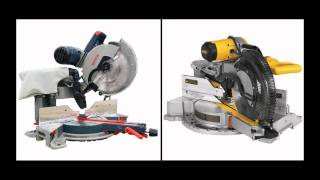
At a Glance
DeWalt DWS780 vs Bosch GCM12SD Buying Guide
Both the DeWalt DWS779/DWS780 and Bosch GCM12SD are 12-inch dual-bevel sliding compound miter saws. Both cut 2x16 lumber in a single pass. The differences matter only in specific use cases.
DeWalt vs Bosch: The Core Difference
DeWalt uses a traditional rail-slide system that extends behind the saw when cutting — you need 14+ inches of wall clearance. The DWS779 and its successor DWS780 use this system with refinements. Bosch's GCM12SD uses a patented AXIAL-GLIDE system that pivots forward, requiring zero rear clearance. This lets you place the Bosch against a wall. Both saws cut with equal precision; the difference is where you can use them.
Where DeWalt Wins
DeWalt wins on price. The DWS779 is $240 less than the Bosch GCM12SD — money most users would rather spend on saw blades, lumber, or another tool. The DWS715 single-bevel model ($299) is a capable option for trim work. DeWalt's XPS cross-cut positioning system (on the DWS780) provides a better blade shadow than a laser for accurate cuts. Wide retail availability and service network also favor DeWalt.
Where Bosch Wins
Bosch wins for shop installations where rear clearance is limited. The AXIAL-GLIDE system also feels smoother in operation — less racking, tighter tolerances over time. The GCM12SD ($687–$742) cuts wider crown molding in the horizontal position. For a permanent shop station, Bosch's footprint advantage and smoother action justify the premium price. The CM10GD ($629) is a 10-in. option if you prefer a lighter saw.
Get DeWalt If / Get Bosch If
Get DeWalt if you move the saw between jobsites, have adequate rear clearance, and want professional 12-in. sliding miter saw performance without the Bosch premium.
Get Bosch if you're building a permanent shop station against a wall and the AXIAL-GLIDE's space-saving design and smoother operation matter.
Price Comparison
DeWalt 12-in. miter saws range from $299 (DWS715 single-bevel) to $635 (dual-bevel sliding with XPS). Bosch GCM12SD runs $687–$742. At the $449 DeWalt DWS779 vs $687 Bosch GCM12SD level, you pay 53% more for Bosch. For most users, that premium is only justified by the no-rear-clearance design.
DeWalt DWS780 vs Bosch GCM12SD Brand Comparison
The DeWalt DWS780 is the standard 12-inch double-bevel sliding compound miter saw on most American jobsites — proven design with XPS shadow line for accurate cuts (no laser drift) and 3,800 RPM motor. The Bosch GCM12SD uses Bosch's patented Axial-Glide system that replaces sliding rails with hinged arm geometry — eliminates the rear clearance most miter saws need (12 inches saved on workbench). DeWalt wins on raw cut speed and brand familiarity for fleet-managed jobsites; Bosch GCM12SD wins on precise cuts and saved workshop space.
Watch Before You Buy
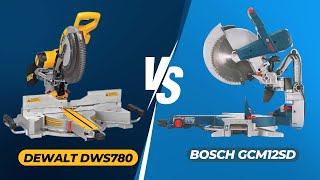
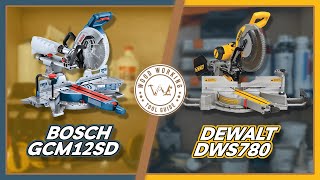
“The DEWALT DWS779 12" Sliding Compound Miter Saw features 16-inch crosscut capacity at 90°. 4.8 stars from 9,014 Amazon reviews signal consistent reliability.”
See Today’s Price →What we like
- 16-inch crosscut capacity at 90°
- Handles wide crown molding and baseboards
- Outstanding cam-lock miter detent accuracy
- Premium DeWalt build quality
- Huge aftermarket support
Watch out for
- $381 — much higher price than 10-inch saws
- 56 lbs requires two people to move
- Rear rails need 16 inches of wall clearance
Read Full Analysis
The DEWALT DWS779 is the value-priced 12-inch sliding compound miter saw on this page, delivering 16-inch crosscut capacity at 90 degrees -- enough to cut crown molding, wide baseboards, and standard framing lumber in a single pass. The cam-lock miter detent system provides repeatable angle stops that hold accuracy across thousands of cuts, a reliability advantage that cabinet makers and trim carpenters notice on repeat-angle work. Against the Bosch GCM12SD, the DEWALT delivers equivalent crosscut capacity for $238 less, with the trade-off of standard rear-rail sliding that requires 16 inches of wall clearance versus the Bosch axial glide. The 56-pound weight requires two people for safe transport between job sites. Best for contractors and serious DIYers who need 12-inch sliding capacity at the lowest price on this page.

“12-amp motor resists stalling in hardwoods. 4.8 stars from 6,863 Amazon reviews signal consistent reliability.”
See Today’s Price →What we like
- 12-amp motor resists stalling in hardwoods
- 48° bevel range covers nearly all trim angles
- Machined aluminum fence for repeatable accuracy
- 11 positive miter stops for fast common-angle setup
- Compact and relatively lightweight at 42 lbs
Watch out for
- Single bevel only (no right tilt)
- It's at the ceiling of this budget
- Corded only — requires outlet or extension cord
Read Full Analysis
12-amp motor resists stalling in hardwoods 48° bevel range covers nearly all trim angles Keep in mind: single bevel only (no right tilt). It's at the ceiling of this budget At $299, the DEWALT DEWALT DWS715 12-Inch Single Bevel Compound Miter Saw costs $150 less than the DeWalt DWS779 12" Sliding Compound Miter Saw on this page, making it the stronger value pick if the spec differences fit your needs.

“Axial-glide: no rear clearance needed. 4.7 stars from 2,031 Amazon reviews signal consistent reliability.”
See Today’s Price →What we like
- Axial-glide: no rear clearance needed
- 15.5" crosscut capacity at 90°
- Buttery smooth glide — no rail chatter
- Squarelock fence system
- No-tools bevel adjustment
Watch out for
- ~$700 — highest price on this list
- 65 lbs — heaviest option
- Proprietary glide means no rail accessory compatibility
Read Full Analysis
Recommended for Glide arm that sits close to walls; smoother cut and compact footprint. Axial-glide: no rear clearance needed Keep in mind: ~$700 — highest price on this list. Keep in mind: 65 lbs — heaviest option. Compared to the BOSCH CM10GD 10 in Dual-Bevel Sliding Glide Miter Saw 15-Amp on this page, the Bosch Bosch GCM12SD 15 Amp 12-Inch Dual-Bevel Glide Miter Saw costs $58 more but may offer additional features or brand support worth considering for serious users.

“The Bosch CM10GD 10 in Dual-Bevel Sliding Glide Miter Saw 15-Amp features 10-inch blade. 4.7 stars from 675 Amazon reviews signal consistent reliability.”
See Today’s Price →What we like
- Patented axial glide arm eliminates side rails, letting the saw sit just 3 inches from a wall — a space advantage that standard sliding rail saws don't offer
- 10-inch dual-bevel head tilts both left and right without flipping the workpiece, halving setup time for repetitive bevel cuts
- Soft-start motor reduces startup jolt and extends motor life versus hard-start equivalents
- Bosch quality control on the glide system keeps the axial arm consistent over years of use without developing backlash or slop
Watch out for
- Heavy and awkward to transport between job sites
- $629 price is significant for homeowners doing occasional trim work
- Glide system adds complexity — requires periodic cleaning to maintain smooth action
Read Full Analysis
The Bosch CM10GD is the space-constrained shop solution on this page. The patented axial glide arm eliminates rear extension rails, allowing the saw to sit just 3 inches from a wall rather than the 16 inches required by the DEWALT DWS779. In small workshops and garages, that 13-inch difference is often the deciding factor. The 10-inch dual-bevel head tilts both left and right without flipping the workpiece, halving setup time on repetitive compound cuts. It costs $180 more than the DEWALT DWS779 on this page despite the smaller 10-inch blade -- the premium pays entirely for the axial glide system and wall clearance savings. The glide mechanism requires periodic cleaning to maintain smooth action over years of use. Best for woodworkers in tight shop spaces where wall clearance is the primary constraint.
Frequently Asked Questions
Is the Bosch GCM12SD better than the DeWalt DWS780?
What is AXIAL-GLIDE and why does it matter?
What is the difference between DeWalt DWS779 and DWS780?
Which 12-inch miter saw is best for a home shop?
How wide can the DeWalt DWS779 and Bosch GCM12SD cut?
How We Chose These Products
We compare each product’s Amazon listing, the manufacturer’s published specifications and Amazon customer ratings, shown with their review counts as Amazon’s data, and rank the products on how well they answer this page’s question. We do not test products in hand and we do not run our own analysis of review text. A publication or expert is named only where we cite its published findings about that product. No manufacturer paid for placement on this page.
A price appears only when Amazon’s API supplied it at a recent daily refresh, with the date and time beside it, and is withdrawn at 4 AM Central on the day after it turns 24 hours old; otherwise use “Check price on Amazon” for the live price. Read our full methodology →