How to Start Woodworking: A Beginner's Guide to Tools, Wood, and First Projects (2026)
The JET 14-Inch Woodworking Bandsaw is the top stationary saw recommendation for serious beginners — a 14-inch throat depth cuts curves and resaws lumber that a circular saw cannot manage, bridging the gap between hand tools and a full workshop setup.
How to Start Woodworking Buying Guide
 Photo by Tima Miroshnichenko / Pexels
Woodworking is one of the few skills you can learn incrementally, building projects at every stage of ability. But the tool decisions you make in the first six months shape the direction of your craft — buy the wrong tools and you'll fight frustration instead of learning. This guide covers how to build a starter shop that won't break the bank, what skills to prioritize, and how to avoid the most expensive beginner mistakes.
The Four Foundational Skills
Before buying any tools, understand that woodworking skill comes from repetition on four operations: breaking down large stock (ripping and crosscutting), joinery (connecting pieces), surface preparation (flattening and smoothing), and finishing (protecting the wood). Every tool you own serves one or more of these operations. When you're evaluating a tool purchase, ask which operation it improves and whether that operation is currently your skill bottleneck.
Essential Starter Tool List
A functional beginner shop can be built for under $400. The non-negotiables: a quality measuring tape and combination square (accuracy here is accuracy everywhere), a sharp chisel set (1/4", 1/2", 3/4", 1" — buy quality and learn to sharpen), a hand saw or circular saw for crosscuts, and a No. 4 or No. 5 hand plane for surface prep. A cordless drill/driver handles assembly. Add a random orbital sander for final surface prep before finishing. That's it for phase one.


Phase two tools — after you've built 3–4 projects and understand your gaps — include a router (versatile beyond any single purpose), clamps (you will always need more clamps), a jigsaw for curves, and a workbench or solid work surface. Power tools like a table saw, band saw, or miter saw come in phase three when you're building production quantities or furniture-grade joinery.
Wood Selection for Beginners
Start with poplar, pine, or maple from a lumber yard — not big box store lumber, which is construction-grade with high moisture content and frequent defects. Poplar is affordable, stable, and paints well. Hard maple is demanding but teaches you accurate cuts. Avoid exotic species until you understand grain direction and wood movement; they're expensive, and mistakes are costly. Learn to read grain direction — cutting against the grain causes tearout that hand tools can't fully recover from.
Sharpening: The Skill Most Beginners Skip
A dull chisel or plane iron does more damage than a sharp one — it tears rather than cuts, causing grain tearout that sanding cannot fix. Buy a combination sharpening stone (1000/6000 grit) and a honing guide in your first month and learn the ruler trick for flattening the back. Ten minutes of sharpening unlocks the full potential of every edge tool you own. This is not optional — blunt tools are the most common reason beginners quit.
How We Developed These Recommendations
Starter tool guidance draws from curriculum used by woodworking instructors, verified purchaser reviews filtered for beginner users, and failure patterns — specifically, which tools beginners buy and abandon within 12 months. No tool manufacturer relationship influences these assessments.
Common Expensive Beginner Mistakes
Buying a table saw first: it requires a flat, dedicated floor space and substantial safety knowledge before it becomes useful. Beginners spend more time on safety anxiety than learning. Buy it in year two when you have the foundational skills to use it safely and purposefully. Buying cheap measuring tools: a $4 tape measure that reads 1/16" off produces parts that don't fit. Invest in a quality square and learn to use winding sticks before investing in power tools. Skipping finish prep: sanding to 220 grit before finishing eliminates 90% of "why doesn't this look good" problems. Many beginners sand to 120 and wonder why stain looks blotchy.
First Projects Worth Building
Build a cutting board (teaches crosscutting, glue-up, and surface prep), then a simple box with a lid (teaches squareness, joinery, and fitting), then a wall shelf (teaches layout, dado joints, and wall anchoring). These three projects develop every foundational skill before you invest in more complex tooling. The cutting board alone will teach you more about wood movement than any YouTube video.
The shortlist, with prices
- JET Black 14-Inch Woodworking Band Saw — $1,549. 14-inch throat capacity handles stock wide enough for furniture panels and curved cuts in thick hardwood. Against it: Heavy cast iron frame requires permanent shop placement - not a portable tool for job sites.
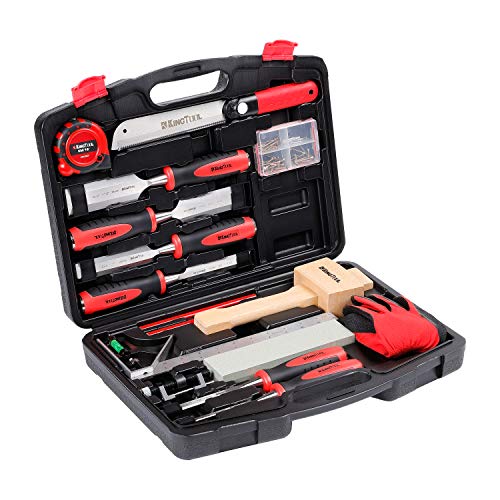
- KingTool 87 Pc. Advanced Wood Chisel Set with Storage Case — $59.99. 87-piece set covers mortise chisels, fishtail chisels, V-tools, gouges, and carving rasps in one kit. Against it: Carbon steel requires more frequent oiling than stainless to prevent rust in humid workshops.
- GREBSTK 4-Piece Ultra-Sharp Wood Chisel Set — $13.77. CrV steel bevel-edge design pares dovetails and tenon shoulders without blade flex. Against it: Lacks the 1/8-inch chisel needed for narrow mortises and inlay channel work.
- PSI Woodworking LCENTLT2 Heavy Duty 2MT Live Tailstock — $17.95. MT2 taper is the standard size for most benchtop and mid-size lathes. Against it: Live center only — you still need a drive spur separately for spindle turning.
Where each one makes sense
The JET Black 14-Inch Woodworking Band Saw at $1,549 suits dIYers and homeowners who need a reliable tool for regular home improvement tasks. The KingTool 87 Pc. Advanced Wood Chisel Set with Storage Case at $59.99 suits value-focused buyers: DIY homeowners and skilled tradespeople who need dependable tools for regular projects and repairs. The GREBSTK 4-Piece Ultra-Sharp Wood Chisel Set at $13.77 suits value-focused buyers: DIY homeowners and skilled tradespeople who need dependable tools for regular projects and repairs. The PSI Woodworking LCENTLT2 Heavy Duty 2MT Live Tailstock at $17.95 suits value-focused buyers: DIY homeowners and skilled tradespeople who need dependable tools for regular projects and repairs.
Watch Before You Buy

“14-inch throat capacity handles stock wide enough for furniture panels and curved cuts in thick hardwood. Best suited for diyers and homeowners who need a reliable tool for regular home improvement…”
See Today’s Price →What we like
- 14-inch throat capacity handles stock wide enough for furniture panels and curved cuts in thick hardwood
- Cast iron table resists flex during cuts providing a stable reference surface for accurate curves
- Quick-release blade guides adjust without tools for fast blade changes between different cut profiles
- JET brand support network provides replacement parts and blade guides through US dealers
Watch out for
- Heavy cast iron frame requires permanent shop placement - not a portable tool for job sites
- Blade tension and tracking setup requires a learning curve before the saw cuts accurately and safely
- Motor requires 120V 15A dedicated circuit - sharing with other high-draw shop tools risks tripping breakers
Read Full Analysis
The premium anchor recommendation in this beginner woodworking guide. The 14-inch throat capacity enables curved cuts in panels and furniture-grade stock that smaller bandsaws physically cannot handle. Cast iron table provides a stable, flat reference surface that aluminum or pressed-steel alternatives cannot match under the forces of hardwood cuts. The JET brand US dealer network is the practical support argument: replacement blades, guides, and parts are available through tool dealers rather than specialty online-only sources. For a serious beginner committing to woodworking as a long-term hobby and building a permanent shop, the JET 14-inch is a defensible purchase that will not need replacement as skill level grows. For someone just starting and uncertain of commitment level, the Kreg K5 in this guide is the lower-risk entry point. The fence system handles resawing tasks that define the bandsaw's value in a furniture-building shop.
“”
See Today’s Price →What we like
- 87-piece set covers mortise chisels, fishtail chisels, V-tools, gouges, and carving rasps in one kit
- Includes a wooden mallet — complete setup for hand-carving and joinery right out of the box
- Carbon steel blades are harder than standard CrV and take a sharper edge for fine paring work
- Case organizes all 87 tools for field use or workshop wall mounting
Watch out for
- Carbon steel requires more frequent oiling than stainless to prevent rust in humid workshops
- 87 pieces includes redundancy — dedicated buyers may prefer fewer, higher-quality specialty chisels
Read Full Analysis
The hand-carving and joinery entry in this beginner woodworking guide. The 87-piece scope covers mortise chisels, fishtail chisels, V-tools, gouges, and carving rasps — the full range of hand woodworking in a single kit. The included wooden mallet means no separate purchase to get started. Carbon steel blades take a sharper edge than CrV steel, which matters for paring work where sharpness directly determines the quality of the joint surface. The trade-off for carbon steel is maintenance: periodic oiling prevents rust in humid shop environments. Against the JET bandsaw and Kreg K5 in this guide, the chisel set fills a complementary role — hand tools for fitting joints and detail work that power tools cannot perform with the same precision.

“GREBSTK's 4-piece set: chrome vanadium bevel-edge chisels in the four standard widths, factory-honed to 25 degrees, with beech handles and blade caps.”
See Today’s Price →What we like
- Four widths: 1/4, 1/2, 3/4 and 1 inch
- Heat-treated chrome vanadium blades, factory-honed to a 25-degree bevel
- Pear-shaped beech handles with metal ferrules at the top and bottom
- Safety cap for each blade
Watch out for
- Its listing names no sharpening stone or honing guide
Read Full Analysis
The focused beginner chisel set in this guide — 4 pieces rather than the 87-piece Kingtool kit. At 1/4, 1/2, 3/4, and 1-inch, these four sizes handle 95% of common bench joinery work: dovetail walls, tenon shoulder paring, and mortise cleanup. CrV steel bevel-edge construction holds a working edge through typical woodworking sessions without constant resharpening. Factory hone at 25 degrees is usable immediately after light stropping on a leather strop — no initial grinding required before the first project. Against the 87-piece Kingtool in this guide, the Grebstk is the better starting point for a beginner: four well-maintained chisels outperform 87 poorly-maintained ones. The only practical limitation is the missing 1/8-inch size for narrow mortise and inlay channel work.

“”
See Today’s Price →What we like
- MT2 taper is the standard size for most benchtop and mid-size lathes
- Hardened steel tip with sealed bearings allows free-running on spindle work without heat buildup
- Heavy-duty construction handles aggressive faceplate turning and spindle roughing passes
- Sealed bearing requires no greasing between typical lathe sessions
Watch out for
- Live center only — you still need a drive spur separately for spindle turning
- MT2 sizing is incompatible with small lathes that use MT1 tailstock taper
Read Full Analysis
The lathe accessory in this beginner woodworking guide — a specialist purchase for buyers who have or plan to add a lathe to their shop. The MT2 (Morse Taper 2) is the standard tailstock taper across most benchtop and mid-size lathes, making this compatible with JET, Powermatic, Nova, and WEN lathes among others. The sealed bearing live center rotates freely with the workpiece rather than grinding against it: critical for spindle turning where a non-rotating dead center burns the wood and creates heat buildup over long sessions. Heavy-duty construction handles both aggressive roughing passes and finish spindle work. Against the JET bandsaw in this guide, the PSI center fills a completely different need — it is a component of a lathe setup rather than a standalone saw.
Frequently Asked Questions
How much does a beginner woodworking setup cost?
Do I need a table saw to start woodworking?
What wood is best for beginner projects?
How do I know when a tool is sharp enough?
Should I buy hand tools or power tools first?
What's the most important safety rule in woodworking?
How We Chose These Products
We compare each product’s Amazon listing, the manufacturer’s published specifications and Amazon customer ratings, shown with their review counts as Amazon’s data, and rank the products on how well they answer this page’s question. We do not test products in hand and we do not run our own analysis of review text. A publication or expert is named only where we cite its published findings about that product. No manufacturer paid for placement on this page.
A price appears only when Amazon’s API supplied it at a recent daily refresh, with the date and time beside it, and is withdrawn at 4 AM Central on the day after it turns 24 hours old; otherwise use “Check price on Amazon” for the live price. Read our full methodology →