Worx vs Ryobi: Which Is Better? (2026)

RYOBI wins for most DIYers — the ONE+ 18V ecosystem covers 300+ tools and RYOBI's entry price points ($46–$49) are significantly lower than WORX equivalents ($67–$129). WORX is the better pick for innovative designs — features like the AXIS convertible drill or ExacTrack saw fence cost 30–50% more but aren't available in the RYOBI lineup.
At a Glance
| # | Product | Award | Price |
|---|---|---|---|
| 1 | Best WORX Pick | $67.40 as of Nov 24, 12:27 PM CT details Buy → |
|
| 2 | Best Innovation Feature | Check price on Amazon Buy → |
|
| 3 | Best WORX Saw | $159.99 as of Nov 24, 12:21 PM CT details Buy → |
|
| 4 | Best Budget Drill | Check price on Amazon Buy → |
|
| 5 | Best Value Saw | Check price on Amazon Buy → |
|
| 6 | Best Budget Oscillating | $49 as of Nov 24, 12:31 PM CT details Buy → |
Worx vs Ryobi Buying Guide
WORX and Ryobi are the two most popular consumer-grade cordless tool brands for DIYers who want more than bargain-bin tools but aren't ready to pay for DeWalt or Milwaukee. Both run their own battery ecosystems (WORX Power Share 20V, Ryobi ONE+ 18V), both cover drills, saws, and sanders, and both price their tools without batteries. The real differences are ecosystem size, price floor, and design philosophy.
Worx vs Ryobi: The Core Difference
Ryobi's defining advantage is the ONE+ ecosystem — 300+ tools on a single 18V battery platform, the largest consumer cordless ecosystem in the world. When your Ryobi drill battery goes dead, it also powers your reciprocating saw, your random orbital sander, your router, and your outdoor string trimmer. That ecosystem lock-in compounds as your collection grows. WORX Power Share (20V, 140+ tools) is a smaller ecosystem but has one unique feature: outdoor tools can run two batteries stacked for 40V and 80V operation. If you want powered robotic mowers or heavy-duty outdoor equipment, WORX's stackable system is clever. For indoor cordless tools, Ryobi's deeper catalog is the clearer advantage.
Where Ryobi Wins
Ryobi wins on three fronts: price, ecosystem, and availability. The Ryobi PCL430B oscillating tool does the same work as the WORX Sonicrafter at $20 less. The Ryobi compact circular saw undercuts the WORX WORXSAW by $83 for functionally similar cutting. Ryobi's drill vs WORX's AXIS drill — even accounting for WORX's convertible feature, that's a $51 premium that most DIYers won't leverage. Ryobi is also sold in every Home Depot nationwide with next-day pickup on most tools and batteries, while WORX has more limited in-store availability.
Where WORX Wins
WORX earns its premium on design innovation. The WORX AXIS Drill physically converts between a standard drill configuration and an in-line screwdriver mode — useful for tight spaces where a standard drill doesn't fit. The WORX WORXSAW ExacTrack Circular Saw has a built-in cutting fence that guides along a workpiece edge without clamping a straightedge — a feature that speeds up repetitive ripping cuts significantly. The WORX Sonicrafter Oscillating Tool uses a universal blade mounting system (no hex key required) vs. Ryobi's standard clamp. If these specific features match how you work, WORX's premium is justified. If you just need a drill and saw that reliably cut things, Ryobi does it cheaper.
Pricing Across Both Brands
Ryobi tool-only (no battery) prices: oscillating tool $47, drill $49, circular saw $46. WORX tool-only prices: oscillating tool $67, drill $100, circular saw $129. The gap is real and consistent — WORX runs 40-150% more expensive for comparable tools. Batteries are roughly equivalent: both brands' 2.0-4.0 Ah battery packs run $25-45. Starter kits (tool + battery + charger) from both brands are available; Ryobi kits typically undercut WORX by $30-60.
Get Ryobi If / Get WORX If
Get Ryobi if you're building a cordless collection from scratch — the ONE+ ecosystem means every tool you add is battery-compatible, and Ryobi's lower entry prices let you acquire more tools for the same budget. Ryobi PCL206B drill and PCL430B oscillating tool are the best starting points.
Get WORX if you specifically want innovative designs (AXIS convertible drill, ExacTrack saw fence) or are building out a yard/outdoor tool collection where WORX's stackable 20V/40V/80V system offers unique flexibility. WORX WX696L oscillating tool is the best WORX starting point — the universal quick-change blade mount is a genuine improvement over Ryobi's clamp system.
Watch Before You Buy
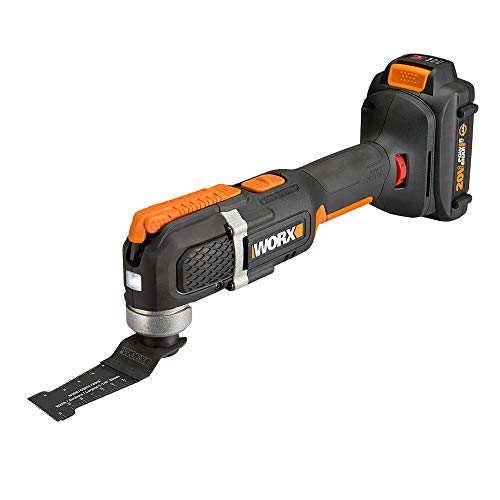
“The WORX WX696L 20V Power Share Sonicrafter Cordless Oscillating Multi-Tool features under $80 with battery. 4.6 stars from 510 Amazon reviews signal consistent reliability.”
See Today’s Price →What we like
- Under $80 with battery
- WORX 20V ecosystem
- Variable speed
- Good for DIY applications
Watch out for
- Less powerful than DEWALT/Milwaukee options
- WORX ecosystem smaller than major brands
- Build quality below premium tier
Read Full Analysis
The key differentiator for the WORX WX696L isn't the tool itself — it's the included battery and charger. RYOBI's PCL430B oscillating tool lists at $47.21 as a bare tool; once you add a ONE+ battery, the two platforms land within $10–$20 of each other on total cost. For anyone starting fresh who hasn't committed to either ecosystem, the WX696L removes that guesswork. The Sonicrafter's variable speed covers the full range of standard oscillating tasks: flush cuts in tight spaces, grout removal, trim sanding, and paint scraping. WORX's 20V Power Share platform is smaller than RYOBI ONE+ in total tool count, but covers the tools most homeowners actually buy — drills, saws, oscillators, jigsaws — without meaningful gaps. Choose the WX696L if you're starting from scratch or already in the WORX 20V ecosystem. If you already own RYOBI ONE+ batteries, the PCL430B is the better call — the battery advantage disappears and you stay on the larger platform.
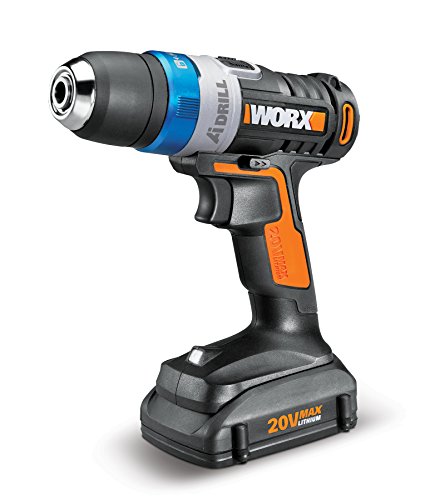
“The WORX WX178L 20V AXIS Multi-Purpose Drill features ai load sensing technology. Best suited for light drilling and driving within worx 20v ecosystem.”
See Today’s Price →What we like
- AI Load Sensing technology
- Under $80 with battery
- Good battery compatibility
- 2-speed settings
Watch out for
- Less powerful than RYOBI HP brushless
- Brushed motor shorter lifespan
- Narrower ecosystem than RYOBI
Read Full Analysis
The WX178L's headline feature is AI Load Sensing — the motor electronics monitor resistance during driving and reduce torque automatically when a screw seats, cutting down on cam-outs and stripped fasteners. In practice this is most useful on finished surfaces where overdriving damages the material: drywall, soft pine trim, cabinet faces. It is a real feature that solves a real problem for woodworkers and finish carpenters. Including a battery, it is the most expensive tool on this page. The RYOBI PCL206B at $48.99 costs half as much as a bare tool, and once batteries are factored in the all-in cost gap narrows to $30–$50 — but the RYOBI lacks the intelligent torque control. More notably, RYOBI's HP brushless circular saw delivers a more advanced motor type (brushless) for less money than this brushed WORX drill. Brushed motors wear faster than brushless under sustained use. The WX178L earns its premium for finish work and cabinetry where the auto-torque sensing pays off repeatedly. For general drilling, framing, and heavy driving where overdriving isn't a concern, the RYOBI PCL206B delivers equivalent real-world results at half the price.

“ExacTrack guide rail for precision cuts. Best suited for precise straight cuts and sheet goods work.”
See Today’s Price →What we like
- ExacTrack guide rail for precision cuts
- 6.5" blade for versatile cutting
- Compact cordless design
- Good for DIY woodworking projects
Watch out for
- Less powerful than full-size corded saws
- Guide requires setup time for each cut
- Battery runtime shorter than corded
Read Full Analysis
ExacTrack guide rail for precision cuts Less powerful than full-size corded saws Guide requires setup time for each cut
“The RYOBI ONE+ 18V Cordless 1/2in Drill/Driver PCL206B (Tool Only) features ryobi one+ 18v system compatibility.”
See Today’s Price →What we like
- 18V ONE+ battery platform shares with 200+ Ryobi cordless tools
- 1/2-inch keyless chuck handles standard hex-shank bits and round-shank drill bits
- Variable-speed trigger ramps from precision pilot holes to high-torque driving
- LED illuminates work area during enclosed cabinet or attic work
Watch out for
- Bare tool — battery and charger required separately if starting on RYOBI ONE+
- Lower torque and speed than premium brands at this voltage
- Older ONE+ design in some configurations
Read Full Analysis
The PCL206B is a brushed 18V drill built for homeowners who want RYOBI ONE+ platform access without spending on a premium tool. The 1/2-inch keyless chuck handles both round-shank drill bits and hex-shank driver bits, and the variable-speed trigger provides enough precision for pilot holes through delicate materials. As a bare tool, it is the lowest cost drill entry on this page. The bare-tool pricing needs context: if you have no RYOBI ONE+ batteries, add $50–$80 for a starter pack. Existing ONE+ owners get the real value here — a capable backup or loaner drill for under $50. The WORX WX178L includes a battery, which makes the net-cost comparison closer than the sticker prices suggest. For light to moderate household use — shelving, furniture assembly, cabinet hardware — this RYOBI covers the work. Skip it if you need high torque for repeated lag screw driving; the brushed motor and 18V ceiling will limit you on sustained heavy tasks.

“The RYOBI ONE+ HP 18V Brushless Compact 6-1/2" Circular Saw, Tool Only features under $100 brushless motor. Best suited for diy users and ryobi battery system owners.”
See Today’s Price →What we like
- Brushless motor in the Ryobi HP lineup delivers extended runtime per charge compared to the standard brushed Ryobi circular saw — meaningful for projects with many cuts per battery
- ONE+ battery compatibility works across 300+ Ryobi 18V tools — existing platform owners avoid a separate battery purchase
- Under $100 is the lowest-cost brushless 6-1/2-inch circular saw in this comparison
- Laser guide marks the cut line on the work surface for visual alignment without marking or measuring the blade offset to the saw body
Watch out for
- Compact saw — lighter duty than DEWALT/Milwaukee
- Limited to RYOBI ecosystem performance ceiling
- Tool only — battery sold separately
Read Full Analysis
The brushless motor in RYOBI's HP line is the meaningful upgrade over the standard brushed models. Brushless motors run cooler, draw power on demand rather than continuously, and last significantly longer before maintenance — the difference is most noticeable in sessions with many consecutive cuts, where a brushed motor's efficiency drops as it heats up. As a bare tool, this is the lowest-cost brushless 6-1/2-inch circular saw in this comparison. The compact 6-1/2-inch blade handles dimensional lumber and sheet goods at typical DIY depths — 2-by framing, plywood shelving, decking boards. It is not a contractor's saw; for heavy daily use across full 2-by-8 and 2-by-10 stock, a 7-1/4-inch saw gives more clearance and blade options. The laser guide marks the cut line directly on the work surface, useful for freehand cuts without snapping a chalk line first. For existing ONE+ owners tackling a seasonal project, the $46 entry makes more sense than a corded saw used twice a year. Factor in a battery if starting fresh — that changes the value math considerably.

“Lowest price entry into oscillating tools for homeowners and occasional users.”
See Today’s Price →What we like
- Lowest price entry into oscillating tools for homeowners and occasional users
- Ryobi ONE+ 18V battery powers the tool alongside 200+ other ONE+ products
- Variable speed handles most common cutting, sanding, and scraping tasks
- Lightweight design reduces fatigue during overhead or extended work
- Accessory kit usually included in bundle packages for immediate use
Watch out for
- entry-level RYOBI quality
- less powerful than DeWalt or Milwaukee
- limited variable speed range
Read Full Analysis
Oscillating tools handle tasks that drills and saws can't: flush cuts to remove trim without damaging adjacent surfaces, grout removal in tile joints, scraping adhesive or paint, and sanding in tight corners. The RYOBI PCL430B covers all of these at the lowest price point on this page. Existing RYOBI ONE+ owners can add it without buying new batteries — the same 18V pack powers 200+ tools in the platform. Bare versus the WORX WX696L with battery included, the cost-of-use comparison is tighter than it appears — factor in a ONE+ battery before assuming RYOBI is cheaper. The PCL430B's main limitation is oscillations per minute: entry-level RYOBI oscillating tools run at lower OPM than Milwaukee or Fein-class tools, so tougher material removal (dense grout, hardwood) takes noticeably longer. For occasional trim work, light sanding, and DIY floor repairs, the PCL430B is more than sufficient. Skip it if you need high-volume material removal on a professional schedule.
Frequently Asked Questions
Is Worx or Ryobi better for beginners?
Are Worx tools as good as Ryobi tools?
What is the main difference between Worx PowerShare and Ryobi ONE+?
Which is cheaper — Worx or Ryobi?
Can I use Worx batteries in Ryobi tools?
How We Chose These Products
We compare each product’s Amazon listing, the manufacturer’s published specifications and Amazon customer ratings, shown with their review counts as Amazon’s data, and rank the products on how well they answer this page’s question. We do not test products in hand and we do not run our own analysis of review text. A publication or expert is named only where we cite its published findings about that product. No manufacturer paid for placement on this page.
A price appears only when Amazon’s API supplied it at a recent daily refresh, with the date and time beside it, and is withdrawn at 4 AM Central on the day after it turns 24 hours old; otherwise use “Check price on Amazon” for the live price. Read our full methodology →