Best Investment Options for Retirement (2026)
Most retirement investors should maximize their 401(k) match first, then fully fund a Roth IRA ($7,000 in 2026), then return to the 401(k). Inside these accounts, low-cost total market index funds or target-date funds are appropriate for the vast majority of investors.
At a Glance
| # | Product | Award | Account Min | Expense Ratio | Key Feature |
|---|
Investment Options for Retirement (2026) Buying Guide
 Photo by Hanna Pad / Pexels
How we evaluated these. We compared retirement investment options including index funds, target-date funds, dividend stocks, bonds, and REITs across expense ratios, historical 10-year returns, tax efficiency in retirement accounts, inflation protection, and withdrawal flexibility, cross-referencing Vanguard, Fidelity, Morningstar, and IRS RMD guidance. This content is for informational purposes only and should not be considered financial advice.
The best retirement investment for most people in 2026 isn't a stock pick or a fund strategy — it's maximizing the tax-advantaged accounts available to you (401k, IRA, HSA) before putting any money into a taxable brokerage account.
Retirement investing follows a specific sequence that maximizes tax advantage before anything else: capture any employer 401(k) match first — it's an immediate 50-100% return on contribution — then fund a Roth IRA to the $7,000 limit if income-eligible, then return to max the 401(k) to $23,500. Within those accounts, a single target-date fund or three-fund index portfolio covers 95% of investors' needs at the lowest possible cost. The most expensive mistake is buying individual stocks in a taxable account before filling tax-sheltered limits. This guide covers the full investment vehicle hierarchy, low-cost fund selection by account type, and asset allocation by age from first contribution through retirement drawdown.
Affiliate disclosure: Some products featured are from partners who compensate us. This does not affect our ratings or editorial recommendations.
Retirement investing is a decision tree: account type first, asset allocation second, specific funds third. Reversing that order is the most common costly mistake.
Step 1: The 401(k) Match Is Free Money
If your employer matches 401(k) contributions — for example, 50 cents per dollar up to 6% of salary — that match is an immediate 50% return on investment before any market performance. Contribute at least enough to capture the full match before doing anything else. A $60,000 salary with a 50% match up to 6% ($3,600) means declining to contribute generates a $1,800 annual loss. No investment strategy compensates for forfeiting free employer money.
Roth IRA vs. Traditional IRA: The Tax Treatment Decision
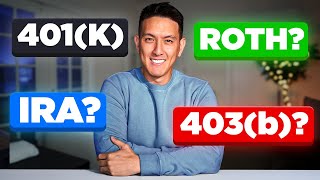
Roth IRA contributions are made with after-tax dollars; all qualified withdrawals in retirement are tax-free, including all growth. Traditional IRA (and traditional 401k) contributions reduce current taxable income; withdrawals in retirement are taxed as ordinary income. The Roth is generally superior if you expect your tax rate to be higher in retirement than now — which is likely for younger workers in lower brackets today. The contribution limit is $7,000 in 2026 ($8,000 if age 50+).
Target-Date Funds: The Default Correct Answer
Target-date funds (TDFs) automatically adjust their stock-to-bond ratio as you approach retirement. They are broadly diversified, require no management, and are offered in most 401(k) plans. Research consistently shows that most active fund managers underperform their benchmark index after fees — TDFs with low expense ratios outperform actively managed funds in the long run for most investors. If your 401(k) offers a target-date fund with an expense ratio below 0.20%, using it as your single fund simplifies the decision correctly.
Index Funds: The Alternative to Target-Date
A three-fund portfolio (total US stock market index, total international stock index, and US bond index) provides full diversification at minimal cost. Vanguard, Fidelity, and Schwab all offer these at expense ratios of 0.03% to 0.07%. The asset allocation between stocks and bonds is typically: subtract your age from 110 to get your stock percentage. At 30, that is 80% stocks; at 60, it is 50% stocks.

Common Retirement Investing Mistakes
Cashing out a 401(k) when changing jobs triggers income taxes plus a 10% early withdrawal penalty before age 59.5, eliminating 30%+ of the balance. Roll over to an IRA or your new employer's 401(k) instead. Holding too much company stock concentrates both employment and investment risk. Waiting to start because "the market is high" — time in the market beats timing the market for long-term investors. Withdrawing from a Roth IRA before 5 years of account age subjects earnings to taxes and penalties.
Retirement investment options carry different tax, liquidity, and risk profiles. See Best No-Penalty CD Rates 2026 for capital-preservation options within a retirement portfolio, HealthEquity vs Optum Bank HSA for a tax-advantaged account that complements retirement investing, and Best Credit Union Savings Accounts for a stable cash component.
How We Compare Retirement Investment Options
We evaluate retirement investment options on four dimensions: tax treatment (pre-tax Traditional vs. after-tax Roth, and when each is advantageous based on current vs. expected future tax bracket), contribution limits for 2026 (401k: $23,500; IRA: $7,000; catch-up contributions for those 50+), investment option quality (expense ratios available within the account, index fund access), and withdrawal flexibility (whether early access is possible and at what cost). We model outcomes over 20-year and 30-year horizons to show the compounding difference between account types for typical middle-income earners.
What to Watch Out For
The most costly retirement investment mistake is optimizing account type before capturing the employer 401(k) match. A dollar-for-dollar employer match is an immediate 100% return on that contribution — no investment decision outperforms a guaranteed employer match. Contribute to the 401(k) match threshold first, before funding an IRA or taxable account. Second, required minimum distributions (RMDs) from Traditional IRAs and 401(k)s begin at age 73 — failing to take the RMD results in a 25% penalty on the undistributed amount. Roth IRAs have no RMD requirement during the owner's lifetime. Third, early withdrawal from a Traditional IRA or 401(k) before age 59½ triggers a 10% penalty plus income tax on the withdrawal — this makes retirement accounts inappropriate as emergency funds.
Related: Best Roth IRA Accounts 2026 · Best 401k Rollover Options · Best Robo-Advisors 2026
Rates as of April 2026. Rates change frequently — verify current rates directly with the issuer before applying.
This content is for informational purposes only and should not be considered financial advice. Consult a qualified financial professional before making major financial decisions.
Frequently Asked Questions
What is the best retirement account to open in 2026?
What is the 4% rule in retirement?
Is a Roth IRA better than a 401(k)?
How do I start investing for retirement with a small amount?
Should I pay off debt before investing for retirement?
What is the best retirement account to open in 2026?
Should I choose a Traditional IRA or Roth IRA?
How We Evaluate Financial Products
We compare financial products based on objective criteria: annual fees, APR ranges, rewards rates, sign-up bonuses, and key perks. We do not factor in issuer relationships or compensation when determining rankings. Products are ranked based on overall value for the target use case described on this page.
Rates and terms change frequently. We update these pages regularly, but always verify current rates directly on the issuer’s website before applying. APR ranges shown reflect the full possible range — your actual rate depends on your creditworthiness.
This content is for informational purposes only and should not be considered financial advice. We compare products; we do not advise on which product is right for your personal financial situation. Read our full methodology →