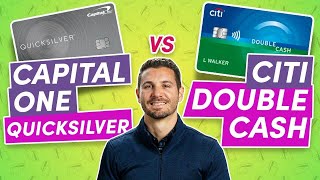
Capital One Quicksilver vs. Citi Double Cash (2026)
The Capital One Quicksilver Cash Rewards Credit Card is our top pick for capital one quicksilver vs citi double cash. No foreign transaction fee (unlike Active Cash's 3%). For budget shoppers, the Citi Double Cash® Card offers solid value at a lower price.
At a Glance
| # | Card / Product | Award | Annual Fee | Rewards Rate | APR Range | |
|---|---|---|---|---|---|---|
| 1 | Capital One Quicksilver Cash Rewards Credit Card | Our Top Pick | $0 | — | — | Apply → |
| 2 | Citi Double Cash® Card | Also Excellent | $0 | — | — | Apply → |
| 3 | Capital One Spark Cash Plus | Worth Considering | $150 (refunded as statement credit if $150,000+ spent in calendar year) | 2% unlimited cash back on all purchases; 5% on hotels and rental cars booked through Capital One Travel | N/A (charge card — balance due in full each month) | Apply → |
Capital One Quicksilver vs. Citi Double Cash (2026) Buying Guide
How we evaluated these. We compared the Capital One Quicksilver and Citi Double Cash across flat cash-back rate, annual fee, sign-up bonus, APR range, and redemption options, cross-referencing NerdWallet, Bankrate, and verified cardholder reviews. Rates as of April 2026. Terms apply.
Capital One Quicksilver earns 1.5% on every purchase with no conditions. Citi Double Cash earns an effective 2% — but only if you pay your statement balance, since the second 1% posts when you pay. Both are no-annual-fee flat-rate cash back cards, making this a question of simplicity versus maximum return for cardholders who reliably pay in full each month.
Some products featured are from partners who compensate us, which may influence which products we write about. This does not affect our evaluations. Our opinions are our own. Learn more.
Choosing between Capital One Quicksilver and Citi Double Cash comes down to one key question: do you want simplicity or maximum cash-back potential? Both are no-annual-fee cards, but they reward spending differently. This guide explains exactly how each card works, where one outperforms the other, and which belongs in your wallet — updated April 2026.
How Each Card Earns Cash Back
Capital One Quicksilver earns a flat 1.5% cash back on every purchase, credited automatically with no redemption threshold. Citi Double Cash earns effectively 2% — 1% when you buy and 1% when you pay — but the second 1% requires paying your statement balance. If you carry a balance, you forfeit half the reward. This distinction matters significantly for people who occasionally revolve a balance.
Sign-Up Bonus and Introductory Offers
Quicksilver typically offers a $200 cash bonus after spending $500 in the first 3 months — a low bar that most cardholders clear easily. Citi Double Cash has historically offered either no bonus or a modest statement credit offer. For cardholders who spend moderately ($500–$2,000/month), Quicksilver's welcome bonus can represent 6–12 months of the earnings gap between the two cards. Do the math before defaulting to Double Cash purely on the 2% rate.
Foreign Transaction Fees and Travel Use
Capital One Quicksilver charges no foreign transaction fees, making it a legitimate travel card for international purchases. Citi Double Cash charges a 3% foreign transaction fee, which wipes out most of the 0.5% earnings advantage on every overseas purchase. If you travel internationally even once a year, Quicksilver wins this category decisively. See our best no-annual-fee cards guide for more travel-friendly options.
APR, Balance Transfers, and Introductory Periods
Citi Double Cash offers an 18-month 0% intro APR on balance transfers (3% transfer fee, minimum $5). This makes it genuinely useful if you're moving debt from a high-rate card. Quicksilver offers a 15-month 0% intro APR on purchases — better for planned large purchases you want to pay down over time. Neither card should be used to carry a revolving balance long-term; both revert to variable APRs in the 19%–29% range after the intro period ends.

Which Card Wins for Which Spender
Quicksilver wins for: international travelers, people who want the welcome bonus, cardholders who occasionally carry a balance, and anyone who values simplicity over squeezing an extra 0.5%. Double Cash wins for: high spenders who pay in full every month (at $30K+/year the gap is $150 extra annually), people transferring existing balances, and cardholders who already have a travel card and want a pure domestic cash-back workhorse. Many personal finance experts recommend pairing Double Cash with a rotating category card like Chase Freedom Flex to maximize both flat-rate and bonus earnings. See our best cash-back cards for the full comparison.
Which Card Wins for Different Spending Profiles
The Capital One Quicksilver vs. Citi Double Cash decision simplifies to the sign-up bonus vs. long-term rate tradeoff for most spenders. The Quicksilver offers a $200 bonus ($500 spend in 3 months) that the Double Cash doesn't currently match. After the bonus, Double Cash's 2% everywhere outperforms Quicksilver's 1.5% by $50/year per $10,000 in spend. Break-even: the Quicksilver's $200 bonus advantage is erased by the 0.5% rate gap after $40,000 in spending — roughly 3–4 years for average spenders. For spenders who rotate cards every few years for new bonuses, Quicksilver wins. For "set it and forget it" long-term holders who keep one card for everything, Double Cash wins. Neither has an annual fee, making this a low-stakes decision.

See also: Best Cash Back Cards | Wells Fargo Active Cash Review | Best No Annual Fee Cards.
Rates shown are current as of April 2026 and may change.
This content is for informational purposes only and should not be considered financial advice. Consult a licensed financial advisor for guidance specific to your situation.
Capital One Quicksilver Cash Rewards Credit Card
“1.5% unlimited cash back. $200 bonus after $500 spend. 0% 15mo purchases + BT. 18.49%–28.49% Variable APR. $0 annual fee.”
What we like
- No foreign transaction fee (unlike Active Cash's 3%)
- No annual fee
- $200 bonus after $500 spend in 3 months
- 0% intro APR for 15 months
Watch out for
- 1.5% rate below Active Cash's 2% for domestic use
- Less rewarding for heavy domestic spenders
Rates as of April 16, 2026. Terms apply. Verify on issuer site.
Citi Double Cash® Card
“2% on all purchases (1% buy + 1% pay). No welcome bonus. 0% 18mo balance transfers. 17.74%–27.74% Variable APR. $0 annual fee.”
What we like
- 2% on all purchases with no annual fee
- ThankYou Points transfer to airline partners with premium Citi card
- Long-standing well-known product with no surprises
Watch out for
- No cell phone protection (vs. Active Cash)
- Higher welcome bonus threshold: $1,500 vs. Active Cash's $500
- Rewards delayed — 1% when you buy + 1% when you pay
Rates as of April 16, 2026. Terms apply. Verify on issuer site.
Capital One Spark Cash Plus
“The Capital One Spark Cash Plus delivers unlimited 2% cash back on every purchase with no categories to track — the best option for high-volume businesses spending over $75,000/year who want maximum s”
What we like
- Unlimited 2% cash back on every purchase — no categories, no caps
- No preset spending limit (adapts to your business needs)
- $150 annual fee refunded if you spend $150,000+ in that year
- 5% cash back on hotels and rental cars booked through Capital One Travel
- $2,000 cash bonus after $30,000 in purchases in the first 3 months
Watch out for
- $150 annual fee — requires $7,500 in annual spending just to break even on rewards vs. a no-fee 0% card
- Charge card — balance due in full every month, no revolving credit option
- No intro APR (charge card structure)
Rates as of April 16, 2026. Terms apply. Verify on issuer site.
Frequently Asked Questions
Which is better: Capital One Quicksilver or Citi Double Cash?
What is the effective reward rate of the Citi Double Cash?
Does Citi Double Cash have any foreign transaction fees?
Which card has a better welcome bonus?
Should I use the Citi Double Cash as my only credit card?
How We Evaluate Financial Products
We compare financial products based on objective criteria: annual fees, APR ranges, rewards rates, sign-up bonuses, and key perks. We do not factor in issuer relationships or compensation when determining rankings. Products are ranked based on overall value for the target use case described on this page.
Rates and terms change frequently. We update these pages regularly, but always verify current rates directly on the issuer’s website before applying. APR ranges shown reflect the full possible range — your actual rate depends on your creditworthiness.
This content is for informational purposes only and should not be considered financial advice. We compare products; we do not advise on which product is right for your personal financial situation. Read our full methodology →
Rates sourced from Capital One (capitalone.com) and Citi (citi.com) issuer websites, confirmed via NerdWallet, U.S. News, and WalletHub. All terms verified March 2026.