Roth IRA vs Traditional IRA: Which Is Better in 2026?
Choose a Roth IRA if you're under 40, expect income to grow, or are currently in a low tax bracket (under 22%). Choose a Traditional IRA if you're currently in the 24%+ bracket and expect lower income in retirement. Fidelity is the best platform for either: zero fees, zero minimums, and access to the best index funds available.
At a Glance
| # | Product | Award | Account Min | Expense Ratio | Key Feature | |
|---|---|---|---|---|---|---|
| 1 | Fidelity Roth IRA | Our Top Pick | N/A | — | — | Apply → |
| 2 | Charles Schwab Roth IRA | Also Excellent | N/A | — | — | Apply → |
| 3 | Vanguard Roth IRA | Best Value | N/A | — | — | Apply → |
| 4 | Betterment Roth IRA | Worth Considering | N/A | — | — | Apply → |
| 5 | M1 Finance Roth IRA | Honorable Mention | N/A | Underlying ETF costs only | — | Apply → |
Roth IRA vs Traditional IRA Buying Guide

How we evaluated these. We compared Roth IRA and Traditional IRA across tax treatment (pre-tax vs. after-tax contributions), income eligibility limits, required minimum distribution rules, early withdrawal penalties, and optimal use case by income bracket and retirement timeline, cross-referencing IRS Publication 590-A/590-B, Vanguard retirement planning data, and Fidelity IRA research. This content is for informational purposes only and should not be considered financial advice.
Roth IRAs use after-tax contributions and grow tax-free — traditional IRAs defer taxes until withdrawal — the right choice depends almost entirely on whether your tax rate will be higher or lower in retirement than it is today.
Some products featured are from partners who compensate us, which may influence which products we write about. This does not affect our evaluations. Our opinions are our own. Learn more.
The Core Difference: When You Pay Taxes
A Roth IRA uses after-tax contributions — you pay income tax now, and all future growth and withdrawals are completely tax-free. A Traditional IRA uses pre-tax contributions — you may deduct contributions from taxable income now, but withdrawals in retirement are taxed as ordinary income. The decision comes down to a single question: will your tax rate be higher now or in retirement? If higher now (typically true for high earners in peak career years), a Traditional IRA defers taxes to a lower-rate period. If higher in retirement (typically true for younger earners who expect income growth), a Roth IRA locks in the lower tax rate today. For most people in their 20s and early 30s, the Roth wins by default.
Where to Open the Account: Self-Directed vs. Robo-Advisor
Self-directed IRAs at Fidelity, Schwab, and Vanguard let you choose your own investments — typically low-cost index funds. Fidelity offers zero-expense-ratio index funds (FZROX, FZILX) and no account minimum. Schwab and Vanguard offer equivalent broad-market index funds at 0.03–0.04% expense ratios — negligible cost differences over a long horizon. Robo-advisors like Betterment automate portfolio construction and rebalancing for an annual fee (typically 0.25%), removing the need to make any investment decisions. M1 Finance occupies the middle ground — you build your own portfolio ("pie") from stocks and ETFs, and M1 handles automatic rebalancing. For investors who want to set and forget, Betterment's 0.25% fee is justified. For investors who will actively choose investments, Fidelity or Schwab offers the same outcome at zero advisory cost.

Contribution Limits and Income Rules
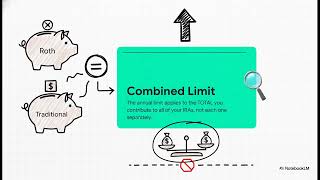
The annual contribution limit for 2026 is $7,000 ($8,000 if age 50 or older) across all IRAs combined — not per account. Roth IRA eligibility phases out at higher incomes: the contribution limit reduces above $150,000 (single filers) and $236,000 (married filing jointly) and reaches zero at $165,000 and $246,000 respectively. Traditional IRA contributions have no income limit for the contribution itself, but the tax deduction phases out if you or your spouse are covered by a workplace retirement plan at higher income levels. High earners above the Roth income limit can use the backdoor Roth strategy: contribute to a non-deductible Traditional IRA and immediately convert it to a Roth.

Required Minimum Distributions: A Critical Long-Term Difference
Traditional IRAs require you to begin withdrawals (Required Minimum Distributions, RMDs) starting at age 73, calculated annually based on account balance and life expectancy. Roth IRAs have no RMDs during the owner's lifetime — money can grow tax-free indefinitely and be left entirely to heirs if desired. For estate planning purposes, a Roth IRA is significantly more valuable than a Traditional IRA of the same size, because heirs inherit the tax-free growth status (though they must take RMDs over their own lifetime under current SECURE Act rules).
Common Mistakes to Avoid
- Defaulting to Traditional without doing the tax-rate math: Many people choose Traditional because "pre-tax sounds good." Run the actual numbers: if your marginal rate is 22% now and you expect 25–28% in retirement, Traditional costs you money over time.
- Contributing but not investing: Money deposited to an IRA sits as cash until you choose investments. An unfunded IRA — money sitting in a money market fund inside the account — earns almost nothing. Select your index funds immediately after contributing.
- Waiting until the deadline to contribute: IRA contributions for a given tax year are due by the April 15th filing deadline. Contributing in January instead of April gives investments an extra 15 months of compound growth over a career — a meaningful difference at scale.
- Withdrawing early: Pre-retirement withdrawals from a Traditional IRA (before age 59½) trigger income tax plus a 10% penalty. Roth contributions (not earnings) can be withdrawn penalty-free, but pulling money out of a Roth undoes the tax-free compounding advantage.
Related Guides
- Best High-Yield Savings Accounts
- Best CD Rates
- Best Money Market Accounts
- Best 529 Plans
- Best HSA Accounts
Rates shown are current as of April 2026 and may change.
This content is for informational purposes only and should not be considered financial advice. Consult a licensed financial advisor for guidance specific to your situation.

Fidelity Roth IRA
“Zero fees, no minimum, full fund access, top-rated mobile app”
What we like
- No account minimum to open a Roth IRA
- $0 commissions on all U.S. stock and ETF trades
- FZROX (Fidelity ZERO Total Market Index): 0.00% expense ratio — the only major broad market fund with zero annual fees
- Fractional shares starting at $1 — invest any dollar amount in any stock or ETF
- Excellent mobile app and website; 24/7 customer service
Watch out for
- FZROX and other Fidelity ZERO funds only available at Fidelity — not transferable to other brokerages
- No automatic rebalancing in self-directed accounts (use Fidelity Go robo-advisor for that)
- Research tools less comprehensive than Schwab’s thinkorswim platform
Rates as of April 16, 2026. Terms apply. Verify on issuer site.
Charles Schwab Roth IRA
“Free investment advice, 24/7 support, excellent educational resources”
What we like
- No account minimum; no annual fee; $0 commissions on stocks and ETFs
- SWTSX (Schwab Total Stock Market Index): 0.03% expense ratio
- thinkorswim platform available for advanced research and analysis
- Schwab Intelligent Portfolios (robo-advisor): no management fee (0.00%) with $5,000 minimum
- 24/7 customer service; 400+ branch locations
Watch out for
- Expense ratios on Schwab index funds (0.03%) slightly higher than Fidelity’s 0.00%
- Schwab Intelligent Portfolios requires $5,000 minimum (vs. Betterment’s $0)
- Schwab Intelligent Portfolios Premium ($30/month after one-time $300 planning fee) for advisor access
Rates as of April 16, 2026. Terms apply. Verify on issuer site.
Vanguard Roth IRA
“The original index fund creator, lowest expense ratios industry-wide”
What we like
- No account minimum for Vanguard ETFs; $0 commissions on ETF trades
- VTSAX (Vanguard Total Stock Market Index) at 0.04% expense ratio
- VOO (Vanguard S&P 500 ETF) at 0.03% expense ratio
- Vanguard is investor-owned — no external shareholders, profits return to fund holders
- Lowest-cost mutual fund lineup in the industry
Watch out for
- Vanguard mutual funds require $1,000–$3,000 minimum initial investment
- Website and app interface widely considered less modern than Fidelity or Schwab
- No fractional share trading for mutual funds
- Customer service quality rated lower than Fidelity by independent reviewers
Rates as of April 16, 2026. Terms apply. Verify on issuer site.
Betterment Roth IRA
“Automated tax-loss harvesting, goal-based planning, socially responsible options”
What we like
- No account minimum to open a Roth IRA
- 0.25%/year management fee (or $4/month if balance under $20,000 without $250/mo recurring deposit)
- Automatic portfolio rebalancing and tax-loss harvesting — no decisions required
- Goal-based investing: set a retirement goal, Betterment manages the allocation
- Socially responsible investing (SRI) portfolio option
Watch out for
- 0.25%/year fee vs. $0 for self-directed Fidelity or Schwab accounts
- Limited control over individual investment selection — designed for hands-off investors
- Premium plan ($100,000 minimum, 0.65%/year) required for unlimited advisor calls
Rates as of April 16, 2026. Terms apply. Verify on issuer site.
M1 Finance Roth IRA
“Fractional shares, custom portfolios, automatic rebalancing at zero cost”
What we like
- Unique 'Pie' investing model — choose your stocks/ETFs, M1 automates contributions and rebalancing
- $250–$2,500 transfer bonus depending on balance transferred ($100K–$1M+)
- $0 trading commissions, $0 management fee
- $3/month IRA fee waived when total M1 assets exceed $10,000
- Expert Pies available — pre-built portfolios you can adopt
Watch out for
- $500 initial deposit required for retirement accounts (vs. $0 at Fidelity/Schwab)
- $3/month IRA fee before $10K threshold — $36/year hidden cost for new investors
- Not ideal for active traders — single daily trade window
- Less investment research and educational content than Fidelity or Schwab
Rates as of April 16, 2026. Terms apply. Verify on issuer site.
Frequently Asked Questions
Should I choose a Roth IRA or Traditional IRA?
What are the 2026 contribution limits for IRAs?
What is the 'backdoor Roth IRA' strategy?
Can I have both a Roth IRA and a Traditional IRA?
What happens to my IRA when I retire?
How We Evaluate Financial Products
We compare financial products based on objective criteria: annual fees, APR ranges, rewards rates, sign-up bonuses, and key perks. We do not factor in issuer relationships or compensation when determining rankings. Products are ranked based on overall value for the target use case described on this page.
Rates and terms change frequently. We update these pages regularly, but always verify current rates directly on the issuer’s website before applying. APR ranges shown reflect the full possible range — your actual rate depends on your creditworthiness.
This content is for informational purposes only and should not be considered financial advice. We compare products; we do not advise on which product is right for your personal financial situation. Read our full methodology →