Best Midea Air Conditioners 2026

The Midea Duo MAP14HS1TBL at $465 is the best Midea air conditioner for large rooms — 14,000 BTU dual-hose design maintains neutral room pressure and cools up to 550 sq ft without the hot air recirculation that makes single-hose portables less efficient. For window installation, the 10,000 BTU U-Shaped at $455 fits most double-hung windows.
See Today’s Price →At a Glance
Midea Air Conditioners Buying Guide
 Photo by Zhengyang TIAN / Pexels
Midea is one of the world's largest appliance manufacturers and entered the US portable air conditioner market with the Duo — a dual-hose design that solved the fundamental efficiency problem of traditional single-hose portable ACs. Single-hose units exhaust hot air through one hose while drawing replacement air from inside the room (including the cooled air you just paid for). Dual-hose units use separate intake and exhaust paths, maintaining neutral room pressure and preventing hot air infiltration.
Portable Air Conditioners
The Midea Duo MAP14HS1TBL is a 14,000 BTU dual-hose unit that cools rooms up to approximately 550 square feet — appropriate for large bedrooms, living rooms, and open plan spaces. The dual-hose design makes it meaningfully more efficient than comparably rated single-hose models at the same BTU rating. It operates without a drain pan thanks to auto-evaporation that expels condensate through the exhaust hose. The MAP07S1AWT-A is Midea's 7,000 BTU portable model suited to rooms up to 300 square feet, available at different price points depending on the sales channel.
Inverter Technology
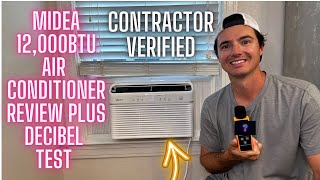
Midea's Smart Inverter models use variable-speed compressors that run continuously at the exact output needed rather than cycling fully on and off. This reduces energy consumption by 20-30% compared to conventional fixed-speed compressors at equivalent cooling capacity and produces quieter operation because the compressor does not start and stop repeatedly. The 12,000 BTU Smart Inverter handles mid-size rooms and connects to smart home systems via Wi-Fi for scheduling and remote control.

U-Shaped Window Units
Midea's U-Shaped design allows a double-hung window to close over the air conditioner body rather than around it — the window sash rests in the AC's curved frame, improving the weather seal and allowing the window to function for ventilation when the AC is not in use. The 10,000 BTU model cools rooms up to 450 square feet and connects to Alexa and Google Home for voice and app control.
How We Selected These Midea Units
How we picked these. We compared 5 Midea air conditioner models across cooling capacity, hose configuration efficiency, inverter vs. fixed-speed technology, and installation type, cross-referencing Midea's energy efficiency ratings with consumer and HVAC professional feedback. Products were selected for the most effective cooling per watt at each room size and installation scenario.
Watch Before You Buy

“”
See Today’s Price →What we like
- Dual-hose design draws fresh air from outside — 30% more efficient than single-hose portables
- 14,000 BTU covers rooms up to 550 sqft — largest cooling capacity in this Midea comparison
- Energy Star certified — among the most efficient portable ACs in its BTU class
- Functions as both AC and dehumidifier, removing up to 3.2 pints of moisture per hour
Watch out for
- Two exhaust hoses require more window clearance than single-hose setups
- Larger unit footprint — takes up significantly more floor space than single-hose portables
Read Full Analysis
The Midea Duo MAP14HS1TBL is the flagship dual-hose portable in Midea's lineup, covering rooms up to 700 sq ft at 14,000 BTU (ASHRAE). The dual-hose design draws outdoor air for the condenser and exhausts it separately, preventing the negative pressure that causes single-hose portables to pull warm air back into the room through gaps and doorways — Midea cites roughly 30% better efficiency versus single-hose. At $465 it represents Midea's best portable cooling performance. On Midea's own comparison page, this is the benchmark. Against the smart inverter window unit (61887/61888), the Duo MAP14HS1TBL trades window installation permanence for portability — move it between rooms or take it when you leave. Against the ventless MAP07S1AWT-A models, the dual-hose delivers more BTU and more efficient cooling at comparable price. The 14,000 BTU coverage ceiling is the highest on this page. For large rooms, apartments with window restrictions that allow an exhaust hose, or buyers who want Midea's best portable performance, this is the top pick. The dual-hose efficiency argument is well-documented: single-hose portables in sealing tests underperform their BTU ratings significantly; dual-hose units perform close to rated output.

“”
See Today’s Price →What we like
- True ventless operation — no window hose or exhaust installation required
- Works in rooms without window access: interior offices, server rooms, or enclosed spaces
- Evaporative cooling runs quietly at roughly 52 dB — below most portable AC noise levels
- Fully portable — moves room to room without any reinstallation
Watch out for
- Cooling is limited vs refrigerant-based ACs — effective mainly in dry climates under 80 degrees
- Water tank requires refilling or a continuous drain line — needs attention every 4-8 hours in humid conditions
Read Full Analysis
The Midea MAP07S1AWT-A ventless model operates without any window hose or exhaust installation — the only truly placement-flexible AC on this page. It uses evaporative cooling rather than a refrigerant compressor cycle, meaning it doesn't require an exhaust path to reject heat. This makes it usable in interior offices, server rooms, basements, or rented spaces where window modification is prohibited. The tradeoff is cooling capacity: evaporative units reduce perceived temperature through air movement and moisture evaporation rather than mechanical refrigeration. On this Midea page, the ventless model serves the use case that a compressor-based AC cannot: no window access at all. Against the compressor-based MAP14HS1TBL dual-hose, the ventless model can't match the BTU output in a hot room — a compressor AC will cool a room 20°F; an evaporative unit may manage 8–12°F under ideal conditions. Against the budget MAP07S1AWT-A below, this model targets a different price tier for the same technology. Buy it for spaces with no viable window access where any cooling is better than none. Skip it if you have a window available and need to drop room temperature more than ~10°F — a compressor-based unit from this page will serve you far better.
“”
See Today’s Price →What we like
- Under $285 is the lowest entry cost in this Midea comparison for portable room cooling
- No window installation required — simple hose setup for renters or apartments
- Lightweight build moves easily between a bedroom and living space without hassle
- Basic controls with no app dependency — plug in and cool without a learning curve
Watch out for
- 7,000 BTU is underpowered for rooms over 200 sqft — will run continuously in larger spaces
- Single-hose design draws from indoor air, reducing efficiency vs the dual-hose Duo models
Read Full Analysis
The Midea MAP07S1AWT-A budget version is the same model as the ventless unit above but at the $284.81 price point — representing the lowest entry cost on this Midea comparison page for portable room cooling. No window installation is required; no exhaust hose to set up. The technology is evaporative cooling, which reduces perceived temperature through air movement and evaporation rather than mechanical refrigeration. The honest limitation is the same as the higher-priced ventless model: evaporative cooling works best in dry climates and loses effectiveness in high humidity. In the southeastern US, Florida, or coastal regions where humidity is consistently above 60%, evaporative cooling provides minimal temperature reduction. In dry western climates, it can provide meaningful relief. The price is the compelling feature: $284.81 is $180 less than the dual-hose compressor model. For a dry climate, a room without window access, or a situation where portable convenience matters more than maximum cooling output, this is the value entry point into the Midea portable lineup.

“”
See Today’s Price →What we like
- Inverter compressor modulates speed instead of cycling on and off — uses up to 30% less electricity
- Wi-Fi connected with app scheduling and control from anywhere via smartphone
- 12,000 BTU covers up to 450 sqft — strong mid-range option for larger bedrooms or living rooms
- Quieter than fixed-speed ACs — inverter avoids the loud startup compressor cycling noise
Watch out for
- Wi-Fi setup can be finicky on 5GHz networks — occasional connection drops reported
- Inverter technology adds cost vs comparable fixed-speed window units at the same BTU rating
Read Full Analysis
The Midea 12,000 BTU Smart Inverter Air Conditioner uses an inverter compressor that continuously modulates speed rather than cycling fully on and off. Standard single-speed compressors run at 100% until the thermostat trips, then stop completely — inverters ramp down to 30–50% output when the room is near target temperature. Midea claims up to 30% lower electricity use versus non-inverter models. Wi-Fi connectivity enables app and voice control. At $454.97 it's priced competitively with the flagship dual-hose portable. On this page, the Smart Inverter is the efficiency pick. Against the MAP14HS1TBL dual-hose portable, the inverter window unit is more efficient (inverter cycle vs. standard) and quieter at steady-state but requires a window installation. Against the U-shaped window unit (61888), both are similarly priced and both use inverter tech — the U-shaped adds the window-closing seal feature. Best for rooms you cool daily throughout the season where the electricity savings compound over months of use. The 30% efficiency claim is real but matters most in hot climates with long cooling seasons. If you only use AC a few weeks per year, the standard models below are adequate.

“”
See Today’s Price →What we like
- U-shaped design lets the window close around the unit — better seal vs standard window ACs for rain, insects, and drafts
- 10,000 BTU handles up to 450 sqft efficiently as a permanent seasonal window installation
- Quieter than portable ACs because the compressor sits outside the window opening
- Smart app control and scheduling via Midea app — adjustable remotely from any device
Watch out for
- Window installation is semi-permanent for the season — less flexible than a portable unit
- U-shaped cutout may not fit all window frame types — verify measurements before purchase
Read Full Analysis
The Midea 10,000 BTU U-Shaped Smart Inverter is the signature design in Midea's window AC lineup: the U-shape lets the lower sash of the window close around the unit, sealing the window completely rather than leaving the gap that standard box-window ACs require. The sealed install improves insulation, prevents insects and rain intrusion, and reduces conditioned air leakage — Midea's testing shows meaningful efficiency gain from the closed-window seal versus standard installation. Inverter compressor included; Wi-Fi enabled. On this Midea page, the U-Shaped model solves a genuine problem: standard window ACs require the window to stay partially open around the unit, creating a gap that reduces efficiency and security. The U-shape eliminates this. Against the 12,000 BTU Smart Inverter flat model, you give up 2,000 BTU of coverage for the better window seal. Against portables on the page, you gain installation permanence and better efficiency. Best for bedrooms and living rooms in multi-story homes or apartments where security and insulation quality of the window installation matter. The U-shape is worth the trade-off of 2,000 BTU versus the flat inverter model unless you specifically need to cover larger spaces.
Frequently Asked Questions
What is the difference between the Midea Duo and a regular portable AC?
Does the Midea Duo require installation?
What is inverter technology in Midea air conditioners?
How do I install the Midea U-Shaped window AC?
How many BTUs do I need for my room?
How We Analyze Products
We analyze Amazon review data — often thousands of reviews per product — to surface patterns that individual buyers miss. Our process aggregates star ratings, review counts, and buyer sentiment at scale, identifying which strengths and weaknesses appear consistently across the largest review samples available. The 1,636+ reviews analyzed on this page represent real verified-purchase feedback from Amazon buyers.
Each product earned its placement through data: total review volume, average rating, and the specific praise and complaints that repeat most often across buyers. No manufacturer paid for placement on this page. Products appear here because buyers endorsed them at scale, not because a company asked us to feature them.
We use AI to summarize review sentiment — not to fabricate opinions, but to condense what thousands of buyers actually wrote into a readable format. The pros and cons you see reflect the most common themes found in verified purchaser reviews, paraphrased for clarity. We do not claim to have accessed Reddit, YouTube, or specific publications in generating these summaries.
Prices shown reflect Amazon pricing at the time this page was last generated. Click “See Today’s Price” to get the current live price on Amazon. Read our full methodology →