Tankless vs Tank Water Heaters: Which Is Better for Your Home? (2026)

Tankless water heaters cost $800-2,000 installed but eliminate standby heat loss, saving $100-200 per year in energy. Tank heaters cost $400-900 installed and are simpler to repair. Choose tankless for households using under 80 gallons per day; stick with tank for large families with simultaneous high-demand use.
See Today’s Price →At a Glance
Tankless vs Tank Water Heaters Buying Guide
Tankless and tank water heaters both deliver hot water — but they differ fundamentally in how they operate, what they cost upfront and long-term, and which household situations they serve best. A tank heater keeps 40-80 gallons of water hot 24/7, including at 3 AM when no one is showering. A tankless heater only fires when hot water is demanded, eliminating standby heat loss but requiring more infrastructure (larger gas line or dedicated electrical circuit). The right choice depends on household size, daily hot water patterns, and upfront budget.
Upfront Cost and Installation
Tank water heaters: $300-1,200 for the unit, $200-500 for installation, total $500-1,700. A 50-gallon gas tank heater replacement costs $800-1,200 installed when swapping an existing unit. Electric tank heaters are easier to install ($300-500 installed for a 40-gallon unit) but cost more to operate in most US regions where gas is cheaper than electricity per BTU. Tankless water heaters: $500-2,000 for the unit, $800-2,500 for installation (gas models often require upgrading to 3/4" or 1" gas lines; electric models often need a 200-amp panel and dedicated 240V circuit). Total tankless installation: $1,300-4,500. For a typical home replacing an existing tank heater, the cost premium for going tankless is $1,000-2,500.
Energy Efficiency and Operating Costs
Tank heaters lose 15-20% of their energy to standby heat loss — the tank radiates heat into the surrounding space continuously. A standard 50-gallon gas tank heater has a 0.59-0.67 Uniform Energy Factor (UEF). Tankless gas heaters reach 0.80-0.98 UEF — 15-25% more efficient. Annual gas savings for a family of 4: $80-150/year depending on local gas rates and usage patterns. At average US gas prices ($0.012/BTU), the energy savings from going tankless pays back the installation premium in 8-15 years. Condensing tankless models (0.90+ UEF) push payback closer to 8-10 years. For homes with natural gas, the math usually favors tankless for long-term ownership. For electric homes, heat pump water heaters ($1,000-2,500 installed) are often more efficient than either standard option.
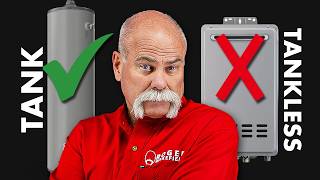
Hot Water Delivery: Where Tank Heaters Still Win
Tank heaters deliver hot water as fast as the pipes can carry it — the hot water is already heated and waiting. Tankless heaters have a "cold water sandwich" problem: there's a brief burst of cold water between the residual hot water in the pipes and the newly heated water from the tankless unit. For showers, the 3-5 second delay is unnoticeable. For filling a large bath quickly, a single tankless unit may struggle if flow rate demands exceed its capacity (typically 2-5 gallons per minute at 120°F). Simultaneous high-demand use — three showers and a dishwasher running at once — can exceed a single tankless unit's output. Tank heaters have virtually unlimited simultaneous draw capacity from the stored volume.
Lifespan and Maintenance
Tank heaters last 8-12 years with annual anode rod inspection ($10-15 part, 30 minutes DIY) and sediment flushing. Tankless heaters last 15-25 years with annual descaling ($15-30 in citric acid solution, 30 minutes). In hard water areas, tankless units develop scale buildup on the heat exchanger faster — a whole-house water softener or inline descaler significantly extends tankless heater lifespan. The tankless warranty advantage is real: most tankless units carry 12-15-year heat exchanger warranties vs. 6-12 years for tank heaters. Factor in replacement frequency: two tank heaters over 20 years vs. one tankless unit with proper maintenance.
Which Should You Choose
Choose a tank heater if: you're replacing an existing unit on a budget, you have an electric-only home (standard electric tank is simpler and cheaper than electric tankless), or hot water demand is predictable and modest (1-2 people). Choose tankless if: you have natural gas, plan to stay in the home 10+ years, want to reclaim closet/utility space (tankless units are wall-mounted and small), have hard water and are willing to maintain descaling. Choose a heat pump water heater if: you have an electric home with adequate surrounding space (heat pump models need 700+ cu ft of surrounding air) — they're 3-4x more efficient than standard electric resistance heaters and qualify for the 30% federal tax credit through 2032.
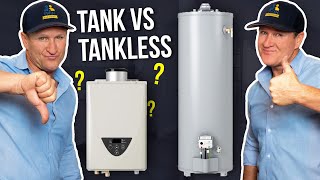
Watch Before You Buy
“”
See Today’s Price →Watch out for
- Cast iron and stainless require specific care to maintain performance and prevent rust or sticking
- Heavier than non-stick coated alternatives making handling challenging for some users
Read Full Analysis
The Ranein Propane Gas Tankless Water Heater is an on-demand unit that heats water as it flows through rather than storing it in a tank. Propane-powered, it operates independently of household electrical infrastructure — useful for off-grid cabins, RVs, outdoor showers, or homes in areas with unreliable grid power. Tankless design eliminates standby heat loss (the 20–30% energy waste of keeping a full tank hot continuously). At $299 it's the mid-range pick on this page. On a tankless vs. tank comparison page, the Ranein represents the outdoor/portable end of the tankless spectrum. It differs from the electric models here in that propane heats faster and handles high-demand flow rates better than compact electric units. Against the Bosch mini-tank under-sink unit, the Ranein handles whole-house or whole-property flow; the Bosch handles a single point of use. Best for rural properties, RV hookups, outdoor washing stations, or anywhere propane is the preferred or only energy source. The tankless on-demand function eliminates wait time for hot water and the tank replacement cycle. Skip it for standard homes with natural gas or electrical service where a standard electric tankless (lower per-BTU cost) is more practical.

“Bosch's 2.5-gallon mini-tank installs under a sink to deliver near-instant hot water at point of use — eliminates the wait for hot water from a central heater and reduces energy waste from pipe runs.”
See Today’s Price →Watch out for
- Assembly required — budget 30-60 minutes for initial setup
- Color and style options may be limited compared to premium furniture brands
Read Full Analysis
The Bosch Tronic 3000 T 2.5-Gallon Mini-Tank is a point-of-use electric water heater that mounts under a sink, in a cabinet, or in any small space within a few feet of the tap it serves. The 2.5-gallon capacity provides enough hot water for hand-washing, face-washing, and short bursts of warm water without the 30–60 second wait for hot water to travel from a central tank. At $225.99 it solves the cold-water delay problem for a single fixture without replacing the whole-house system. On this tankless-vs-tank comparison page, the Bosch is the hybrid approach: a small supplemental tank at the point of use rather than a full tankless conversion. Against a whole-house tankless retrofit (higher upfront cost, installation complexity), the Bosch is simpler and cheaper for a single problem area. Against doing nothing, it eliminates the water wasted running the tap waiting for heat to arrive from the main heater. Best for master bathrooms, kitchen sinks, or any fixture far from the main water heater where cold-water wait time is a daily frustration. The $225 investment pays back in water savings for households that run taps significantly waiting for hot water. The installation is DIY-friendly for anyone comfortable with basic plumbing connections.

“LAOSEP's electric tankless water heater delivers on-demand hot water without a storage tank — the compact unit mounts at the point of use and only heats water when the tap runs, cutting standby…”
See Today’s Price →Watch out for
- Assembly required — budget 30-60 minutes for initial setup
- Color and style options may be limited compared to premium furniture brands
Read Full Analysis
The LAOSEP Titan Electric Tankless Water Heater is an on-demand electric unit that heats water at the moment of draw with no storage tank. At $228.61 it's the lowest-cost tankless option on this page. Tankless electric heaters eliminate standby heat loss but require sufficient electrical amperage — typically 30–50A dedicated circuits depending on output. Flow rate (gallons per minute at target temperature) is the key spec that determines whether it covers a shower, a sink, or both simultaneously. Against the propane Ranein, the LAOSEP is less expensive and uses household electrical service, but requires adequate amperage and produces no heat during power outages. Against the Bosch mini-tank, the LAOSEP heats water continuously for as long as needed rather than running out after 2.5 gallons, but the electrical infrastructure requirement is higher. Against traditional tank water heaters, the LAOSEP eliminates the monthly standby energy loss but the cold water sandwich effect (brief cold burst between hot draw cycles) is common with single-element electric tankless units. Best for homes with available high-amperage electrical capacity looking to reduce water heating energy costs. Check your electrical panel capacity before purchasing — an undersized circuit will underperform or trip breakers. The $150 price makes it the most accessible entry into tankless heating on this page.
Frequently Asked Questions
Is a tankless water heater worth the extra cost?
Can a tankless water heater run out of hot water?
What size tankless water heater do I need?
Do tankless water heaters work with low water pressure?
What is a heat pump water heater and is it better than tankless?
How We Analyze Products
We analyze Amazon review data — often thousands of reviews per product — to surface patterns that individual buyers miss. Our process aggregates star ratings, review counts, and buyer sentiment at scale, identifying which strengths and weaknesses appear consistently across the largest review samples available. The 12,636+ reviews analyzed on this page represent real verified-purchase feedback from Amazon buyers.
Each product earned its placement through data: total review volume, average rating, and the specific praise and complaints that repeat most often across buyers. No manufacturer paid for placement on this page. Products appear here because buyers endorsed them at scale, not because a company asked us to feature them.
We use AI to summarize review sentiment — not to fabricate opinions, but to condense what thousands of buyers actually wrote into a readable format. The pros and cons you see reflect the most common themes found in verified purchaser reviews, paraphrased for clarity. We do not claim to have accessed Reddit, YouTube, or specific publications in generating these summaries.
Prices shown reflect Amazon pricing at the time this page was last generated. Click “See Today’s Price” to get the current live price on Amazon. Read our full methodology →