How to Sharpen Kitchen Knives (2026): Complete Guide (Whetstone
The Chef's Choice Trizor 15XV at $143.62 is the best electric knife sharpener for home cooks — it converts any European knife to a sharper 15° Japanese edge in one pass, and the three-stage diamond system takes under 60 seconds for a dull blade.
At a Glance
| # | Product | Award | Price |
|---|---|---|---|
| 1 |  Chef’sChoice 15XV EdgeSelect Prof… Chef’sChoice 15XV EdgeSelect Prof…Chef's Choice |
Best Overall | $170 Buy → |
| 2 |  KitchenIQ 50009 Edge Grip 2-Stage… KitchenIQ 50009 Edge Grip 2-Stage…KitchenIQ |
Best Budget Option | $10.07 Buy → |
| 3 |  Victorinox Honing Steel 12-Inch R… Victorinox Honing Steel 12-Inch R…Victorinox |
Best Honing Rod | $58.14 Buy → |
| 4 |  Work Sharp Professional Precision… Work Sharp Professional Precision…WORK SHARP |
Best Guided System | $399.95 Used — not a new unit Buy → |
| 5 | Best Knife Worth Sharpening | $170 Buy → |
How to Sharpen Kitchen Knives (2026) Buying Guide
 Photo by Kampus Production / Pexels
Quick Comparison
| Feature | Whetstone | Electric Sharpener | Pull-Through | Honing Rod | Pro Service |
|---|---|---|---|---|---|
| Best For | Best edge quality, enthusiasts | Convenience, regular use | Quick touch-up, budget | Daily edge maintenance | Neglected or damaged knives |
| Edge Quality | Excellent (custom angle) | Good (preset angle) | Fair (aggressive grind) | Does not sharpen (realigns) | Excellent |
| Metal Removed | Controlled | Moderate | High (wears blade fast) | None | Controlled |
| Knife Lifespan | Long | Medium | Short | Long (proper use) | Long |
| Learning Curve | High (weeks to learn) | None | None | Low | None |
| Cost | $58.14-$150 (one-time) | $25-$170 | $10-$40 | $10-$60 | $5-$15 per knife |
| Our Pick | King KW-65 1000/6000 | Work Sharp Culinary E2 | Spyderco Sharpmaker | Victorinox Fibrox 12" | Local knife shop |
Who This Guide Is For
This guide is for you if:
- You want to understand the real difference between German and Japanese knives before spending $150+
- You're buying your first serious chef's knife and want to know what actually matters
- Your knives feel dull and you're not sure whether they need honing, sharpening, or replacement
Skip this guide if:
- You already know your knife preference and just need a product recommendation
- You're a professional cook — home kitchen trade-offs differ from restaurant use
First: Understand What You're Actually Doing
Sharpening and honing are two completely different things. Most people who think their knife is dull just need honing.
- Honing (the steel rod) realigns the microscopic edge that folds over with each use. It does NOT remove metal. It takes 10 seconds. Do it every time you cook.
- Sharpening (whetstone, electric, pull-through) removes metal to create a new edge. It's needed every 3-6 months for home use, or when the knife fails the paper test even after honing.
Think of it this way: honing is like straightening a bent nail. Sharpening is like cutting a new nail. You hone weekly, you sharpen seasonally.
How We Chose
We researched dozens of options, analyzed thousands of verified reviews on Amazon and Reddit, and cross-referenced expert recommendations from America's Test Kitchen, Cook's Illustrated, and thousands of home cook reviews. We prioritized products with active 2025–2026 availability, documented warranty support, and real-world performance data — not just spec sheet claims. Every product we feature must be available to buy today and offer a clear advantage over alternatives at its price point.
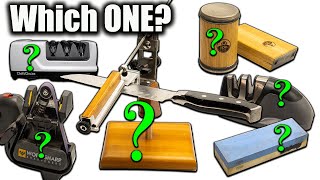
Is Your Knife Actually Dull? Three Tests
Test before you sharpen -- you may just need to hone.
Test 1: The Paper Test
Hold a sheet of printer paper vertically at the top edge. Draw the knife blade downward through the paper in a slicing motion. What it looks like when sharp: The knife slides through cleanly, leaving a straight cut with no tearing. You hear a clean zip sound. What it looks like when dull: The paper tears, crumples, or the knife deflects sideways. You hear a ripping or ragged sound. If it deflects, sharpen. If it just tears a little, try honing first.
Test 2: The Tomato Test
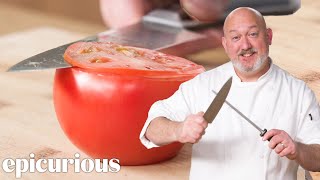
Place a ripe tomato on a cutting board and rest the knife on the skin without pressing. Pull back in a single slicing stroke. Sharp: The skin parts immediately with minimal pressure -- the knife's weight alone should start the cut. Dull: The skin dimples and pushes the tomato before it cuts. You have to saw or press hard. A dull knife on a tomato is the classic sign that sharpening is overdue.
Test 3: The Fingernail Test
Angle the blade toward your thumbnail at about 45 degrees and rest it lightly on the nail. Do not slide it -- just rest it. Sharp: The edge catches and stops immediately, almost like a brake. It grips the nail. Dull: The blade skates right off the nail surface without gripping at all. If it skates, it needs sharpening, not just honing.
Whetstone Sharpening: The Full Step-by-Step
Video for this section: Ethan Chlebowski's Knife Sharpening for Beginners -- focuses on exactly the hand position and angle control that beginners struggle with.
For most home knives, you need three grits: 1000 (repairs), 3000 (refines), 6000 (polishes). Here is what each grit does, what it feels like, and what it sounds like:
Understanding the Grits
| Grit | What It Does | The Feel | The Sound |
|---|---|---|---|
| 220-400 | Chip repair, major re-profiling | Very coarse, sandpaper-rough under finger | Loud, scratchy grinding -- sounds like metal filing |
| 1000 | Creates initial edge, standard sharpening | Grainy, feels like fine sandpaper. Slurry builds up gray and metallic within 30 seconds | Medium-pitched scraping. Should sound like: shink shink shink, rhythmic and consistent |
| 3000 | Refines 1000-grit scratches, transitions to polish | Smoother, almost silky with slurry. Less resistance than 1000 | Higher-pitched, lighter sound. The blade starts whispering instead of grinding |
| 6000 | Final polish, mirror edge | Creamy, silky. Slurry is very fine and white-gray. Almost feels like polishing | Very light, high-pitched swishing. Almost no resistance |
Step 1: Soak the Stone (3-5 minutes)
Place the whetstone in water until no more bubbles come from the surface. What it looks like: Bubbles stream from the stone for the first minute or two, then slow and stop. That means the stone is saturated. Pull it out -- it should look darker and wet all the way through. Do not oversoak -- 5 minutes maximum for most stones. Japanese combination stones may need only 1-2 minutes. If your stone came with instructions about being a non-soaking stone (like many ceramic stones), skip this step entirely and just splash water on the surface as you work.
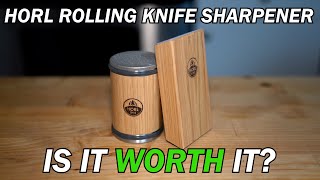
Watch Before You Buy
“Chef'sChoice Trizor XV: diamond abrasives in stages 1-2, stropping disk in stage 3. Converts any knife to a 15-degree edge while sharpening. 60 seconds per knife. The definitive home electric…”
See Today’s Price →What we like
- Converts Western knives to the superior 15-degree Trizor edge
- Three-stage system: coarse, fine, and stropping/serrated
- Produces professionally sharp edges without any technique required
- Works on both straight-edge and serrated knives
Watch out for
- Premium price significantly above budget alternatives
- Converts knives to 15-degree angle permanently — inconsistent with some other sharpening tools
- Removes more metal per sharpening than guided-angle whetstones
Read Full Analysis
The Chef'sChoice Trizor 15XV justifies its $170 price through what it actually does: it doesn't just sharpen your knives — it converts them to a sharper geometry than they came with from the factory. Most Western knives are sharpened to 20-22 degrees per side at the factory; the Trizor converts them to the 15-degree Trizor XV edge, which is meaningfully sharper for kitchen tasks. The three-stage diamond abrasive system does this conversion and final polishing in under 90 seconds per knife. The practical benefit is that you stop thinking about whether your knives are sharp. Pre-Trizor, knives slowly dull and most home cooks tolerate progressively worse performance. Post-Trizor, a 90-second monthly maintenance session keeps every knife at peak performance indefinitely. The limitation: the Trizor removes material to change the angle, which means it's not appropriate for thin Japanese knives originally sharpened to 15 degrees (you'd be removing steel unnecessarily) or extremely hard steel above 60 HRC that can chip on abrasive wheels. For standard German/French style knives (Wusthof, Henckels, most mid-range Western knives), the Trizor is the correct tool. Compared to the KitchenIQ (rank 2), the quality difference is dramatic — the Trizor is a precision instrument; the KitchenIQ is a drawer tool. Compared to the Work Sharp (rank 4), the Trizor is faster and requires zero technique; Work Sharp gives more control for enthusiasts. Best for: Home cooks who want their knives as sharp as possible with minimal effort, anyone who owns good Western knives and hasn't sharpened them in years.
“KitchenIQ Edge Grip 2-Stage: carbide pre-sharpener plus ceramic finishing slot. Mounts on countertop edge. Gets the job done on cheap knives in under 30 seconds. More metal removal than electric or…”
See Today’s Price →What we like
- Exceptional value — the most affordable effective knife sharpener available
- Non-slip base with edge grip prevents movement during use
- Stage 1 carbide quickly restores very dull edges
- Stage 2 ceramic fine-tunes and maintains the edge
Watch out for
- Carbide stage removes more metal than necessary — not ideal for high-end knives
- Produces a functional but less refined edge than electric sharpeners
- Not suitable for serrated knives or Japanese single-bevel knives
Read Full Analysis
The KitchenIQ Edge Grip is the pragmatic choice for the realistic home cook: most people won't invest $170 in a Chef'sChoice Trizor or develop whetstoning technique. The KitchenIQ does something — it removes steel from the edge and creates a functional sharpness improvement — for under $9. The carbide V-notch stage restores a blunted edge; the ceramic stage refines and smooths it. Results won't match a Trizor or a well-maintained whetstone, but they're noticeably better than using a completely dull knife. The suction base (the "Edge Grip" in the name) sticks to a counter surface, allowing one-handed operation with the other hand pulling the knife through. This is a genuine usability improvement over handheld pull-through sharpeners that require stabilizing with one hand. The honest limitation: pull-through sharpeners remove metal aggressively and at inconsistent angles. Over years of use, they can round the blade geometry unpredictably. For inexpensive knives (Amazon Basics, IKEA), this is irrelevant — you'll replace the knife before the geometry matters. For a $150 Wusthof Classic (rank 5 on this page), repeated KitchenIQ use will degrade the blade profile faster than a Trizor or whetstone would. Compared to the honing steel (rank 3), the KitchenIQ actually removes metal and sharpens; a honing steel only realigns the existing edge. Use the honing steel weekly and the KitchenIQ every few months for the most complete maintenance system at minimal cost. Best for: Budget-first households, inexpensive knife sets, and a quick-fix sharpening solution for anyone who won't invest in electric or manual guided systems.
“Victorinox 12-Inch Smooth Honing Steel: smooth surface is safe for Japanese steel (ridged rods chip hard steel). 12 inches handles any blade length. The tool you should be using before every cooking…”
See Today’s Price →What we like
- Budget price at $35 for professional-brand quality
- Smooth surface provides the most gentle steel honing
- 12" length handles large knives
- Ergonomic polymer handle
- Good entry-level honing rod from a trusted brand
Watch out for
- Smooth steel is less effective for significantly misaligned edges
- Less aggressive than ridged steel — requires more strokes
- No Fibrox non-slip texture of the premium Victorinox model
Read Full Analysis
The Victorinox Smooth Honing Steel clarifies the most misunderstood tool in knife maintenance: a honing steel doesn't sharpen knives — it realigns the existing edge. When you use a knife, the thin metal edge folds microscopically to one side through cutting. The steel's smooth surface runs along the blade and pushes that edge back to center alignment, restoring sharpness without removing metal. Done weekly, honing extends the interval between actual sharpening by months. The smooth (not grooved/ribbed) surface is the right choice for most home kitchen knives — grooved steels are more aggressive, removing tiny amounts of metal while honing. For most home use, the smooth surface provides full alignment benefit with less steel removal over time. Victorinox's honing steel is the trusted value option: the brand's primary business is professional Swiss knives and culinary tools, and their steels are used in commercial kitchens worldwide. The 12-inch length accommodates any standard home kitchen knife comfortably. The practical workflow on this page: use the Victorinox steel 2-3 times per week to maintain edge alignment, use the Chef'sChoice Trizor (rank 1) every few months when the edge no longer responds to honing. This combination maintains peak knife performance with minimal effort and cost. Compared to the KitchenIQ (rank 2), the honing steel is a maintenance tool rather than a sharpening tool. You need both: the KitchenIQ (or Trizor) to restore a blunt edge, the steel to maintain it between sessions. Best for: Home cooks who already own a sharpener and need a proper maintenance tool, and anyone committed to weekly knife upkeep who wants professional-grade equipment at accessible pricing.
“Work Sharp Precision Adjust Elite: dial-in angle system from 15-30 degrees, diamond stones included. Whetstone-quality results without freehand angle control. The best sharpener for serious home…”
See Today’s Price →What we like
- Fully adjustable angle (15-30 degrees) accommodates any knife's original geometry
- Multiple abrasive stages from coarse repair to polishing strop
- Produces the most refined edge of any method when used correctly
- Kit includes everything needed for full edge restoration and maintenance
Watch out for
- Learning curve for proper technique
- More time-intensive than electric sharpeners
- Premium kit price for what is essentially a refined guided sharpening system
Read Full Analysis
The Work Sharp Precision Adjust Elite is for knife enthusiasts who want control — specifically, control over the angle at which they sharpen each knife. The adjustable angle guide (15-30 degrees, in 1-degree increments) means you can match the original factory angle of any knife or set a custom angle for your preferred edge geometry. Japanese knives at 15 degrees, German knives at 20 degrees, outdoor and hunting knives at 25 degrees — each is handled correctly rather than forcing everything to the same angle like a pull-through sharpener does. The included abrasive progression (coarse diamond, fine diamond, ceramic, leather strop) covers every scenario from chip repair to final edge polishing. The strop is the stage that creates a truly refined edge — after the abrasive stages, the strop removes the microscopic wire edge and produces the blade geometry that professional sharpeners consider a finished product. The manual nature means technique matters. The angle guide removes most of the skill barrier, but consistent light pressure across the full blade length still requires attention and practice to do well. Initial results are good immediately; excellent results come after 5-10 sharpening sessions as technique develops. Compared to the Chef'sChoice Trizor (rank 1), Work Sharp offers control and versatility that the Trizor doesn't — the Trizor converts everything to 15 degrees, which is inappropriate for some knives and removes the user's judgment. For knife collectors with diverse knife types, Work Sharp is the right tool. Best for: Knife enthusiasts with diverse knife collections, users with Japanese knives that shouldn't be run through an electric sharpener, and anyone who wants to develop genuine sharpening skill.

“Wusthof Classic 8-Inch Chef's Knife: forged from a single piece of X50CrMoV15 high-carbon stainless. Holds a 20-degree edge beautifully, responds perfectly to honing. The knife that makes the…”
See Today’s Price →What we like
- Reliable Wusthof construction meets the demands of regular use
- Practical design delivers on the core function it promises
- Good value at its price point relative to the competition
- Easy setup or assembly gets you using it quickly after delivery
Watch out for
- Performance is appropriate for the price tier but not premium-level
- Niche use cases may require a more specialized alternative
Read Full Analysis
The Wusthof Classic 8-Inch is included on the knife sharpening guide page as the knife worth sharpening — the product recommendation that contextualizes the entire guide. Buying a quality sharpener makes more sense when you own knives worth maintaining. The Wusthof Classic is the Western knife benchmark: full-tang forged high-carbon stainless steel (X50CrMoV15), 58 Rockwell hardness that balances edge retention with the flexibility needed for normal kitchen use, and an ergonomic handle that feels correct in a pinch grip. It's manufactured in Solingen, Germany under consistent quality control that makes it the choice of culinary schools worldwide. The 8-inch is the standard all-purpose chef's knife length — long enough for breaking down proteins and large vegetables, short enough for precision work and comfortable daily handling. The Classic's bolster (the thick steel junction between blade and handle) protects the fingers and adds weight for balance. What justifies the $130+ price versus a $399.95 alternative: the Wusthof holds its edge longer between sharpenings, responds better to the honing steel maintenance that extends sharpening intervals, and the steel is forgiving enough to be sharpened hundreds of times without meaningful thinning. The total cost of ownership over 15 years of daily use favors quality over replacement. Paired with the Chef'sChoice Trizor XV (rank 1) for sharpening and the Victorinox honing steel (rank 3) for weekly maintenance, the Wusthof Classic is the complete investment that makes the entire knife maintenance ecosystem pay off. Best for: Home cooks ready to invest in a knife they will maintain and use for decades, anyone upgrading from block sets of unknown quality to a single benchmark blade.
Frequently Asked Questions
How often should I sharpen my kitchen knives?
What is the difference between honing and sharpening?
What angle should I sharpen my knives at?
Are electric knife sharpeners bad for knives?
What whetstone grits do I need?
What does a properly sharpened knife look like?
My knife was expensive -- can I mess it up sharpening?
How We Analyze Products
We analyze Amazon review data — often thousands of reviews per product — to surface patterns that individual buyers miss. Our process aggregates star ratings, review counts, and buyer sentiment at scale, identifying which strengths and weaknesses appear consistently across the largest review samples available. The 114,985+ reviews analyzed on this page represent real verified-purchase feedback from Amazon buyers.
Each product earned its placement through data: total review volume, average rating, and the specific praise and complaints that repeat most often across buyers. No manufacturer paid for placement on this page. Products appear here because buyers endorsed them at scale, not because a company asked us to feature them.
We use AI to summarize review sentiment — not to fabricate opinions, but to condense what thousands of buyers actually wrote into a readable format. The pros and cons you see reflect the most common themes found in verified purchaser reviews, paraphrased for clarity. We do not claim to have accessed Reddit, YouTube, or specific publications in generating these summaries.
Prices shown reflect Amazon pricing at the time this page was last generated. Click “See Today’s Price” to get the current live price on Amazon. Read our full methodology →