Best Desk Microphones 2026: USB, Condenser & Podcast
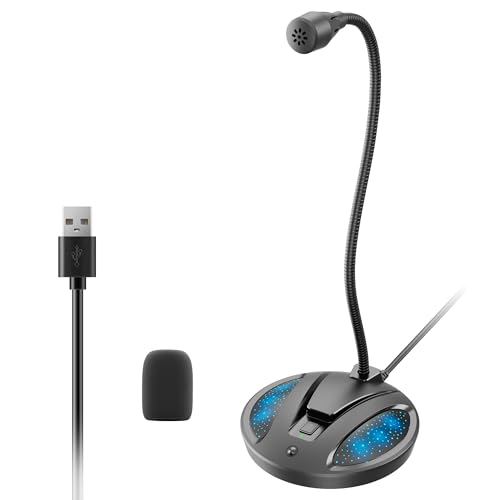
The CMOCIIY USB Gooseneck Desk Microphone is our pick for calls and streaming: its listing details give a 93 dB signal-to-noise ratio against the BOYA CM40's 75 dB, on a 5.7-inch metal gooseneck with a one-tap LED mute. Choose the BOYA CM40 if you want to hear yourself while recording: it has a headphone jack for monitoring, a 0-30 dB gain knob and a 9.7 mm condenser capsule.
Holiday shopping





At a Glance
Related guides we’ve checked
 Best Cajon for Beginners (2026)Top pick: Meinl Percussion Cajon
 Kala vs Cordoba Ukulele: Which Brand Makes Best ConcertTop pick: Cordoba 15CM Concert Ukulele
 Yamaha vs Fender: Which Brand Is Better? (2026)Top pick: Yamaha FG830 Solid Top Folk Guitar
Gift shopping? Holiday Gift Guide 2026: checked picks for everyone on your list.
Desk Microphones Buying Guide
 Photo by Alpha En / Pexels
A desk microphone replaces your laptop's built-in mic for calls, streaming and recording - the upgrade is audible in the first sentence you speak. The four picks here cover USB plug-and-play, a condenser capsule for extra detail, a dual XLR-or-USB design that grows with you, and a wireless lavalier for anyone who moves.
USB vs. XLR vs. Wireless
A USB microphone connects straight to a computer with no extra hardware - the CMOCIIY and BOYA CM40 both work this way, and that simplicity is why USB dominates desk setups. An XLR connection, like the second output on the FIFINE AmpliTank K688, needs a separate audio interface or mixer but opens the door to studio-grade preamps later. A wireless lavalier such as the MAONO Wave T5 clips to a shirt instead of sitting on the desk, trading a little room tone for freedom to stand up and move.
Capsule Type and Pickup Pattern
The BOYA CM40 uses a condenser capsule, which is more sensitive to quiet detail and higher frequencies than the dynamic capsule inside the FIFINE - that sensitivity is why condenser mics sound fuller for voice but also pick up more of a noisy room. A cardioid pickup pattern, like the FIFINE's, focuses on what is directly in front of the capsule and rejects sound from behind it; the CMOCIIY, BOYA and MAONO are listed as omnidirectional and rely on noise reduction instead. Either way, placing the mic a few inches from your mouth matters.

Gooseneck, Mute and Everyday Controls
Both the CMOCIIY and BOYA CM40 mount on a flexible gooseneck (metal on the CMOCIIY, by its listing) so the capsule sits close to your mouth without a separate boom arm, and both include a one-tap mute button for calls. The BOYA adds a gain knob and a headphone jack for real-time monitoring, which the CMOCIIY's listing does not mention - useful if you want to hear exactly what the microphone is capturing while you record.
Picking by Use Case
Buy the CMOCIIY for video calls and casual streaming where simple plug-and-play matters more than capsule quality. Step up to the BOYA CM40 if you record voiceover or podcast audio and want to monitor your own voice while you speak. Choose the FIFINE if you think you will eventually add a mixer or interface, since its XLR output carries over. Pick the MAONO wireless lavalier if you present standing up, cook on camera, or otherwise move while recording.

How we picked: we compared each product's own listing - what it is, what comes in the box, the specifications its maker states and the warranty - and ranked them on how well they answer this page's question. We have not tested these products in hand.
Watch Before You Buy

“CMOCIIY's plug-and-play USB gooseneck mic: no drivers on Windows or Mac, a 5.7-inch metal gooseneck, a one-tap LED mute and noise reduction for keyboard clicks and fan hum.”
See Today’s Price →What we like
- Plug and play on Windows or Mac with no drivers
- 5.7-inch metal gooseneck that turns 360 degrees
- One-tap LED mute button
- Noise reduction for keyboard clicks and fan hum, by its listing
- Weighted base with non-slip silicone pads
Watch out for
- Omnidirectional pickup, so it hears more of the room than a cardioid mic
- One-month warranty, by its listing details
Read Full Analysis
The CMOCIIY is the simplest way off a laptop's built-in mic. It plugs into a USB port on Windows or Mac with no drivers or setup, and its listing names Zoom, Teams, Skype, YouTube and Twitch among the apps it works with. A 5.7-inch metal gooseneck turns 360 degrees so the capsule can sit close to your mouth, and a weighted base with non-slip silicone pads keeps it in place. A one-tap LED button mutes and unmutes during a call, and its breathing lights can be switched off. Its listing gives an omnidirectional pickup pattern with noise reduction that it says filters keyboard clicks, fan hum and background noise. Its listing does not mention a headphone jack or a gain knob, and its listing details give a one-month warranty. Choose the BOYA CM40 instead if you want to hear yourself through headphones while you record.
Skip this if: You want to hear yourself through headphones while recording - the BOYA CM40 has a monitoring jack.

“BOYA's CM40 is a USB-C gooseneck mic with a 9.7 mm condenser capsule, 192kHz/24-bit audio, ENC noise cancellation, a headphone jack for monitoring and a 0-30 dB gain knob.”
See Today’s Price →What we like
- 9.7 mm condenser capsule that handles up to 130 dB SPL
- 192kHz/24-bit audio from a built-in sound card
- 3.5 mm headphone jack for latency-free monitoring
- Stepless 0-30 dB gain knob and one-touch mute
- ENC noise cancellation
- USB-C for Windows, macOS and USB-C phones and tablets
Watch out for
- Omnidirectional pickup, so it hears more of the room than a cardioid mic
Read Full Analysis
The BOYA CM40 is the gooseneck to buy if you want to hear yourself. Its built-in sound card records at 192kHz/24-bit through a 9.7 mm condenser capsule that BOYA says captures fine vocal detail and handles up to 130 dB SPL without distortion. A 3.5 mm headphone jack gives real-time, latency-free monitoring, a stepless knob sets gain from 0 to 30 dB, and a one-touch button mutes it. ENC noise cancellation suppresses background noise, and its listing details give an omnidirectional pattern. It connects by USB-C and works with Windows, macOS and USB-C phones and tablets, while a 360-degree flexible gooseneck and an anti-slip silicone base hold it in place. Its listing details give a 2-year warranty. Choose the CMOCIIY instead if you only join calls and want nothing to adjust.
Skip this if: You want monitoring-free simplicity - the CMOCIIY plugs in with nothing to adjust.

“FIFINE's K688 is a metal dynamic mic with USB and XLR outputs, a cardioid pattern, tap-to-mute, a gain knob and a headphone jack with its own volume control.”
See Today’s Price →What we like
- USB and XLR outputs on one mic
- Dynamic capsule with a cardioid pattern
- Tap-to-mute, gain knob and headphone jack with volume control over USB
- Windscreen and shock mount included
- 8.2 ft USB-C to USB-A cable in the box
Watch out for
- Mute, gain and monitoring controls work only over USB
- No XLR cable, mic stand or boom arm in the box
Read Full Analysis
The FIFINE K688 is the mic that can grow with a setup. Plug its 8.2 ft USB-C to USB-A cable into a Windows or Mac computer and it works with no software; later, its XLR output connects to a sound card or mixer. It is a dynamic mic with a cardioid pattern that FIFINE says deals with background noise such as hard drives and computer fans, and its metal build handles 130 dB SPL. Over USB you get tap-to-mute on the front, a gain knob and a 3.5 mm headphone jack with its own volume control for real-time monitoring; FIFINE notes these controls work only over USB. FIFINE says to record close to it, and the included windscreen tames plosives while the shock mount cuts vibration from the desk. The box holds the mic with its shock mount, the USB cable, a 5/8 to 3/8 inch adapter and a manual; an XLR cable, a mic stand and a boom arm are not included.
Skip this if: You want a mic that stands on the desk out of the box - FIFINE includes no mic stand or boom arm.

“MAONO's Wave T5 is a wireless clip-on lavalier: a 9 g magnetic transmitter recording 48kHz/24-bit, with ENC noise cancellation, four voice presets and up to 40 hours with its charging case.”
See Today’s Price →What we like
- Wireless transmitter weighing 9 g, with a magnetic clip
- 48kHz/24-bit recording with an 80 dB signal-to-noise ratio
- Independent noise-cancellation and mute buttons; 3 ENC modes and 14 levels in the Maono Link app
- Four one-tap voice presets
- Up to 9 hours per transmitter and 40 hours with the charging case
Watch out for
- Transmitters need charging, up to 9 hours per charge
- Omnidirectional pickup, so it hears more of the room than a cardioid mic
Read Full Analysis
The MAONO Wave T5 is the pick for anyone who moves while recording. Instead of standing on the desk, its 9 g transmitter clips to your clothing with a magnet and sends audio to a receiver, and its title lists iPhone, Android, camera and PC. MAONO gives 48kHz/24-bit recording, an 80 dB signal-to-noise ratio and a 120 dB maximum SPL, with a dedicated ENC chip whose three modes and 14 levels are set in the Maono Link app. Four one-tap voice presets - Vocal Enhancer, Brightness, Warmth and Magnetic Radio - shape the sound without editing. Each transmitter runs up to 9 hours and the charging case brings the total to 40 hours; the receiver needs no charging, and its Type-C port charges your phone while you record. MAONO says frequency hopping keeps audio clear up to 300 m in the open and 100 m with the transmitter behind your back. At a fixed desk it is one more thing to charge than a wired USB mic.
Skip this if: You sit still at a fixed desk position - a wired USB mic is simpler and one less battery to charge.
Frequently Asked Questions
Do I need an audio interface for a desk microphone?
What microphone pickup pattern is best for solo podcasting?
What is the difference between a condenser and a dynamic microphone?
Which microphone here is best for calls and streaming?
Can I use a wireless lavalier mic at a desk?
How We Chose These Products
We compared each microphone's own listing - its capsule, pickup pattern, connections, controls and what comes in the box - and ranked them on how well they serve a desk setup. We have not tested these microphones in hand.
We compare each product’s Amazon listing, the manufacturer’s published specifications and Amazon customer ratings, shown with their review counts as Amazon’s data, and rank the products on how well they answer this page’s question. We do not test products in hand and we do not run our own analysis of review text. A publication or expert is named only where we cite its published findings about that product. No manufacturer paid for placement on this page.
A price appears only when Amazon’s API supplied it at a recent daily refresh, with the date and time beside it, and is withdrawn at 4 AM Central on the day after it turns 24 hours old; otherwise use “Check price on Amazon” for the live price. Read our full methodology →