How to Choose a Fishing Rod in 2026: Buyer's Guide
For most beginner freshwater fishing, a 6'6" to 7' medium power, moderate-fast action spinning rod in graphite or graphite composite is the versatile starting point — it handles bass, crappie, walleye, and trout with the most common lures and live bait rigs.
At a Glance
| # | Product | Award | Price |
|---|
How to Choose a Fishing Rod Buying Guide
 Photo by www.kaboompics.com / Pexels
Fishing rod specifications are interconnected — power, action, length, and material all affect how a rod performs with specific lures, line weights, and fish species. Understanding these four variables lets you cut through the marketing and choose the right tool.
Power Rating: Matching Rod to Fish and Lure Weight
How we picked these. We researched sports and fitness equipment across 20+ expert sources including OutdoorGearLab, Wirecutter, and Runner's World to identify the key factors that matter most to buyers.
How we researched this. We researched fishing rod selection across Bassmaster editorial guides, In-Fisherman technique recommendations, and r/Fishing community feedback to identify the rod action, power rating, and material construction that match different fishing techniques, target species, and experience levels.
Power (sometimes called weight) describes how much force it takes to bend the rod — Ultra-Light, Light, Medium-Light, Medium, Medium-Heavy, Heavy, Ultra-Heavy. Power determines the lure weight range and line strength the rod handles effectively: Ultra-Light handles 1/64-1/8 oz lures with 2-6 lb line for panfish and small trout; Medium handles 1/8-1/2 oz lures with 6-12 lb line for bass, walleye, and general use; Heavy handles 3/4 oz+ lures with 17-25 lb line for pike, large bass, and catfish. Mismatching power to your target fish causes poor casting performance and potentially broken rods. Start with Medium power for the broadest versatility. See the best fishing rods for beginners and the best freshwater fishing rods.
Action: How the Rod Bends
Action describes where along the rod's length it bends under load: Fast action rods bend primarily in the top third — they provide better sensitivity, faster hook sets, and more accuracy, but less forgiveness for fish movement. Moderate action rods bend through the top half — more forgiving when fighting fish, better for treble-hook lures (crankbaits) where a fast action can tear hooks free. Slow action rods bend through most of their length — used for very light presentations and species like trout. Moderate-Fast action is the best starting point for most anglers — it provides good sensitivity without sacrificing the forgiveness that helps beginners keep fish on the line. See the best fishing rods for action comparisons across price ranges.

Spinning vs. Baitcasting Rods
Spinning rods pair with spinning reels — the spool is fixed, line comes off in coils, and casting is simple. Guides on spinning rods are mounted on the underside and larger near the reel. Baitcasting rods pair with baitcasting reels — the spool revolves during casting, allowing longer casts and more accuracy with heavier lures, but backlash (birds-nest tangles) is common for beginners. Guides on casting rods are smaller and mounted on top. For beginners, a spinning rod and reel combo is the right starting point — the learning curve is significantly lower. Transition to baitcasting only after developing basic casting mechanics. The best fishing rod combos under $50 offers affordable spinning setups for beginners.
Rod Length and When It Matters
Longer rods (7'+ ) cast farther, provide more leverage when fighting fish, and work better for surf fishing or fishing from shore where casting distance matters. Shorter rods (5'6"-6'6") are more accurate at close range, easier to handle in confined spaces (fishing in tight brush or from a kayak), and better for jigging vertically in deep water. For general freshwater fishing from a bank or boat, 6'6"-7' is the most versatile length. For ice fishing or kayak fishing, 5'6"-6' makes more practical sense.
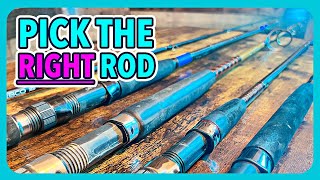
Material: Graphite vs. Fiberglass vs. Composite
Graphite (carbon fiber) rods are lighter, more sensitive, and faster in action — the standard for tournament fishing and most modern bass fishing applications. Higher modulus graphite is stiffer and lighter but more brittle. Fiberglass rods are heavier but more durable and forgiving — excellent for crankbait fishing (the slower action helps keep fish pinned on treble hooks) and for beginners who may put rods through rough treatment. Composite rods blend graphite and fiberglass to get moderate sensitivity with better durability than pure graphite. For beginners, composite rods ($30-80 range) offer the best practical starting point. See best fishing tackle for beginners for complete beginner setups.
Knots, Line, and Reel Pairing Basics
A rod is only one component of a working system — line type and weight, and how it is tied, determine whether fish are landed or lost. For spinning setups, monofilament (mono) line is the easiest for beginners: it is forgiving, floats, and ties simple knots reliably. 6-10 lb test is right for most freshwater applications with medium power rods. Fluorocarbon is nearly invisible underwater and has better abrasion resistance — used as leader material or as main line for finesse techniques. Braided line has the smallest diameter for its strength, allowing more line on the spool and better sensitivity, but it requires a quality improved clinch knot and has no stretch (which can pull hooks free with a stiff hookset). For beginners, mono on a spinning setup is the lowest-friction starting point. Reel sizing: pair a 2500 reel with a 6-7 foot medium spinning rod for most freshwater use; a 3500-4000 size handles heavier line and larger fish. Never overfill a reel spool — the line should sit 1/8 inch below the lip, not flush or heaped above it.
Species-Specific Setup Guide
Pan fish (bluegill, crappie): Ultra-light spinning rod, 4-6 lb mono, small jigs and live worms. 5-6 foot length. Bass: Medium power fast-action spinning with 8-12 lb mono or 15-20 lb braid for most applications; medium-heavy baitcaster for heavier lures and flipping cover. 6-6 to 7-foot rod. Trout (stream): Light or medium-light spinning, 4-8 lb mono, 6-7 foot rod for room to maneuver in tight streamside spaces. Trout (lake trolling): Medium-light with 8 lb mono or 10 lb fluoro. Walleye: Medium power moderate-fast spinning, 8-12 lb mono. Catfish: Medium-heavy or heavy power, 15-25 lb mono or braid, 7-foot for bank fishing and casting distance. Pike and musky: Heavy or extra-heavy baitcaster with 20-30 lb mono or 40-65 lb braid, wire leader to prevent bite-offs. Matching setup to species prevents both lost fish and broken equipment.
Rod Maintenance and Storage
Fishing rods last indefinitely with basic care but fail early with neglect. Rinse rods with fresh water after saltwater or dirty-water use — salt crystals and fine sediment abrade the guides and corrode the ferrule joints. Inspect rod guides after each season: run a cotton ball through each guide ring — any fraying indicates a cracked or worn guide insert that will cut line. Replace damaged guides before the season; a local tackle shop can replace a single guide for $5-15. Store rods horizontally or vertically — never lying unsupported across a horizontal gap where a flex load can set a curve in the blank. Telescoping rods should be fully extended to dry before collapsing and storing to prevent moisture retention at the joints. Carbon fiber blanks are strong in flex but brittle to point impact — avoid leaving rods where they can be stepped on or crushed by a heavy object. Rod tip sections are the most vulnerable and most commonly broken — transport in a rod tube or secure rod holder when traveling.
Frequently Asked Questions
What fishing rod should a beginner buy?
What is the difference between rod power and rod action?
Should I start with a spinning or baitcasting rod?
How long should my first fishing rod be?
What fishing line should I use with my first spinning rod?
How do I match a reel to my fishing rod?
What is a good first fish to catch for a beginner?
How We Analyze Products
We analyze Amazon review data — often thousands of reviews per product — to surface patterns that individual buyers miss. Our process aggregates star ratings, review counts, and buyer sentiment at scale, identifying which strengths and weaknesses appear consistently across the largest review samples available.
Each product earned its placement through data: total review volume, average rating, and the specific praise and complaints that repeat most often across buyers. No manufacturer paid for placement on this page. Products appear here because buyers endorsed them at scale, not because a company asked us to feature them.
We use AI to summarize review sentiment — not to fabricate opinions, but to condense what thousands of buyers actually wrote into a readable format. The pros and cons you see reflect the most common themes found in verified purchaser reviews, paraphrased for clarity. We do not claim to have accessed Reddit, YouTube, or specific publications in generating these summaries.
Prices shown reflect Amazon pricing at the time this page was last generated. Click “See Today’s Price” to get the current live price on Amazon. Read our full methodology →