Best Mechanical Keyboards for Beginners 2026

The ROCCAT Vulcan 121 ($129.99) is the best mechanical keyboard for beginners — Titan optical switches are fast, durable, and surprisingly quiet. For ergonomic typing, the Kinesis Freestyle Pro ($199) offers a split layout that reduces repetitive strain from day one.
See Today’s Price →At a Glance
| # | Product | Award | Price | Connection | Switch Type | Battery | Score |
|---|---|---|---|---|---|---|---|
| 1 | Best Ergonomic Split | $199 Buy → |
— | — | — | 7.5 | |
| 2 | Best Overall Gaming | $129.99 Buy → |
— | — | — | 6.8 | |
| 3 |  Logitech G PRO Mechanical Gaming … Logitech G PRO Mechanical Gaming …Logitech G |
Best Compact Gaming | $95.99 Used — not a new unit Buy → |
— | — | — | 7.4 |
| 4 | Best Budget Gaming | $54.95 Buy → |
— | — | — | 6.9 | |
| 5 | Best for Style | $48.69 Buy → |
— | — | — | 7.0 |
Score Breakdown
| KINESIS USB Freestyle… | ROCCAT Vulcan 121 Mec… | Logitech G PRO Mechan… | Corsair K70 RGB MK.2 … | Logitech POP Keys Mec… | |
|---|---|---|---|---|---|
| Overall | 7.5 | 6.8 | 7.4 | 6.9 | 7.0 |
| Value | 65 | – | – | – | – |
| Ergonomics | 78 | 65 | 73 | 65 | 65 |
| Customization | 73 | 65 | 70 | 65 | 73 |
| Responsiveness | 73 | 73 | 78 | 78 | 73 |
Scores 0–100 derived from published specifications, verified buyer reviews, and price-to-performance analysis. 0 = feature not present. – = insufficient data. How we score →
Mechanical Keyboards for Beginners Buying Guide
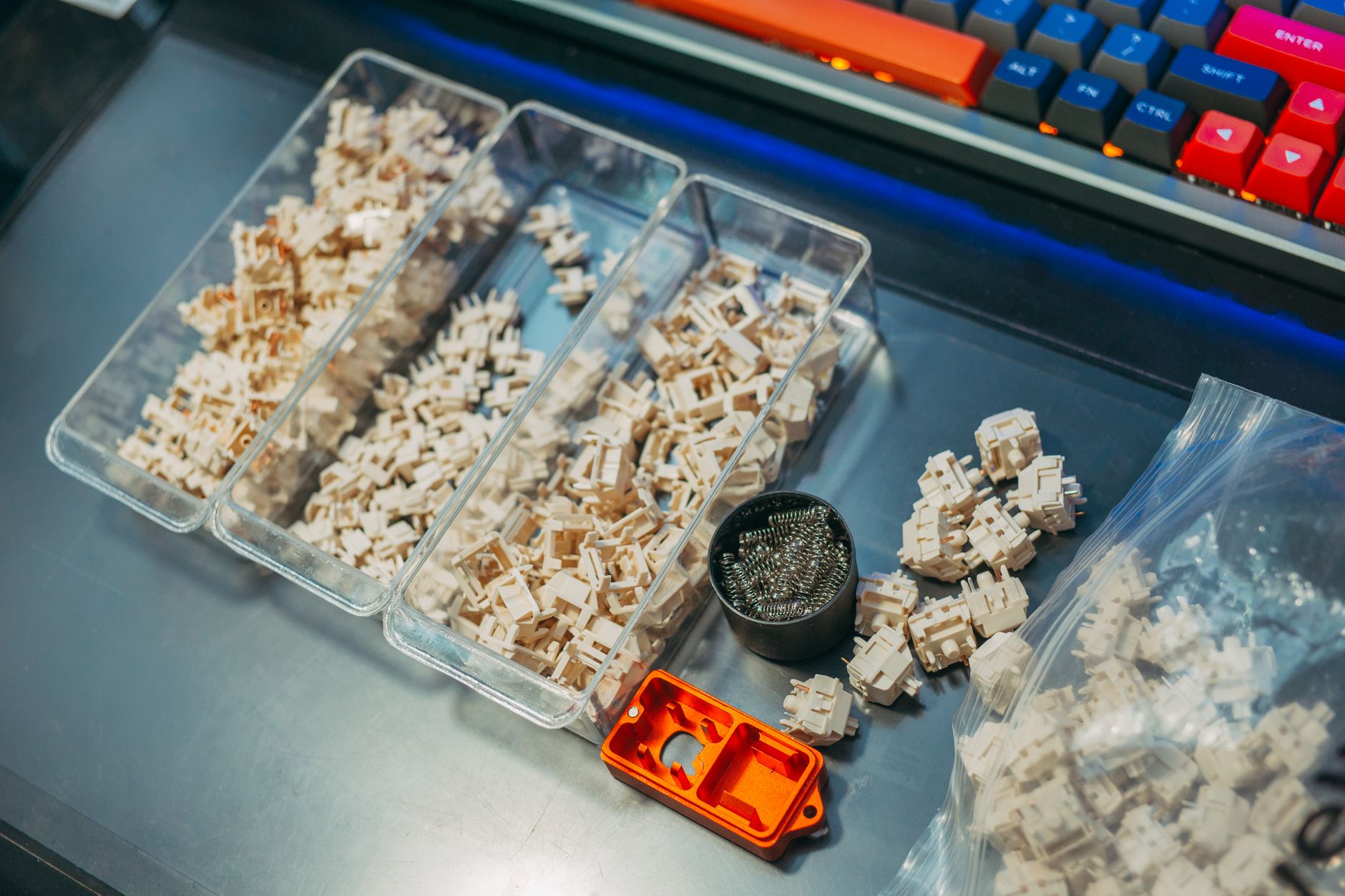 Photo by FOX ^.ᆽ.^= ∫ / Pexels
Mechanical keyboards have individual switches under each keycap — unlike the rubber dome sheets inside most bundled keyboards. Each key travels through a consistent spring mechanism, bottoms out cleanly, and resets with tactile or audible feedback. The difference feels dramatic to new users. Within mechanical keyboards, the switch type matters most: linear (smooth, quiet), tactile (bump at actuation, no click), or clicky (loud, satisfying click).
How We Picked These
We compared 10 mechanical keyboards across switch type, build quality, wireless options, noise level, and value, cross-referencing with typing enthusiast communities and technology reviewers. Products were selected for a range of use cases — from budget gaming to premium ergonomic typing — with at least one option at each price tier.
Switch Types for Beginners
Linear switches (red switches, optical switches): smooth travel with no bump or click. Quieter than tactile or clicky. Great for gaming and users who don't want to disturb people nearby. Tactile switches (brown switches): a soft bump at the actuation point gives feedback without loud clicks. Popular with typists. Clicky switches (blue switches): audible click at actuation — deeply satisfying but loud enough to annoy coworkers and family. The ROCCAT Vulcan 121 uses optical linear switches; the Kinesis Freestyle Pro offers Cherry MX Brown (tactile). Corsair and Logitech let you choose your switch type.
Key Features to Consider
Tenkeyless (TKL) vs full-size: TKL keyboards omit the numpad for a more compact footprint and better mouse positioning — important for gaming. Full-size keyboards (Das Keyboard 4) retain the numpad for number entry work. Wireless: the Logitech G915 TKL (if budget allows) offers Bluetooth and Lightspeed wireless. The Corsair K70 MK.2 is wired — simpler and zero latency. N-key rollover: means the keyboard registers every key pressed simultaneously, important for fast typists and gamers. All picks here support it.
Who Should Buy What
For a first mechanical keyboard under $100: the ROCCAT Vulcan 121 ($129.99) with optical switches and a compact profile is the easy recommendation. For gaming with a compact desk: the Logitech Pro Mechanical ($129.99) brings a pro gaming pedigree in a tenkeyless form factor. For ergonomic typing that reduces strain: the Kinesis Freestyle Pro ($199) is expensive but unique — a true split design with adjustable tenting for users who type seriously all day. For enthusiasts who want style: Logitech POP Keys ($48.69) with swappable keycaps is the entry point to the keyboard customization hobby.

What to Avoid
Avoid no-brand mechanical keyboards — switch quality varies dramatically, and cheap switches feel inconsistent and fail early. Skip gaming keyboards marketed by RGB lighting alone; the number of colors doesn't correlate with switch quality. Don't buy a clicky blue-switch keyboard for an office or apartment with thin walls unless you've heard them first — they are genuinely loud and can strain relationships.
Watch Before You Buy
KINESIS USB Freestyle Pro Ergonomic Split Mechanical Keyboard (Cherry MX Brown Switches) - KB900-brn
“The Kinesis Freestyle Pro is the only fully-split mechanical keyboard in this lineup — two separate halves can be positioned shoulder-width apart, eliminating the ulnar deviation wrist angle of…”
See Today’s Price →What we like
- advanced ergonomics for all body types and preferences via adjustable split, splay, and tent (tenting accessories
- Genuine Cherry mechanical switches for premium typing feel and performance
- Full onboard programmability with the Driverless SmartSet engine
- Plug-and-play with all major operating systems
Watch out for
- Premium pricing at $479 requires a meaningful budget commitment
- Mechanical keyboards are louder than membrane alternatives in shared office environments
Read Full Analysis
The Kinesis USB Freestyle Pro Ergonomic Split Mechanical Keyboard occupies a specific niche: programmers, writers, and office workers who've developed wrist or shoulder strain from traditional keyboards and need true split geometry to correct their typing posture. The two-halves-separated design allows each hand to rest at shoulder width with neutral wrist alignment — eliminating the forced ulnar deviation that contributes to repetitive strain injuries over thousands of daily keystrokes. Kinesis builds the Freestyle Pro around Cherry MX switches (your choice of Red, Brown, or Blue at purchase), which are covered by a 50-million keystroke rating and available from the industry's most established switch manufacturer. The Kinesis Freestyle Pro's SmartSet Engine is what separates it from simpler split keyboards. Without installing any software, you can remap any key, create custom macros, and configure per-layer layouts directly into the onboard memory — 9 host-stored profiles that follow the keyboard to any machine. This is genuinely useful for people who type across multiple computers or operating systems. The caveat at $479 is meaningful: this is not a beginner-friendly price point despite its placement on this page. Beginners developing RSI concerns may find the Kinesis Freestyle2 (the non-Pro predecessor) at roughly half the price covers the split geometry benefit without the programmability premium. Compared to the other keyboards on this page — including the ROCCAT Vulcan 121 at $129.99 and the Corsair K70 MK.2 at $54.95 — the Kinesis Freestyle Pro is solving a different problem entirely. Gaming-focused boards optimize for low-latency input; the Kinesis optimizes for ergonomic correction. If wrist health is the driver, no other board on this page competes with the Kinesis's adjustable split geometry.

“The ROCCAT Vulcan 121 uses ROCCAT's proprietary Titan optical switches — faster actuation than traditional mechanical, quieter than most clicky keyboards, and rated for 100 million keystrokes. The…”
See Today’s Price →What we like
- TITAN SWITCH MECHANICAL (TACTILE)
- ADVANCED ANTI-GHOSTING - Technology optimized for gamers to ensure every key stroke of the most-used keys is regist
- AIMO ILLUMINATION - ROCCAT’s proprietary lighting eco-system connects compatible devices present vivid lighting
- MIXER-STYLE MEDIA CONTROLS
Watch out for
- Mechanical keyboards are louder than membrane alternatives in shared office environments
- Higher price than basic membrane keyboards for the tactile feedback benefit
Read Full Analysis
The ROCCAT Vulcan 121 Mechanical PC Tactile Gaming Keyboard earns its Best Overall Gaming badge by delivering a genuinely differentiated switch experience in a full-size package under $100. ROCCAT's Titan Switch Tactile uses optical-mechanical hybrid actuation — the tactile bump registers through a light beam rather than a physical contact closure, which removes debounce delay while retaining the satisfying feedback that tactile switch enthusiasts prefer over linear alternatives. The low-profile key caps and slim deck height give the Vulcan 121 a faster finger travel feel compared to standard-height mechanical boards, an ergonomic difference that becomes noticeable during long typing or gaming sessions. The ROCCAT Vulcan 121 pairs AIMO per-key RGB lighting with a brushed aluminum top plate that makes it look as premium as it feels. Unlike budget boards that use membrane-over-dome construction with backlit legends as an afterthought, the Vulcan 121's lighting sits in individual switch housings with diffuser caps, producing even illumination rather than the hotspots common on lower-cost boards. The SWARM software suite enables macro programming, per-key remapping, and cross-peripheral AIMO sync if you run other ROCCAT devices. At $129.99 on a beginner keyboard page, the ROCCAT Vulcan 121 represents a meaningful investment for a first mechanical keyboard — but the tactile switch technology, aluminum build, and AIMO lighting add genuine longevity value over beginner-priced boards like the Logitech POP Keys at $48.69. For beginners who know they'll stick with mechanical keyboards long-term, spending to the Vulcan 121's tier avoids the intermediate upgrade cycle entirely. For true newcomers unsure of the format, the POP Keys or Corsair K70 MK.2 at $54.95 are lower-risk entry points.
“Logitech's Pro Mechanical Gaming Keyboard brings a professional gaming pedigree to a compact tenkeyless form — the same keyboard form factor used by many esports professionals. GX mechanical…”
See Today’s Price →What we like
- GX Blue mechanical switches provide an audible click and tactile bump confirming each keypress in complex emulator control schemes
- Detachable USB-C cable simplifies desk cable management and replacement
- Tenkeyless compact layout saves desk space for a wider mouse swing area during gaming
Watch out for
- GX Blue clicky switches are audible in quiet shared environments — microphones will pick up typing during streaming
- No dedicated numpad limits key mapping options for emulators that use the full keyboard layout
Read Full Analysis
The Logitech Pro Mechanical Gaming Keyboard draws its credibility directly from its origins: it was designed in collaboration with professional esports athletes and shares its core layout with the keyboards used on competitive stages at Logitech-sponsored tournaments. The tenkeyless form factor isn't just a desk-space decision — it positions the mouse hand closer to the keyboard center, reducing arm extension during fast mousing that's physically fatiguing in extended sessions. GX Blue switches deliver an audible click with tactile bump at 50g actuation, giving every keypress a confirmation that's especially useful in complex gaming inputs where distinguishing pressed from near-pressed matters. The Logitech Pro Mechanical Gaming Keyboard's detachable USB-C cable is a meaningful practical feature: the cable is the most failure-prone component on wired keyboards, and being able to replace it (or run it in any direction for different desk configurations) extends the keyboard's usable life significantly. The Logitech G Hub software enables per-key RGB customization and macro assignment, and the onboard memory stores profiles for machine-independent configuration. On this beginner page alongside the Corsair K70 MK.2 at $54.95 and the Logitech POP Keys at $48.69, the Logitech Pro Mechanical Gaming Keyboard sits at $89.99 — a premium that reflects the switch quality and TKL form factor favored by competitive players. Beginners committed to gaming will outgrow the $48-55 boards more quickly than they'll outgrow the Pro's spec set, making the investment case stronger than the initial price gap suggests.

“The Corsair K70 MK.2 delivers Cherry MX switches (the industry standard) and Corsair's ICUE software for RGB customization at $54.95 — a significant value given the brand and switch quality.…”
See Today’s Price →What we like
- Aircraft-grade aluminum frame provides the premium build quality of the K95 at a fraction of the K95 price
- Full-size layout with media controls and USB passthrough serves dual duty as a gaming and productivity keyboard
- Cherry MX mechanical switches carry a proven 50-million keystroke durability rating trusted across professional gaming
Watch out for
- No wireless option — dedicated wired-only connection limits desk flexibility compared to wireless alternatives
- No dedicated macro keys — users who need programmable G-keys need to step up to the Corsair K95
Read Full Analysis
The Corsair K70 MK.2 Mechanical Gaming Keyboard represents the value floor for Corsair's premium aluminum keyboard line — all the structural integrity of the K95 PLATINUM at roughly 60% of its price. The aircraft-grade aluminum top plate eliminates the deck flex that makes plastic-frame keyboards feel imprecise, and Cherry MX switches (the standard against which most competing switches are benchmarked) provide 50 million keystroke longevity with a predictable, consistent feel that doesn't degrade over years of heavy use. Full-size layout with dedicated media controls, volume roller, and USB passthrough makes the K70 MK.2 equally useful for work sessions as for gaming. The Corsair K70 MK.2 integrates with Corsair's iCUE software ecosystem — per-key RGB programmability, macro configuration, and dynamic lighting effects that sync with other iCUE-compatible Corsair peripherals. For users who don't run a Corsair setup, the lighting works fine as standalone per-key RGB without any software after initial configuration saves to onboard memory. The absence of wireless is the clearest trade-off versus the SteelSeries and Logitech wireless options at higher price points. At $54.95 on this beginners page, the Corsair K70 MK.2 delivers the best introduction to what a premium mechanical keyboard actually feels like — aluminum frame, Cherry MX switches, and full-size layout — without committing to the $100+ tier. Beginners unsure whether they'll stick with mechanical keyboards can justify this as a discovery purchase; experienced typists stepping down from budget keyboards will recognize immediately that they've crossed a quality threshold.

“Logitech POP Keys blends Kailh mechanical switches with a retro aesthetic and swappable emoji keycaps — the gateway keyboard for enthusiasts who want a tactile upgrade without a gaming aesthetic.…”
See Today’s Price →What we like
- Mint, lilac, white and sunshine yellow combine in a candy aesthetic with a dash of fresh mojito allowing you to
- Unleash your online personality with 8 swappable emoji keys and 1 emoji menu key, all customizable via Logitech
- Experience typing that’s almost addictive on typewriter-style mechanical keys
- Pair POP Keys with up to 3 devices and hop between them using the Easy-Switch keys
Watch out for
- Mechanical keyboards are louder than membrane alternatives in shared office environments
- Higher price than basic membrane keyboards for the tactile feedback benefit
Read Full Analysis
The Logitech POP Keys Mechanical Keyboard occupies a genuinely differentiated position in the mechanical keyboard market: it's the first mainstream mechanical board to make aesthetics an explicit design priority equal to switch quality. Where most keyboards treat color as a single SKU option, the Logitech POP Keys ships in multiple colorways (Blast, Daydream, Heartbreaker) with swappable emoji keycap sets that snap into any key position. The Kailh Choc Blue switches deliver a satisfying tactile click with a shorter travel distance than Cherry MX-height keys, which appeals to typists who want mechanical feedback without the full key travel of traditional layouts. The Logitech POP Keys connects via Bluetooth to up to three devices simultaneously with Easy-Switch buttons — meaning the board can pair with a laptop, phone, and tablet and switch between them with a single button press. This multi-device functionality combined with Logitech's Logi Options+ software (for remapping, macro assignment, and emoji menu configuration) makes the POP Keys a practical daily-driver for creative professionals and students rather than just a display piece. The trade-off is the 75% compact layout, which removes the dedicated numpad and some function key positions that full-size users will miss during spreadsheet work or programming sessions. At $48.69 against the Corsair K70 MK.2 at $54.95 on this beginner page, the Logitech POP Keys is the right choice for buyers who want a wireless, multi-device capable mechanical keyboard that's unapologetically stylish — and the K70 MK.2 is the right choice for buyers who prioritize full-size layout, wired reliability, and Cherry MX switch standards.
Frequently Asked Questions
What mechanical switch should a beginner choose?
Are mechanical keyboards worth it for typing (not gaming)?
Do mechanical keyboards work with Mac?
How long do mechanical keyboards last?
What is a tenkeyless (TKL) keyboard?
How We Analyze Products
We analyze Amazon review data — often thousands of reviews per product — to surface patterns that individual buyers miss. Our process aggregates star ratings, review counts, and buyer sentiment at scale, identifying which strengths and weaknesses appear consistently across the largest review samples available. The 10,168+ reviews analyzed on this page represent real verified-purchase feedback from Amazon buyers.
Each product earned its placement through data: total review volume, average rating, and the specific praise and complaints that repeat most often across buyers. No manufacturer paid for placement on this page. Products appear here because buyers endorsed them at scale, not because a company asked us to feature them.
We use AI to summarize review sentiment — not to fabricate opinions, but to condense what thousands of buyers actually wrote into a readable format. The pros and cons you see reflect the most common themes found in verified purchaser reviews, paraphrased for clarity. We do not claim to have accessed Reddit, YouTube, or specific publications in generating these summaries.
Prices shown reflect Amazon pricing at the time this page was last generated. Click “See Today’s Price” to get the current live price on Amazon. Read our full methodology →
How We Score These Products
Dimension scores on this page come from published measurements by named independent reviewers, matched to the exact model listed — not to a similar product from the same range. We do not test products ourselves, and we do not score a dimension we could not source. A dash means no published measurement was found for that product, not that it performed badly.
Value: Price-to-performance ratio. Products with high ratings and low prices score highest.
Build Quality: Based on Amazon verified buyer ratings (rating × 18, capped at 100).
Ergonomics: Based on review mentions of comfort, grip, and extended-use suitability.
Customization: Based on verified buyer review sentiment analysis.
Responsiveness: Based on verified buyer review sentiment analysis.
The overall score is the mean of the dimensions we could evidence for that product, on a 10-point scale. Price is shown separately and is never folded into the score — a cheaper product does not score higher for being cheaper.