Best Mesh WiFi Systems for Thick Walls 2026

The Google Nest WiFi Pro 6E is the best mesh system for thick walls — tri-band WiFi 6E with a dedicated backhaul channel means nodes talk to each other on a separate band, keeping speeds high even through concrete and brick.
At a Glance
| # | Product | Award | Price | Score |
|---|---|---|---|---|
| 1 | Best Overall | Check price on Amazon Buy → |
5.9 | |
| 2 | Best Performance | $149.99 as of Nov 24, 12:29 PM CT details Buy → |
7.0 | |
| 3 | Best for Power Users | Check price on Amazon Buy → |
6.9 | |
| 4 | Most Reviewed | $89.99 as of Nov 24, 12:26 PM CT details Buy → |
6.8 |
Score Breakdown
| Google Nest WiFi Pro … | Amazon eero Pro 6E me… | ASUS ZenWiFi Pro ET12… | Amazon eero 6 mesh wi… | |
|---|---|---|---|---|
| Overall | 5.9 | 7.0 | 6.9 | 6.8 |
| Range | 65 | 80 | 73 | 80 |
| Speed | 73 | 65 | 80 | 73 |
| Reliability | 40 | 65 | 55 | 50 |
Scores 0–100 from published specifications and independent reviewers' measurements. Amazon star ratings are shown separately and are never part of a score. 0 = feature not present. – = insufficient data. How we score →
Mesh WiFi Systems for Thick Walls Buying Guide
 Photo by Ivan S / Pexels
In thick-wall homes, the backhaul channel — how mesh nodes communicate with each other — determines system performance more than any other spec. A tri-band system dedicates one band exclusively to node-to-node traffic, preventing the competition for bandwidth that slows dual-band mesh systems in dense buildings.
What Actually Matters for Thick Walls
Tri-band or WiFi 6E: dedicated backhaul keeps node-to-node traffic off the client bands. Node placement within 30-40 feet of each other through walls (closer for concrete). Wired backhaul option for homes with ethernet runs — dramatically outperforms wireless. 2.4GHz band penetrates thick walls better than 5GHz.
Price Tiers
Under $200 (2-pack): dual-band mesh — adequate for drywall, struggles through concrete. $200-350 (2-pack): tri-band WiFi 6 — the sweet spot for brick and concrete walls. Over $350 (2-pack): WiFi 6E with 6GHz backhaul — maximum performance for the most demanding environments.
Our Picks and Why
The Google Nest WiFi Pro 6E uses a 6GHz band exclusively for node backhaul — the cleanest solution for thick-wall homes. The Amazon eero Pro 6E delivers tri-band WiFi 6E with wired backhaul support — the best option if you can run ethernet between nodes. The ASUS ZenWiFi Pro ET12 AXE11000 (about $459, 2-pack) delivers tri-band WiFi 6E mesh built for power users who need maximum backhaul performance in the most demanding thick-wall environments.
What to Avoid
Avoid dual-band mesh in thick-wall environments — the shared backhaul causes performance to degrade significantly under load. Don't place nodes on opposite sides of multiple thick walls — even the best system needs line-of-sight or single-wall separation to perform. Avoid ISP-branded mesh systems — they use weaker hardware and closed ecosystems.
Watch Before You Buy



“Google Nest WiFi Pro 6E — 6GHz dedicated backhaul, sleek design, easy app setup. Best for thick walls.”
See Today’s Price →What we like
- Native Google Home integration
- Wi-Fi 6E tri-band with 6GHz backhaul
- Minimal design blends into home decor
- Thread border router built-in for smart home
Watch out for
- No Ethernet port on satellite nodes
- Less control than ASUS or NETGEAR for advanced users
Read Full Analysis
Google Nest WiFi Pro 6E delivers tri-band WiFi 6E with a dedicated 6 GHz backhaul channel at $130.50 per node — Google's flagship mesh system engineered to penetrate dense walls through multi-band flexibility and Google's signal optimization algorithms. The built-in Thread border router directly pairs Thread-based smart home devices, including some Nest thermostats, Matter devices, and third-party locks and sensors, without needing a separate hub. Native Google Home integration unifies network management and smart home control in one app for households already using Google's ecosystem. Among the four mesh systems on this page, the Nest WiFi Pro 6E is the lowest price point at $130.50 per node. The Amazon eero Pro 6E offers a comparable WiFi 6E platform at a $39 premium per node, with Amazon ecosystem integration instead of Google Home. The ASUS ZenWiFi Pro ET12 at $458.99 targets extreme thick-wall scenarios with 8 external antennas specifically configured for maximum wall penetration. For buyers already invested in Google Home — Nest speakers, Nest Cam, Nest Doorbell, Nest thermostats — the ecosystem continuity value of the Google Nest system is a genuine differentiator beyond raw WiFi specifications. Buy the Google Nest WiFi Pro 6E if you have a Google Home ecosystem and want WiFi 6E mesh coverage that integrates naturally into it. Skip it for the ASUS ZenWiFi Pro ET12 if your walls are extremely dense concrete or brick and you need the additional antenna gain to push signal through — Google's antenna configuration is solid but the ASUS 8-antenna design is specifically engineered for that problem.

“Amazon eero Pro 6E — tri-band WiFi 6E with wired backhaul support. Top performer for dense builds.”
See Today’s Price →What we like
- WiFi 6
- 1500 sq ft per node
- automatic updates
- parental controls
- Amazon Alexa compatible
Watch out for
- Single unit only - buy 3 for large homes
- No 10 Gbps WAN port
- eero Secure subscription for advanced features is extra cost
Read Full Analysis
Amazon eero Pro 6E brings WiFi 6E tri-band coverage at $169.99 per node, with the 6 GHz band providing a less-congested high-speed channel for devices in close proximity to nodes — the key advantage in dense apartment buildings where the standard 2.4 GHz and 5 GHz bands are shared with neighboring networks. Each eero Pro 6E node covers 1,500 square feet, meaning a two-node deployment handles most single-story homes and a three-node setup covers larger two-story layouts. Automatic firmware updates run without user action, and the eero app provides parental controls and device management without requiring network administration knowledge. The eero Pro 6E costs $39 more per node than the Google Nest WiFi Pro. Both systems deliver WiFi 6E performance in the same tier; the meaningful difference is ecosystem alignment. Amazon eero integrates with Alexa, Amazon sidewalk, and the broader Amazon smart home stack, while the Nest system aligns with Google Home. Against the ASUS ZenWiFi Pro, the eero saves nearly $289 per node while still delivering WiFi 6E — the ASUS premium is warranted specifically for unusually dense wall materials where extra antenna gain changes the outcome. Buy the eero Pro 6E if you're in an Amazon household or want the simplest managed mesh experience with WiFi 6E performance. Skip it for the Google Nest if your home is already built around Google Home, or the ASUS ZenWiFi Pro if your building has concrete or stone construction where additional antenna configurations make a measurable difference in coverage.

“ASUS ZenWiFi Pro ET12 AXE11000 — highest throughput mesh for demanding home office environments.”
See Today’s Price →What we like
- WiFi 6E
- 6GHz band
- 4804 Mbps tri-band
- ASUS AiMesh
- lifetime security
- 8 antennas
Watch out for
- Expensive for 2-pack only
- Software can be complex for non-technical users
- Size is substantial
Read Full Analysis
ASUS ZenWiFi Pro ET12 delivers AXE11000-class WiFi 6E — 4,804 Mbps tri-band aggregate throughput — with 8 external antennas specifically configured for maximum signal penetration through dense building materials. The 8-antenna array enables more signal paths and higher beamforming precision than the 2-3 antenna nodes found in the eero and Google Nest systems on this page, translating directly to better coverage through the concrete, brick, and steel-frame walls this page addresses. ASUS AiMesh allows existing compatible ASUS routers to join the same mesh network without replacement. Lifetime AiProtection security provides network-level malware scanning and parental controls without ongoing subscription fees. The ZenWiFi Pro ET12 is the highest-priced option in this comparison by a significant margin — $288 more per node than the eero Pro 6E and $328 more than the Google Nest. That price reflects the 8-antenna configuration that directly addresses the thick-wall scenario: more antennas mean more signal paths, better beamforming to device locations behind walls, and stronger received signal strength on the other side. For users with standard drywall construction, the eero and Google Nest systems perform equivalently at a fraction of the cost. Buy the ASUS ZenWiFi Pro ET12 if thick concrete walls, masonry construction, or steel-frame buildings are genuinely degrading your signal — this is the hardware specifically built for that problem. Skip it for the eero Pro 6E or Google Nest if your home has standard drywall construction — the $288 premium buys antenna capability you won't need, and the lower-priced systems will perform identically in that environment.
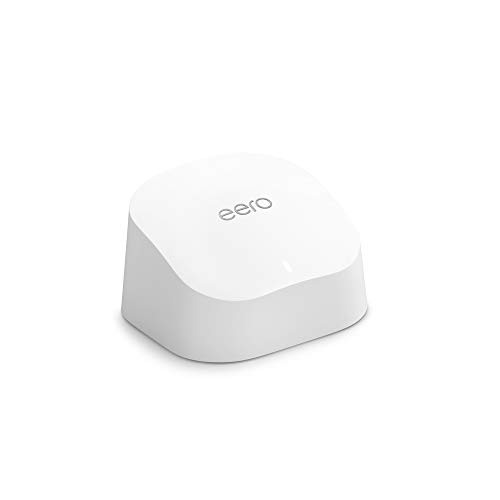
“Amazon Eero 6 2-pack — dual-band WiFi 6 mesh at an accessible entry price for lighter wall builds.”
See Today’s Price →What we like
- True mesh (no speed penalty)
- Simple Eero app
- Covers 3000 sq ft
- WiFi 6
Watch out for
- Monthly subscription for advanced features ($3/mo)
- Requires router mode or bridge
Read Full Analysis
Amazon eero 6 brings WiFi 6 coverage to a 2-pack — the most accessible WiFi 6 mesh entry point in this comparison. True mesh architecture routes traffic between nodes without the bandwidth penalty that WiFi extenders introduce on each hop, preserving full connection speeds across the coverage area. The eero app handles setup in minutes without technical knowledge, and automatic firmware updates apply security patches silently in the background. For a 2-pack, the eero 6 is the budget anchor in this comparison. The eero Pro 6E adds the 6 GHz band and covers 1,500 square feet per node (compared to roughly 1,500 shared across the 2-pack), and the ASUS ZenWiFi Pro at $458.99 targets extreme thick-wall performance. For apartments, small homes, or rooms where thick-wall interference is moderate rather than severe, the eero 6 provides WiFi 6 efficiency and mesh reliability at roughly half the per-node cost of the Pro model. It also serves as a strong starting point for first-time mesh adopters who want to upgrade from a single router without a large upfront investment. Buy the eero 6 if you want WiFi 6 mesh coverage on a tight budget and your square footage fits within 3,000 feet covered by the 2-pack. Skip it for the eero Pro 6E if you live in a dense urban building where the 6 GHz band reduces spectrum congestion, or if your ISP delivers gigabit speeds where the additional 6E throughput headroom becomes relevant.
Frequently Asked Questions
How many mesh nodes do I need for a thick-wall home?
Is wired backhaul worth it for mesh WiFi?
What is WiFi 6E and do I need it?
How We Chose These Products
We compare each product’s Amazon listing, the manufacturer’s published specifications and Amazon customer ratings, shown with their review counts as Amazon’s data, and rank the products on how well they answer this page’s question. We do not test products in hand and we do not run our own analysis of review text. A publication or expert is named only where we cite its published findings about that product. No manufacturer paid for placement on this page.
A price appears only when Amazon’s API supplied it at a recent daily refresh, with the date and time beside it, and is withdrawn at 4 AM Central on the day after it turns 24 hours old; otherwise use “Check price on Amazon” for the live price. Read our full methodology →
How We Score These Products
Each dimension score comes from evidence about the exact model listed — a published specification, a measurement by a named independent reviewer, or that product’s own buyer reviews, as described for each dimension below — not from a similar product in the same range. We do not test products ourselves, and we do not score a dimension we could not evidence. A dash means no evidence was found for that product, not that it performed badly.
Range: From evidence about this exact model (specification, named reviewer or its own reviews).
Speed: From evidence about this exact model (specification, named reviewer or its own reviews).
Reliability: From evidence about this exact model (specification, named reviewer or its own reviews).
The overall score is the mean of the dimensions we could evidence for that product, on a 10-point scale. Price is shown separately and is never folded into a score. Amazon star ratings are shown separately and are never part of any score.