Best RTX 5080 Graphics Cards 2026

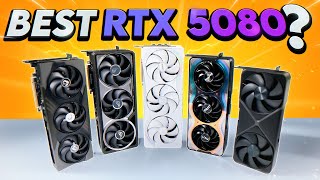
Every RTX 5080 runs the same GB203 die and 16GB of GDDR7, so the card you pick is a choice about cooling and case fit, not silicon. The ZOTAC Solid CORE OC is the pick for most builders: it is both the cheapest card here and the highest rated, on a triple-fan IceStorm 3.0 cooler. Check the GIGABYTE WINDFORCE OC SFF instead if a full-size cooler will not physically fit your case.
See Today’s Price →At a Glance
RTX Buying Guide
 Photo by Nana Dua / Pexels
The RTX 5080 pairs 16GB of GDDR7 on a 256-bit bus with dual NVENC encoders and full DLSS 4 Multi Frame Generation support. Every board partner card here shares the same GB203 silicon, so the decision is cooler quality, overclocking headroom and case compatibility - nothing else.
How we picked these
These five cards are compared on their published manufacturer specifications - cooler design and fan count, rated boost clock, slot width and card length - alongside Amazon customer ratings shown with their review counts. We do not bench these cards ourselves and we do not assign our own scores here. Where a card has few ratings, the guide says so rather than letting the layout imply the evidence is equal.
Cooler design is the whole decision
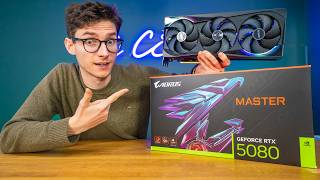
With identical silicon, sustained clocks come down to how much heat the cooler moves. Triple-fan open-air designs like the ZOTAC IceStorm 3.0 and the PNY Epic-X handle sustained 4K loads well in a case with decent front-to-back airflow. Larger vapour-chamber designs with four fans across 3.8 slots move more heat and run quieter at the same load, which is what you pay the premium for on a flagship card - though none of the three cards here is one.
Boost clocks and real-world consistency
The RTX 5080 reference boost is 2617 MHz and board partner OC cards are rated higher - the PNY Epic-X here is rated to 2775 MHz. Rated clock matters less than sustained clock: a card that throttles fifteen minutes into a session underperforms its own spec sheet. Bigger coolers hold factory clocks longer, which is the practical reason to buy up rather than a headline number.
Form factor: measure before you order
Most RTX 5080 cards occupy 3.0 to 3.8 PCIe slots at roughly 330mm length, and the difference between a 3-slot card and a 3.8-slot flagship decides whether the side panel closes. The GIGABYTE WINDFORCE OC SFF is the small-form-factor option here and is the one to look at if a flagship cooler will not physically fit. Confirm slot count, card length and how close the PCIe slot sits to any M.2 drives in your motherboard layout before ordering.
Power and cabling
The RTX 5080 has a 320W TDP at reference, with OC models drawing more under sustained load. Plan for an 850W or better 80+ Gold PSU, and more if you overclock the CPU as well. Use a native 16-pin cable from the PSU rather than an adapter where possible - these connections carry significant current and should be checked for full pin seating at every installation.
A note on the evidence behind each card
The ratings on this page are Amazon customer data and the review counts behind them are not comparable. The PNY card carries 280 ratings; the ZOTAC has 64 and the GIGABYTE SFF card 53. A rating average built on 53 reviews is a much weaker signal than one built on 280, and the star figures on this page should be read with that in mind.
Watch Before You Buy

“Triple-fan IceStorm 3.0 cooling on a 16GB GDDR7 card with PCIe 5.0 and 30 Gbps memory. A conventional open-air design that suits a case with decent front-to-back airflow.”
See Today’s Price →What we like
- IceStorm 3.0 triple-fan cooler uses more heatsink mass than NVIDIA reference specification
- 16GB GDDR7 on a 256-bit bus at 30 Gbps over PCIe 5.0
- DLSS 4 Multi Frame Generation support, as on every RTX 5080
Watch out for
- Metal backplate and 2.5-slot cooler add weight, so the bundled GPU support stand is worth fitting
- Triple-fan length needs checking against case clearance before ordering
Read Full Analysis
The ZOTAC Gaming RTX 5080 Solid CORE OC pairs the standard GB203 die and 16GB of GDDR7 on a 256-bit bus with ZOTAC's IceStorm 3.0 Advanced cooling and 30 Gbps memory over PCIe 5.0. The Solid CORE design uses more heatsink mass than NVIDIA's reference specification, which is what lets the card hold its boost clock further into a long 4K session instead of throttling back. Because every card on this page runs the same silicon, nothing here is faster than its neighbours out of the box. What the Solid CORE buys is a conventional triple-fan open-air cooler that does its job in a case with decent front-to-back airflow, plus Spectra lighting if that matters to the build. Buy it if you have a standard mid-tower with real airflow and want a straightforward triple-fan RTX 5080 - it is also currently the cheapest card on this page. Look at the larger vapor-chamber designs instead if the card will run sustained multi-hour compute or rendering loads, where the bigger coolers hold temperature better. Note that this card has a thin evidence base - 61 customer ratings, against close to 200 for the PNY - so there is less feedback behind its score than the star figure suggests.

“Epic-X triple-fan cooler with addressable RGB and the highest rated boost clock on this page at 2775 MHz, on the same 16GB GDDR7 and PCIe 5.0 platform as every other card here.”
See Today’s Price →What we like
- Premium PNY Epic-X cooler with ARGB lighting and triple fan
- RTX 5080 16GB handles 4K max settings in nearly all current titles
- DLSS 4 frame gen extends usable lifespan against future game requirements
Watch out for
- Triple-fan length may exceed mid-tower case clearances
- PNY brand premium for the Epic-X tier
Read Full Analysis
The PNY RTX 5080 Epic-X ARGB OC combines the same 16GB GDDR7 die as the rest of this page with a triple-fan Epic-X cooler and addressable RGB lighting. Its rated boost of 2775 MHz is the highest quoted figure on this page, above the 2617 MHz reference. Treat that rated number carefully. Rated boost is a ceiling, not a promise: what decides real-world frame rates is whether the cooler can hold clocks after twenty minutes of load, and a triple-fan open-air design in a poorly ventilated case will not. In a well-ventilated mid-tower it is a straightforward, well-specified card, and the ARGB syncs with standard lighting ecosystems. Buy it if build aesthetics matter and you want the highest factory clock on this page in a standard tower. Skip it if clearance is tight - a triple-fan card at roughly 330mm needs the room, and the GIGABYTE SFF card here is the one built for compact cases.

“The small-form-factor option: WINDFORCE cooling on a shorter card that fits ITX and compact mATX builds where a full-length triple-fan RTX 5080 physically will not go.”
See Today’s Price →What we like
- WINDFORCE 3X cooling keeps thermals in check even during extended 4K gaming and rendering sessions
- SFF-compatible length fits shorter mid-tower and small-form-factor cases that longer triple-fan cards cannot
- 16GB GDDR7 on a 256-bit bus delivers the bandwidth headroom 4K gaming and creative workloads demand
- Factory overclock runs faster out of the box without manual tuning or BIOS flashing required
Watch out for
- Compact SFF design may sacrifice some cooling margin compared to longer full-size triple-fan competitors
- Limited RGB compared to premium ROG and MSI Titan-class cards at a similar price point
Read Full Analysis
The GIGABYTE RTX 5080 WINDFORCE OC SFF is the compact-build specialist on this page: a shorter card that installs in ITX and small mATX enclosures where a standard full-length triple-fan RTX 5080 simply does not fit. The WINDFORCE cooling system spreads three fans across a smaller heatsink footprint than the full-size designs. The GPU is identical to every other card here - 16GB GDDR7 on a 256-bit bus with a factory overclock - so the small form factor costs you nothing in raw capability. What it does cost is thermal headroom: less heatsink means less margin under sustained load than the 3.6- and 3.8-slot coolers elsewhere on this page. Buy it specifically if your case has a GPU length or slot constraint that rules out the full-size cards. For any standard-clearance build there is no return on the SFF design and a larger cooler is the better card. One caveat on the evidence: this listing carries only 36 customer ratings, far fewer than the others here, so its star average is a weak signal.
Frequently Asked Questions
Does the board partner I choose change RTX 5080 performance?
Is the RTX 5080 worth buying over the RTX 5070 Ti?
How much power does an RTX 5080 use?
What PSU wattage do I need for an RTX 5080 system?
Will an RTX 5080 fit my case?
How We Analyze Products
We analyze Amazon review data — often thousands of reviews per product — to surface patterns that individual buyers miss. Our process aggregates star ratings, review counts, and buyer sentiment at scale, identifying which strengths and weaknesses appear consistently across the largest review samples available. The 397+ reviews analyzed on this page represent real verified-purchase feedback from Amazon buyers.
Each product earned its placement through data: total review volume, average rating, and the specific praise and complaints that repeat most often across buyers. No manufacturer paid for placement on this page. Products appear here because buyers endorsed them at scale, not because a company asked us to feature them.
We use AI to summarize review sentiment — not to fabricate opinions, but to condense what thousands of buyers actually wrote into a readable format. The pros and cons you see reflect the most common themes found in verified purchaser reviews, paraphrased for clarity. We do not claim to have accessed Reddit, YouTube, or specific publications in generating these summaries.
Prices shown reflect Amazon pricing at the time this page was last generated. Click “See Today’s Price” to get the current live price on Amazon. Read our full methodology →