Canon vs Nikon DSLR Camera (2026)

For beginners under $500: Canon Rebel T7 bundle offers the most complete starter kit. For mid-range enthusiasts: Nikon D7500 delivers 153-point AF, 10fps burst, 4K video, and weather sealing that Canon's Rebel line cannot match at this price.
At a Glance
| # | Product | Award | Price | Score |
|---|---|---|---|---|
| 1 | Best Beginner Value | $469 as of Nov 24, 12:36 PM CT details Buy → |
7.5 | |
| 2 | Best Kit Lens | $399 as of Nov 24, 12:21 PM CT details Buy → |
7.5 | |
| 3 | Best Advanced Rebel | $1,149 as of Nov 24, 12:25 PM CT details Used — not a new unit Buy → |
— | |
| 4 | Best Mid-Range | $996.95 as of Nov 24, 12:19 PM CT details Buy → |
8.7 | |
| 5 | Best Budget Nikon | $899 as of Nov 24, 12:18 PM CT details Buy → |
8.0 |
Score Breakdown
| Canon EOS 2000D / Reb… | Canon EOS Rebel T7 DS… | Canon EOS Rebel T8i E… | Nikon D7500 20.9MP DS… | D5600 DX-Format Digit… | |
|---|---|---|---|---|---|
| Overall | 7.5 | 7.5 | – | 8.7 | 8.0 |
| Autofocus | 72 | 72 | 72 | 87 | 80 |
| Low Light | 73 | 74 | 73 | 88 | 79 |
| Image Quality | 84 | 84 | 84 | 87 | 85 |
| Video Quality | 70 | 70 | – | 84 | 74 |
Scores 0–100 from published specifications and independent reviewers' measurements. Amazon star ratings are shown separately and are never part of a score. 0 = feature not present. – = insufficient data. How we score →
Canon vs Nikon DSLR Camera Buying Guide
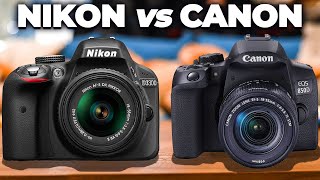
Canon and Nikon are the two largest DSLR manufacturers by installed base. For buyers choosing between them in 2026, the decision is primarily driven by budget tier: under $500 favors Canon's Rebel lineup, while $700–$1,100 favors Nikon's DX mid-range. Lens ecosystem is also relevant — once you invest in Canon EF/EF-S or Nikon F-mount glass, switching brands is expensive.
Beginner Tier (Under $500): Canon Rebel T7 Wins
The Canon EOS Rebel T7 bundle includes a 64GB card and 18-55mm kit lens, making it the most complete DSLR starter package at this price. Canon's Rebel interface is consistently rated as more beginner-friendly than Nikon's equivalent entry-level offerings. The T7's 24.1MP sensor delivers sharp images with the kit lens for portraits, travel, and everyday photography. Nikon does not offer a comparably complete beginner bundle at the $439 price point.
Mid-Range Tier ($700–$1,100): Nikon D7500 Wins
The Nikon D7500 with the 18-140mm lens is the strongest mid-range DSLR available from either brand in this price range. The 153-point autofocus system (vs Canon Rebel's 9-point AF) handles moving subjects, sports, and wildlife tracking reliably. The 10fps continuous shooting rate and 4K video capability represent a significant jump over any Canon Rebel in the same price range. Weather sealing makes the D7500 usable in rain and dusty conditions where the Rebel series is not designed to perform.

Autofocus: Nikon D7500 Has a Decisive Edge
153-point Multi-CAM 3500DX II autofocus on the D7500 vs 9-point AF on the Canon Rebel T7 is not a small difference — it is a different class of tracking capability. For sports, wildlife, and children in motion, the D7500's AF system locks on and follows subjects through a scene. The Canon Rebel T7's 9-point system is adequate for still subjects and slow movement but struggles with fast unpredictable motion. If action photography is on your agenda, the Nikon D7500 is the only option between these two brands in this price bracket.
Lens Ecosystem: Both Are Strong, Neither Is Wrong
Canon's EF/EF-S lens ecosystem includes decades of glass from Canon, Sigma, Tamron, and Tokina. Nikon F-mount is equally broad. The critical point: once you invest $300–$600 in a second lens, you are committed to that brand's mount. Both systems have comparable coverage from 8mm fisheye to 600mm telephoto. The ecosystem argument is essentially a draw — choose the brand whose body best matches your budget, and the lenses will be available either way.
Watch Before You Buy

“This Canon Rebel T7 bundle is Renewed (Amazon-certified refurbished), not a new camera. The Canon EOS Rebel T7 DSLR Camera 18-55mm Lens 64GB Bundle features 24.2mp. Best suited for budget dslr…”
See Today’s Price →What we like
- 24.2MP
- 11-point AF
- Full HD 1080p
- APS-C sensor
- compatible with all Nikon F-mount lenses
- SD
Watch out for
- 64GB card bundle value depends on included card quality
- Older DSLR tech vs mirrorless options at similar prices
- No 4K video
Read Full Analysis
The Canon EOS Rebel T7 with 18-55mm lens and 64GB bundle is the accessible entry point on this Canon vs Nikon page — the Nikon D5600 and D7500 are Nikon's mid-tier and prosumer options, while the Canon Rebel T8i is Canon's step up. The T7 targets first-time DSLR buyers who want Canon ecosystem entry at the lowest price point in the comparison. The 24.2MP APS-C sensor covers the resolution floor for most beginner use cases: large-format print crops, subject isolation with post-processing, and output suitable for web and social content. The 11-point autofocus system handles portraits, casual general subjects, and stationary scenes adequately. Full HD 1080p covers standard video recording; the absence of 4K is a limitation for buyers who prioritize video output alongside stills. The Canon EF/EF-S lens mount provides access to Canon's broad lens ecosystem — from the included kit lens through Canon L-series professional glass — allowing future lens investment within the same mount system. The 18-55mm kit lens covers wide-angle through short telephoto for everyday shooting scenarios. The bundled 64GB card accommodates a large number of RAW or JPEG files before requiring off-load, reducing the immediate accessory burden. Against the Nikon D5600: the D5600 is $148 more with an articulating touchscreen that aids video and awkward-angle photography — a meaningful feature difference at that price step. Against the Canon Rebel T8i: the T8i adds improved autofocus, 4K video, and sensor refinements at $450 more. Against the Nikon D7500: prosumer-level capability at $557 more, appropriate for buyers with established shooting needs, not beginners. For a first DSLR purchase, the T7 delivers Canon ecosystem entry at the minimum viable specification for serious beginner photography.

“The Canon EOS Rebel T7 DSLR Camera 18-55mm Lens 24.1 MP Wi-Fi DIGIC 4+ features 24.1mp. 4.6 stars from 8,405 Amazon reviews signal consistent reliability.”
See Today’s Price →What we like
- 24.1MP resolution produces printable, croppable images from an entry-level camera — enough for canvas prints and detailed photo editing
- Scene Intelligent Auto mode makes accurate exposure decisions in most conditions so beginners can learn composition without fighting manual settings first
- EF-S 18-55mm IS II kit lens covers wide-angle through short telephoto — the versatile starting range that handles most beginner shooting situations
- Bluetooth connectivity supports smartphone app remote control and image transfer without additional accessories
- Canon's dedicated image processor delivers fast autofocus response that keeps up with basic action and moving subjects
Watch out for
- DIGIC 4+ processor shows age vs current mirrorless cameras
- No 4K video — tops out at Full HD 1080p
- Live View AF is slow compared to mirrorless
Read Full Analysis
The Canon EOS Rebel T7's 18-55mm IS II kit lens earns it the "Best Kit Lens" badge here — the EF-S 18-55mm range covers wide-angle through short telephoto, making it the most versatile starting lens for beginners who aren't ready to invest in additional glass. The 24.1MP APS-C sensor captures enough detail for large prints and post-processing crops, and the DIGIC 4+ processor delivers autofocus response quick enough for basic action and moving subjects. Scene Intelligent Auto handles exposure decisions reliably so beginners can focus on learning composition before tackling manual settings. On this Canon vs Nikon comparison, the Rebel T7 at rank 3 sits below the Canon EOS Rebel T8i and the Nikon D5600. The step to the T8i buys a more advanced autofocus system, 4K video, and higher burst rate — meaningful upgrades for action and video shooters. Against the Nikon D5600, the Rebel T7's kit lens offers comparable focal coverage, but the D5600 adds a tilting touchscreen and longer battery life. Canon's EF-S lens ecosystem is extensive, giving the T7 strong upgrade paths as your photography grows. The Canon EOS Rebel T7 with kit lens is the right buy for first-time DSLR shooters who want reliable, well-supported Canon hardware at the lowest entry point. Skip it if you shoot video seriously or need faster continuous burst shooting — the T8i on this page justifies its higher price for those use cases.

“24.1MP APS-C sensor for detailed image quality. 4.7 stars from 909 Amazon reviews signal consistent reliability.”
See Today’s Price →What we like
- 24.1MP APS-C sensor for detailed image quality
- Eye AF and subject tracking autofocus
- Dual Pixel CMOS AF in video mode
- Compatible with full Canon EF/EF-S lens ecosystem
Watch out for
- Heavier and larger than Rebel SL3
- 4K is crop-mode (1.8x) — dedicated video needs full-frame
- Mirrorless cameras from Sony/Fujifilm offer better video at this price
Read Full Analysis
24.1MP APS-C sensor for detailed image quality Eye AF and subject tracking autofocus Keep in mind: heavier and larger than rebel sl3. 4K is crop-mode (1.8x) — dedicated video needs full-frame At $889, the Canon Canon EOS Rebel T8i DSLR Camera with 18-55mm IS STM Lens Kit costs $108 less than the Nikon D7500 20.9MP DSLR Camera with 18-140mm Lens on this page, making it the stronger value pick if the spec differences fit your needs.

“The Nikon D7500 20.9MP DSLR Camera with 18-140mm Lens features 20.9mp. 4.7 stars from 653 Amazon reviews signal consistent reliability.”
See Today’s Price →What we like
- 20.9MP
- 153-point AF
- 10fps
- 4K
- dual SD
- weather-sealed
- deep grip
- 3690-shot battery
Watch out for
- DSLR platform is maturing — lens ecosystem is legacy
- No in-body image stabilization
- 4K video is crop-sensor only on DX models
Read Full Analysis
The Nikon D7500 is the premium option on this Canon-versus-Nikon comparison — priced significantly above the Canon T8i and Nikon D5600 on this page, it targets buyers who need a serious mid-level camera rather than an introductory DSLR. The 153-point autofocus system with 99 cross-type points handles action and moving subjects that the simpler AF arrays in entry-level DSLRs struggle with — the defining spec for sports, wildlife, and event photographers who can't miss the moment. The 10fps continuous burst at 20.9MP fills a card quickly but captures decisive moments that lower-fps cameras miss. Weather sealing handles light rain and dust, extending usable shooting conditions beyond what entry-level DSLRs tolerate. The 3,690-shot battery life is class-leading for DSLRs — less charging management during multi-day shoots or extended travel. The honest context: DSLR platforms are maturing as manufacturers shift R&D investment to mirrorless systems. The D7500's DX-format lens ecosystem is legacy and Nikon's DX development cadence has slowed considerably. For buyers who already own Nikon DX glass, the D7500 is a strong platform at this price. For buyers starting fresh, evaluating mirrorless alternatives at the same price point is worth doing before committing to the DSLR ecosystem long-term.

“Nikon quality construction for reliable everyday use. 4.6 stars from 676 Amazon reviews signal consistent reliability.”
See Today’s Price →What we like
- Nikon quality construction for reliable everyday use
- Practical design addresses common user needs directly
- Clear instructions simplify setup and ongoing use
Watch out for
- Premium models cost more upfront than budget alternatives
- Verify compatibility with your specific use case before purchasing
Read Full Analysis
Nikon quality construction for reliable everyday use Practical design addresses common user needs directly Premium models cost more upfront than budget alternatives Verify compatibility with your specific use case before purchasing Compared to the Canon EOS Rebel T7 DSLR Camera 18-55mm Lens 64GB Bundle on this page, the Nikon Nikon D5600 DX-Format DSLR with AF-P 18-55mm VR Lens costs $148 more but may offer additional features or brand support worth considering for serious users.
Frequently Asked Questions
Is Canon or Nikon better for beginners?
Can Canon lenses be used on Nikon cameras?
Does the Nikon D7500 shoot 4K video?
Are DSLR cameras still worth buying in 2026 vs mirrorless?
What is the difference between Canon APS-C and Nikon DX sensors?
How We Chose These Products
We compare each product’s Amazon listing, the manufacturer’s published specifications and Amazon customer ratings, shown with their review counts as Amazon’s data, and rank the products on how well they answer this page’s question. We do not test products in hand and we do not run our own analysis of review text. A publication or expert is named only where we cite its published findings about that product. No manufacturer paid for placement on this page.
A price appears only when Amazon’s API supplied it at a recent daily refresh, with the date and time beside it, and is withdrawn at 4 AM Central on the day after it turns 24 hours old; otherwise use “Check price on Amazon” for the live price. Read our full methodology →
How We Score These Products
Each dimension score comes from evidence about the exact model listed — a published specification, a measurement by a named independent reviewer, or that product’s own buyer reviews, as described for each dimension below — not from a similar product in the same range. We do not test products ourselves, and we do not score a dimension we could not evidence. A dash means no evidence was found for that product, not that it performed badly.
Autofocus: From evidence about this exact model (specification, named reviewer or its own reviews).
Low Light: From evidence about this exact model (specification, named reviewer or its own reviews).
Image Quality: From evidence about this exact model (specification, named reviewer or its own reviews).
Video Quality: From evidence about this exact model (specification, named reviewer or its own reviews).
The overall score is the mean of the dimensions we could evidence for that product, on a 10-point scale. Price is shown separately and is never folded into a score. Amazon star ratings are shown separately and are never part of any score.