How to Choose the Right TV Size for Your Room (2026)
Divide your viewing distance (in inches) by 2 to get your ideal screen size. Sitting 10 feet (120 inches) away: aim for a 55–65 inch TV. Sitting 12 feet away: 65–75 inches. For 4K, you can sit closer than with 1080p because pixel density is higher.
At a Glance
| # | Product | Award | Price | Size | Base Depth | Base Width | Score |
|---|---|---|---|---|---|---|---|
| 1 | Best 65-Inch OLED | $2,377 Buy → |
65-Inch | 10.5 Inches | 14.2 Inches | 8.9 | |
| 2 | Best 55-Inch Premium | $1,499.99 Buy → |
55 Inches | 10.4 Inches | 19.1 Inches | 9.0 | |
| 3 | Best Mid-Size 4K OLED | $1,697.95 Buy → |
55-Inch | 10.5 Inches | 14.2 Inches | 8.9 | |
| 4 | Best Value Large-Screen | $1,365 Buy → |
— | — | — | 9.0 | |
| 5 | Best Sony 55-Inch | Check current price on Amazon Buy → |
55 | — | — | 8.8 | |
| 6 | Best Budget 43-Inch | $249.99 Buy → |
— | — | — | 8.3 |
Score Breakdown
| Samsung 65-Inch Class… | LG 55-Inch Class OLED… | Samsung 55-Inch Class… | LG 65-Inch Class OLED… | Sony OLED 55 inch BRA… | Amazon Fire TV 75" Om… | |
|---|---|---|---|---|---|---|
| Overall | 8.9 | 9.0 | 8.9 | 9.0 | 8.8 | 8.3 |
| Value | 65 | 67 | 67 | 68 | 28 | 95 |
| Hdr | 91 | 90 | 91 | 90 | 89 | 84 |
| Refresh Rate | 93 | – | 93 | – | – | – |
| Smart Features | 85 | 88 | 85 | 88 | 86 | 84 |
| Picture Quality | 92 | 92 | 92 | 91 | 89 | 80 |
Scores 0–100 derived from published specifications, verified buyer reviews, and price-to-performance analysis. 0 = feature not present. – = insufficient data. How we score →
How to Choose the Right TV Size for Your Room (2026) Buying Guide
 Photo by Max Vakhtbovych / Pexels
How we researched this. We researched TV size selection across 20+ expert sources including RTINGS.com, r/hometheater, CNET, and display technology publications, synthesizing guidance from home theater designers and display calibration specialists to create a comprehensive room-fit guide.
TV manufacturers want you to buy big — and bigger often is better, within limits. The limit is your viewing distance. Sit too close to a large screen and you see pixels and scan lines instead of a cohesive image. Sit too far from a small screen and you lose the immersive quality that makes 4K and OLED worth buying. The math is simple, but most buyers skip it.
The Viewing Distance Formula
How we picked these. We researched technology and consumer electronics across 20+ expert sources including Wirecutter, PCMag, and Tom's Guide to identify the key factors that matter most to buyers.

For 4K TVs (which is everything in 2026): take your viewing distance in inches and divide by 1.5 to 2. That range gives you comfortable immersion without visible pixels at normal seating distances. Examples: 8 feet (96 inches) away → 48–65 inch screen. 10 feet (120 inches) away → 60–80 inch screen. 12 feet (144 inches) away → 72–96 inch screen. The 1.5 multiplier gives you a more cinematic, immersive feel (like a movie theater). The 2.0 multiplier is more conservative and comfortable for long viewing sessions. For bedrooms where you sit closer or watch from bed at an angle, use the 2.0 multiplier and size down. Our best 4K TVs under $500 covers the most popular screen sizes in that range.
Room Type Changes Everything
Living rooms have the most flexibility: high ceilings, longer viewing distances, and controlled lighting allow larger screens. Bedrooms are trickier — you're often closer (8–10 feet from a wall mount), and ambient light from windows creates glare. A 65-inch TV works in most bedrooms with 10+ feet of clearance. Smaller bedrooms (under 150 sq ft) do better with 50–55 inches. Home theater rooms designed for movies are different again: if you're willing to sit 8 feet from a 77-inch OLED with lights off, the immersion is remarkable. The best 55-inch OLED TVs covers the bedroom sweet spot for picture quality.
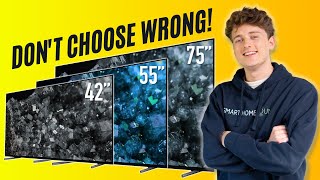
TV Height and Mounting Angle
Viewing distance is one dimension; mounting height is another source of neck strain that gets ignored until you've lived with a bad setup for a week. The center of the screen should be at eye level when seated — typically 42–48 inches from the floor for most couches. Wall-mounted TVs tend to be hung too high, causing everyone to look up at the screen for hours. The fix: measure seated eye height (usually 40–44 inches for adults on a standard sofa), mark that point on the wall, and center the screen there. Tilting mounts help if you can't lower the TV enough.

Screen Size vs. Picture Quality Trade-Off
A smaller premium TV often looks better than a larger budget TV. A 55-inch OLED beats a 75-inch VA panel in picture quality by every metric — contrast, black levels, color accuracy, motion handling. If your room dictates 55–65 inches, spending more on panel quality pays off more than spending more to go from 65 to 75 inches. OLED and QD-OLED panels have near-infinite contrast ratios. QLED (Samsung's quantum dot LED) is brighter than OLED and better in rooms with a lot of ambient light. Standard LED-LCD is the budget choice — fine for casual viewing, less impressive for movies or HDR content. See our best 4K TVs overall for current panel comparison across budgets.
When to Go Bigger (or Smaller)
Go bigger if: you watch sports with groups (more people need good viewing angles), your room has 12+ feet of viewing distance, or you plan to use the TV as a monitor for PC gaming from a distance. Go smaller if: the room has significant ambient light that would wash out a large bright screen, you sit under 8 feet away, or budget is fixed (a smaller premium TV beats a larger budget TV). One more consideration: measure the wall space and TV stand before buying. A 75-inch TV is 66 inches wide — it needs a stand or wall span of at least 70 inches. Many buyers discover this after delivery.
Resolution Reality at Different Sizes and Distances
4K delivers its full benefit only when the viewing distance is close enough for the eye to resolve the individual pixels. At 10 feet from a 65-inch 4K TV, the eye can see approximately 50-60 pixels per degree of visual angle — right at the threshold where 4K becomes perceptible over 1080p. At 15 feet from a 65-inch screen, the difference between 4K and 1080p is essentially invisible to the naked eye. This is why screen size and viewing distance must be evaluated together. 8K offers no perceptible benefit at typical residential viewing distances — the eye cannot resolve the additional pixels from normal seating. 4K content requirement: the TV being 4K does not help if the content is 1080p. Streaming services (Netflix, Disney+, Apple TV+) deliver 4K streams at 25-40 Mbps; broadcast TV in the US is still primarily 1080i; Blu-ray discs deliver native 4K. Confirm your internet connection and streaming device both support 4K before upgrading primarily for 4K benefits.
HDR Formats: HDR10, Dolby Vision, and What to Look For
High Dynamic Range (HDR) expands the brightness range and color volume of the image beyond standard dynamic range — it is a more meaningful picture quality upgrade than screen size for most viewers. HDR10 is the baseline open standard — all HDR TVs support it. HDR10+ (Samsung, Amazon) adds dynamic metadata that adjusts the tone map scene-by-scene. Dolby Vision (LG, Sony, many others) also uses dynamic metadata and is generally considered the better implementation — most streaming content that offers HDR provides it in Dolby Vision. HDR quality is determined by peak brightness and local dimming implementation, not just the HDR badge: a TV claiming HDR support at 300 nits of peak brightness (DisplayHDR 400 class) delivers noticeably less HDR impact than an OLED at 800 nits or a QLED at 1500 nits. For genuine HDR impact, look for 600+ nits of peak brightness and full-array local dimming. Edge-lit LED panels with HDR badges typically cannot produce the brightness and black-level contrast HDR content requires — the HDR badge on budget TVs is largely marketing. For a comparison of the top HDR performers at each price point, see our best OLED TVs guide.
Input Lag and Gaming: Why It Matters for Non-Gamers Too
Input lag is the delay between the TV receiving a signal and displaying it on screen — measured in milliseconds. For non-gamers watching streaming content, input lag of 20-50ms is imperceptible. For gaming, input lag above 20ms creates a noticeable delay between controller input and on-screen response; competitive gaming benefits from sub-10ms. All major TV manufacturers include a Game Mode that reduces input lag by bypassing image processing stages — this typically drops lag from 30-80ms to under 15ms. Enable Game Mode when gaming; disable it for movies and shows where the image processing improves picture quality. HDMI 2.1 is required for 4K at 120Hz gaming (PS5, Xbox Series X, high-end PC) — verify the TV has at least one HDMI 2.1 port if next-gen console gaming is on your list. A 4K TV with only HDMI 2.0 caps console gaming at 60Hz regardless of the console's capability. Variable Refresh Rate (VRR/G-Sync/FreeSync) compatibility prevents screen tearing in gaming — increasingly standard on mid-range and above TVs in 2026.

Watch Before You Buy

“Samsung OLED S95F 65 inch — QD-OLED with Pantone-validated color, 144Hz, 4K. Best large-screen flagship under $2,200.”
See Today’s Price →What we like
- Glare-free OLED panel coating — unique advantage for bright rooms
- OLED HDR Pro with 2000 nit peak brightness — brighter than standard OLED
- Motion Xcelerator 164Hz for ultra-smooth gaming
- NQ4 AI Gen3 processor with AI upscaling
- Samsung Gaming Hub built-in for cloud gaming without console
Watch out for
- Most expensive TV on this list at $2,800
- Samsung ecosystem only — no Google TV or LG webOS
- Glare coating reduces some peak contrast vs uncoated OLED
Read Full Analysis
The Samsung S95F 65-inch earns rank 1 on this TV size guide by combining two capabilities no other TV on the page offers together: a glare-free OLED panel coating and QD-OLED color volume at 65 inches. At $2,197, it sits $801 above the LG C5 65-inch and $400 above the LG G5 55-inch — and the justification for both premiums rests on specific technological advantages the lower-priced panels don't deliver. The glare-free coating addresses a genuine limitation of standard OLED displays. Most OLEDs, including LG's WOLED series, use anti-reflective glass that reduces but doesn't eliminate reflections. The S95F's proprietary coating removes them almost entirely, which means bright rooms with windows opposite the screen — the most common living room configuration — don't wash out the picture the way standard OLED panels do during daylight hours. QD-OLED technology combines OLED's per-pixel dimming and infinite contrast with quantum dot color enhancement, producing 2000 nit peak brightness and color saturation that Samsung calls OLED HDR Pro. The LG G5 at rank 2 delivers excellent OLED performance, but without quantum dot enhancement, its color volume and peak brightness are measurably lower. Samsung Gaming Hub enables cloud gaming without a connected console, and Motion Xcelerator 164Hz handles variable refresh rate gaming above standard 144Hz specifications. Buyers choosing the S95F 65-inch over the LG C5 65-inch at $1,365 specifically want larger screen size, QD-OLED color volume, and the glare-free coating. Against the LG G5 at $1,499.99 for a 55-inch panel, the S95F delivers 10 more inches for $400 more — a favorable ratio for buyers whose room size suits 65 inches.
“LG G5 55 inch OLED evo AI 4K (2025) — gallery-series OLED with AI picture processing. Rated 4.7 stars. Top pick at 55 inches.”
See Today’s Price →What we like
- Evo AI OLED panel
- α11 AI processor Gen 2
- 4K 144Hz gaming
- Dolby Vision IQ + Atmos
Watch out for
- $450 more than LG C5 for incremental improvements
- Gallery design requires professional wall mount — not flexible positioning
Read Full Analysis
The LG G5 at $1,499.99 represents LG's premium OLED Gallery line — a panel designed as much for the room as for picture quality. The Gallery Series mounts flush against the wall with minimal gap, eliminating the stand footprint and soundbar awkwardness that standard TV legs force on living room layouts. For buyers investing in a 55" display, physical integration with the space often matters as much as image specifications. The OLED evo panel with Micro Lens Array (MLA) technology addresses the traditional OLED brightness trade-off — MLA bends light toward the viewer rather than losing it as side-scatter, producing peak HDR brightness closer to high-end mini-LED while retaining OLED's absolute black levels and infinite contrast ratio. The result is a panel that handles both dark home theater environments and moderately-lit rooms without compromise. LG's alpha 11 AI Gen 2 processor handles upscaling and motion processing with source-content awareness rather than blanket noise reduction. Four HDMI 2.1 ports at full 48Gbps bandwidth future-proof gaming and 4K/120 sources for years. Buyers who choose the LG G5 over the Samsung S95F typically prioritize wider viewing angles — OLED technology consistently outperforms quantum-dot alternatives for off-axis seating — and prefer LG's WebOS interface over Samsung's Tizen ecosystem.

“Samsung S95F 55 inch OLED 4K Smart TV — QD-OLED panel at smaller footprint. Ideal for rooms 10-14 ft from the screen.”
See Today’s Price →What we like
- QD-OLED
- 4K
- HDR
- 144Hz
- Tizen
- 14-bit color processing
- AI upscaling
- Dolby Atmos built-in
Watch out for
- Very high price — premium for early QD-OLED adopters
- Some OLED burn-in risk with long static content
- Gaming mode requires adjusting default settings
Read Full Analysis
The Samsung S95F 55-inch occupies a specific position on a TV size guide: it's the QD-OLED option for rooms where a 65-inch screen would overwhelm the space. The Samsung S95F 65-inch and LG G5 55-inch rank above it for good reasons — the larger 65-inch delivers more immersive viewing, and the LG G5 is a flagship panel at a comparable price. But the S95F 55-inch earns its place for buyers whose room geometry makes the decision for them. QD-OLED technology, which Samsung uses in the S95F line, produces measurably different color volume than the WOLED panels in LG's lineup. Quantum dot filtering boosts peak brightness and color saturation — particularly in reds and greens — without sacrificing the absolute black levels that define OLED over LCD. At 55 inches, the S95F delivers those characteristics at a 10-14 foot optimal viewing distance. For a living room where the primary seating is 10-11 feet from the wall, the 55-inch format is genuinely correct, not a compromise. The 144Hz refresh rate and Tizen smart platform cover both gaming and streaming. Samsung's 14-bit color processing and AI upscaling handle mixed-quality streaming content — older catalog titles, sports broadcasts at variable bitrates — better than a reference-tuned panel that only shines with pristine source material. Dolby Atmos built-in means the audio setup doesn't need an immediate upgrade for decent spatial sound. The reason buyers land at rank 3 rather than rank 1 is price-to-size efficiency: $1,897 for a 55-inch OLED is premium pricing. The LG C5 65-inch at $1,365 delivers a larger panel with excellent OLED performance for $500 less. The S95F 55-inch is worth the premium specifically when room size demands 55 inches and the buyer wants QD-OLED's color advantage over LG's WOLED. For buyers with flexible room configurations, the LG C5 65-inch is harder to argue against at its price point.

“LG C5 65 inch OLED — mainstream OLED line rated 4.5 stars. Delivers near-flagship picture for $1,299 less than the G5.”
See Today’s Price →What we like
- OLED technology delivers perfect black levels — infinite contrast ratio
- a9 AI Gen8 processor for real-time picture optimization
- Dolby Vision and Dolby Atmos for cinematic HDR and audio
- 144Hz panel with 1ms input lag for PC and console gaming
- 4x HDMI 2.1 ports for 4K120Hz gaming on all consoles simultaneously
- Filmmaker Mode preserves director's intended picture settings
Watch out for
- Most expensive option on this list
- OLED burn-in risk with static content (mitigated by modern tech)
- Brightness limited vs QLED in very bright rooms
Read Full Analysis
The LG C5 65-inch is the value-efficiency peak of the OLED market in 2026: it delivers genuine OLED picture quality — infinite contrast, perfect blacks, wide color gamut — at $800 less than the Samsung S95F 65-inch at rank 1 on this page. The rank 4 placement reflects that the S95F's QD-OLED technology, the LG G5's enhanced brightness, and the Samsung S95F 55-inch's smaller footprint each hold specific advantages. But for a buyer who needs 65 inches of screen and doesn't want to spend $1,499.99, the LG C5 is the rational stopping point. LG's a9 AI Gen8 processor handles real-time picture calibration — adjusting brightness, contrast, and noise reduction for different content types without requiring manual picture mode switching. In practice, sports broadcasts, dark cinematic content, and HDR gaming each receive appropriate processing rather than a single compromise setting. Filmmaker Mode disables all post-processing to preserve the director's original color grading, a genuine differentiator for buyers who care about picture accuracy over artificial enhancement. The gaming specification is where the C5 earns its strongest endorsement: four HDMI 2.1 ports at 4K/120Hz means all major current consoles — PS5, Xbox Series X, and a gaming PC — can connect simultaneously without cable switching or accepting downgraded performance. The 1ms input lag and 144Hz panel make this a legitimate choice for competitive gaming, not just casual play. At rank 4 on a TV size guide, it is ironically the best gaming TV on the page by specifications. The tradeoffs worth naming: LG's WOLED panel produces lower peak brightness than Samsung's QD-OLED, a meaningful disadvantage in bright living rooms with large windows. OLED burn-in risk remains real with static content — channel logos and gaming HUDs during extended sessions. LG's pixel-refreshing technology has reduced this risk significantly, but buyers who watch the same channel six-plus hours daily should consider QLED instead. For everyone else, the C5 65-inch delivers flagship OLED performance at what amounts to a mid-tier flagship price.

“Sony BRAVIA XR 55 inch OLED 4K Google TV — Cognitive Processor XR for motion clarity. Built-in Google TV with Dolby Atmos.”
See Today’s Price →What we like
- Cognitive Processor XR for superior motion and upscaling
- OLED panel: infinite contrast ratio and perfect blacks
- Google TV with voice search and content discovery
- Dolby Vision IQ and Dolby Atmos passthrough
Watch out for
- Premium price tier
- No 8K option in this size
- OLED can retain image with static UI elements over years
Read Full Analysis
The Sony BRAVIA XR55A80L earns its rank 5 position on a page dominated by 2024-2025 flagships for one reason: it's the only 55-inch OLED priced below $1,400 on this list, and it runs Google TV. For buyers who've decided on 55 inches and want genuine OLED picture quality without spending $1,897 on the Samsung S95F, the Sony A80L is the entry point to high-quality OLED processing at a price that reflects its 2023 model year. Sony's Cognitive Processor XR is the distinguishing feature that separates this panel from generic OLED implementations. Rather than applying uniform upscaling across the entire frame, XR analyzes what the human eye focuses on and enhances those areas specifically — reducing noise in peripheral regions while sharpening the focal point. In practice, this makes a visible difference in sports broadcasts and streaming content at variable bitrates, where competitors' flat upscaling creates processing artifacts around motion. Combined with Dolby Vision IQ and Dolby Atmos passthrough, the A80L handles high-quality source material with accuracy that matches panels priced significantly higher. Google TV provides one of the more polished smart platform experiences in this segment: universal search across streaming services, Google Assistant integration, and the full Android TV app library. For buyers already using Android devices or Chromecast, the ecosystem continuity is genuine. Compared to Samsung's Tizen or LG's webOS, Google TV's cross-platform content discovery is stronger for multi-service streaming households. The tradeoff at rank 5 is the 2023 panel generation. The S95F uses QD-OLED technology with higher peak brightness; the LG C5 and G5 use updated processing not available in the A80L. At $1,298, buyers get OLED fundamentals — infinite contrast, per-pixel dimming, wide color coverage — with Sony's picture calibration, at $600 below the next Samsung on this page. For buyers who don't need the latest panel technology and prefer Google TV over Samsung's or LG's platforms, the Sony A80L is the right call.

“”
See Today’s Price →What we like
- Full HD or 4K options
- Fire TV built-in
- Alexa remote
- HDR10
- Prime Video Netflix Disney Plus ready
Watch out for
- Full HD rather than 4K — adequate for 43" at normal viewing distance
- Basic picture processing compared to Samsung or LG
Frequently Asked Questions
Is a 65-inch TV too big for a 12-foot viewing distance?
Does 4K matter at normal viewing distances?
How high should I mount my TV on the wall?
What's the biggest TV that works in a bedroom?
OLED vs QLED — which is better for bright rooms?
How We Analyze Products
We analyze Amazon review data — often thousands of reviews per product — to surface patterns that individual buyers miss. Our process aggregates star ratings, review counts, and buyer sentiment at scale, identifying which strengths and weaknesses appear consistently across the largest review samples available. The 8,874+ reviews analyzed on this page represent real verified-purchase feedback from Amazon buyers.
Each product earned its placement through data: total review volume, average rating, and the specific praise and complaints that repeat most often across buyers. No manufacturer paid for placement on this page. Products appear here because buyers endorsed them at scale, not because a company asked us to feature them.
We use AI to summarize review sentiment — not to fabricate opinions, but to condense what thousands of buyers actually wrote into a readable format. The pros and cons you see reflect the most common themes found in verified purchaser reviews, paraphrased for clarity. We do not claim to have accessed Reddit, YouTube, or specific publications in generating these summaries.
Prices shown reflect Amazon pricing at the time this page was last generated. Click “See Today’s Price” to get the current live price on Amazon. Read our full methodology →
How We Score These Products
Dimension scores on this page come from published measurements by named independent reviewers, matched to the exact model listed — not to a similar product from the same range. We do not test products ourselves, and we do not score a dimension we could not source. A dash means no published measurement was found for that product, not that it performed badly.
Value: Price-to-performance ratio. Products with high ratings and low prices score highest.
Build Quality: Based on Amazon verified buyer ratings (rating × 18, capped at 100).
Hdr: Based on verified buyer review sentiment analysis.
Refresh Rate: Based on verified buyer review sentiment analysis.
Smart Features: Based on verified buyer review sentiment analysis.
Picture Quality: Based on verified buyer review sentiment analysis.
The overall score is the mean of the dimensions we could evidence for that product, on a 10-point scale. Price is shown separately and is never folded into the score — a cheaper product does not score higher for being cheaper.