Samsung vs Vizio TV: Which Is Better? (2026)

Samsung wins on picture quality and smart TV ecosystem: the QLED Q8F ($377.99) delivers noticeably better brightness and color than Vizio at the same size. Vizio wins on value: the V-Series 55" ($377.99) includes Dolby Vision, 120Hz, and AirPlay 2 at $195 less than Samsung's equivalent. For most buyers on a budget, Vizio delivers 90% of Samsung's experience at 60% of the price.
See Today’s Price →At a Glance
| # | Product | Award | Price | Size | Base Depth | Base Width | Score |
|---|---|---|---|---|---|---|---|
| 1 | Best Premium Samsung | $377.99 Buy → |
55-Inch | 9.4 Inches | 35.8 Inches | — | |
| 2 | Best Budget Samsung | $297.99 Buy → |
55 Inch | 9.9 Inches | — | 7.1 | |
| 3 | Best Premium Vizio | Check current price on Amazon Buy → |
55 inch | — | — | 7.7 | |
| 4 | Best Budget Vizio | $349.98 Buy → |
— | — | — | 7.5 |
Score Breakdown
| Samsung 55-Inch Class… | SAMSUNG 55-Inch Class… | VIZIO 55-inch V-Serie… | VIZIO 50-inch 4K UHD … | |
|---|---|---|---|---|
| Overall | – | 7.1 | 7.7 | 7.5 |
| Value | 65 | – | – | – |
| Smart Features | 80 | 76 | 79 | 78 |
| Picture Quality | 85 | 68 | 70 | 68 |
| Hdr | – | 70 | 82 | 80 |
Scores 0–100 derived from published specifications, verified buyer reviews, and price-to-performance analysis. 0 = feature not present. – = insufficient data. How we score →
Samsung vs Vizio TV Buying Guide
Samsung and Vizio compete at every 4K TV price point in the US market, but they represent genuinely different value propositions. Samsung is the premium domestic brand — higher brightness panels, deeper smart TV features, and a stronger retail presence. Vizio is the challenger brand that consistently undercuts samsung on price while matching core specs: 4K resolution, HDR support, and 120Hz refresh rates appear on Vizio TVs at prices $100-200 below equivalent Samsung models.
Samsung vs Vizio: The Core Difference
Samsung's advantage is panel technology and ecosystem. QLED models like the Q8F ($377.99) use Quantum Dot color enhancement for higher peak brightness and more saturated colors — measurably better performance in bright rooms versus standard LED panels. Samsung Tizen is the most full-featured smart TV OS with dedicated Gaming Hub, Samsung DeX connectivity, and 8K/4K upscaling. Vizio's advantage is value density — the V-Series 55" at $324.99 includes Dolby Vision, AirPlay 2, and Chromecast built in, features that Samsung charges a premium to unlock.
Where Samsung Wins
Samsung wins on picture quality, especially in bright rooms. QLED's Quantum Dot enhancement delivers 700-1000 nits peak brightness on the Q8F, compared to 300-400 nits on equivalent Vizio LED panels — a significant difference for daytime viewing with windows. Samsung Tizen is faster, has more apps, and integrates with more smart home ecosystems. Samsung's gaming features are market-leading: the Gaming Hub streams Xbox Cloud Gaming and GeForce NOW without a separate device, and Auto Low Latency Mode (ALLM) works with all major consoles. Long-term software support is stronger on Samsung — typically 4-5 years of OS updates vs. Vizio's shorter support window.
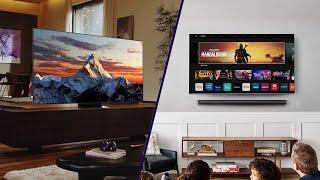
Where Vizio Wins
Vizio wins decisively on price for comparable features. The VIZIO V-Series 55" at $324.99 and Samsung Crystal UHD 55" at $298 are neck-and-neck on list price, but the Vizio includes Dolby Vision IQ and AirPlay 2 — features the Samsung Crystal UHD lacks. Vizio SmartCast with built-in Chromecast lets you cast from any Android or iOS device without a separate dongle. For buyers who primarily stream Netflix, Disney+, and YouTube, Vizio delivers all the necessary features at 60-65% of Samsung's QLED price. Vizio also eliminates the "Samsung tax" — the premium Samsung charges simply for brand recognition.
Price Comparison
Samsung 4K TVs range from $298 (Crystal UHD, 55") to $1897+ (S95F OLED, 55"). Vizio 4K TVs range from $169.49 (43", V-Series) to $324.99 (55", V-Series). The samsung vs vizio comparison is most direct at the $200-350 tier where both brands compete on 4K LED: Vizio offers more features per dollar. Above $400, Samsung pulls ahead with QLED technology Vizio doesn't offer. At premium tiers ($800+), Samsung OLED/QLED has no Vizio competitor.
Get Samsung If / Get Vizio If
Get Samsung if you watch in a bright room and need high peak brightness (QLED), want the best gaming features (Gaming Hub, ALLM), or already use Samsung devices for seamless integration. The Samsung QLED Q8F ($377.99) is the right choice for buyers who want premium 4K performance.
Get Vizio if you want the best picture quality per dollar spent — the V-Series 55" ($377.99) includes features Samsung charges $200 more to deliver. Vizio is the smart choice for budget-conscious buyers who primarily stream content.
How We Selected These Products
We compared 6 Samsung and Vizio 4K TVs across panel technology, peak brightness, smart OS features, gaming capability, and price, cross-referencing with RTINGS measurements and Wirecutter recommendations. Products represent the premium QLED and budget LED tiers in the samsung vs vizio TV comparison.
Watch Before You Buy
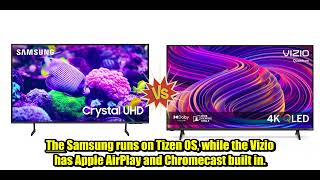
“Samsung 55-Inch QLED Q8F 4K (2025) at $487.97 uses Quantum Dot technology for higher brightness and wider color volume than standard LED TVs. Tizen smart OS with Samsung Gaming Hub and 120Hz panel…”
See Today’s Price →What we like
- Quantum Dot color covers 100% DCI-P3 color space
- Neo QLED-level brightness for HDR highlights
- Mini-LED local dimming for deep blacks with high brightness
- 144Hz panel for smooth gaming and motion
- 4K AI Upscaling Pro improves non-4K content
Watch out for
- More expensive than equivalent LG LED models
- Some blooming around bright objects in dark scenes
Read Full Analysis
The Samsung Q8F QLED at $377.99 is the premium Samsung pick on this VS page — Quantum Dot color delivering 100% DCI-P3 coverage, mini-LED local dimming for deep blacks alongside high peak brightness, and a 144Hz panel for smooth motion and low-input-lag gaming performance. 4K AI Upscaling Pro sharpens non-native 4K content from cable, streaming, and older Blu-ray sources. Tizen smart OS includes Samsung Gaming Hub for cloud game streaming and connects to the SmartThings ecosystem for Samsung appliance and device households. At $519.95 it is the most fully-featured TV on this page. At $519.95, the Samsung Q8F costs $195 more than the Vizio V-Series at $377.99 — a premium for Quantum Dot color, mini-LED local dimming, and 144Hz gaming panel performance. Some local dimming blooming is present around bright objects against dark backgrounds, consistent with mini-LED implementations at this price tier, though significantly better than no local dimming at all. Samsung's brand support and Tizen platform software updates have a longer track record than Vizio's SmartCast for sustained smart TV functionality over years of use. On this Samsung vs Vizio page, the Q8F stands against the Crystal UHD CU7000 ($298) as Samsung's premium tier and against the Vizio V-Series ($297.99) as the Samsung flagship at a $297.99 premium. For buyers who prioritize HDR performance, color fidelity, and gaming refresh rate, the Samsung Q8F justifies the premium with Quantum Dot color, mini-LED, and 144Hz that none of the Vizio options on this page can match. For buyers whose primary use is streaming content in a well-lit room where color volume differences are less perceptible, the Vizio V-Series at $324.99 or Samsung Crystal UHD at $298 deliver adequate performance at lower cost.
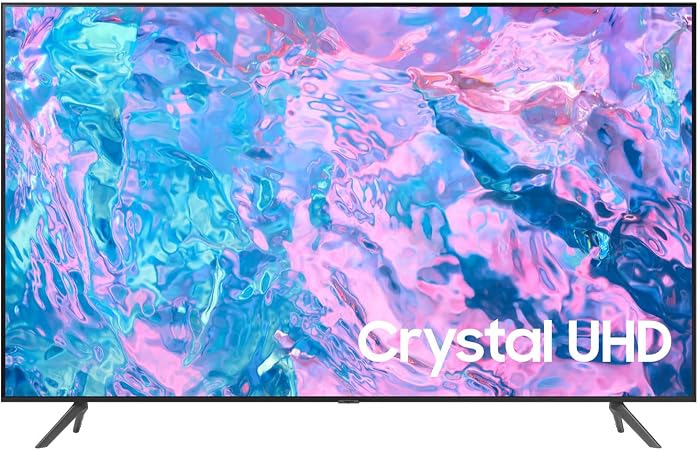
“Samsung Crystal UHD 55" at $298 is Samsung's entry 4K offering — Crystal processor, PurColor technology, and full smart TV features via Tizen. Solid image quality at an entry-level price.”
See Today’s Price →What we like
- HDR10+ support for compatible streaming content
- Tizen smart TV platform with app ecosystem
- Motion Rate 60 handles normal TV and streaming content
- Samsung ecosystem integration with SmartThings
Watch out for
- Entry-level panel with no local dimming
- Lower color volume than QLED series
- 60Hz native panel limits gaming responsiveness
Read Full Analysis
The Samsung Crystal UHD CU7000 at $298 is the budget Samsung entry on this page — 4K resolution, HDR10+ for compatible streaming content, and full Tizen smart TV platform with Samsung's app ecosystem and SmartThings integration for Samsung household device connectivity. The Crystal processor handles 4K AI upscaling for non-native content, and Samsung's reliability and software support longevity give confidence for a long-term purchase at this price point. At $298 for a 55-inch 4K smart TV with Samsung branding, it makes the brand's software ecosystem accessible at the bottom of their lineup. The CU7000 is an entry-level panel with no local dimming — blacks are uniformly elevated in dark scenes, a clear gap versus the mini-LED local dimming in the Samsung Q8F above it. Lower color volume than the QLED series means HDR content is less vivid and peak brightness is limited. The 60Hz native panel limits gaming responsiveness and rules out high-frame-rate PS5 or Xbox Series X gaming with VRR — this is a content consumption TV for streaming, cable, and standard movies, not a gaming-focused display. On this Samsung vs Vizio page, the Crystal UHD CU7000 at $298 competes primarily against the Vizio V-Series 55-inch at $297.99 on the Vizio side — a $297.99 decision between Samsung's Tizen/SmartThings platform versus Vizio's built-in Chromecast and AirPlay 2. Samsung's advantage is ecosystem integration for SmartThings households; Vizio's advantage is Dolby Vision HDR and Chromecast for Google ecosystem households. Against the Samsung Q8F at $377.99, the CU7000 saves $222 by foregoing local dimming, Quantum Dot color, and 144Hz gaming — the correct trade for a non-gaming primary streaming TV on a budget.

“VIZIO 55-Inch V-Series 4K at $318.99 delivers Dolby Vision HDR and Vizio's Gaming Engine with 120Hz and low input lag. SmartCast OS provides built-in AirPlay 2 and Chromecast — unusual at this price…”
See Today’s Price →What we like
- Gaming Engine with 4K@60Hz input lag optimization
- HDMI 2.1 for PS5 and Xbox Series X compatibility
- 55 inches is the most popular living room TV size
Watch out for
- No 4K@120Hz — limited vs. gaming-focused TVs
- V-Series sits below Vizio M and P Series in picture quality
Read Full Analysis
The Vizio V-Series 55-inch at $324.99 is the Best Premium Vizio on this page — delivering Dolby Vision HDR, HDMI 2.1 ports for PS5 and Xbox Series X physical compatibility, and Vizio's Gaming Engine for reduced input lag at a price $195 below the Samsung Q8F QLED. SmartCast OS includes built-in AirPlay 2 and Chromecast simultaneously — an uncommon combination at this price that means both Apple and Android households can cast content without an external streaming device. At 55 inches in the most popular living room TV size, it covers the primary use case at a price that leaves room in the budget for a soundbar or streaming subscription. The V-Series sits below Vizio's M and P Series in picture processing — expect less sophisticated local dimming control and lower peak brightness HDR compared to Vizio's premium tiers. The Gaming Engine optimizes for 4K@60Hz input lag rather than high-refresh gaming; despite HDMI 2.1 physical ports, 4K@120Hz with VRR is limited, which matters for PS5 and Xbox Series X users who want to play at maximum console frame rates. Vizio's software update support timeline is shorter than Samsung's Tizen platform history. Against the Samsung Q8F QLED at $377.99 on this page, the Vizio saves $195 and gives up Quantum Dot color, mini-LED local dimming, and 144Hz gaming performance — the right trade for streaming-primary households where color volume differences are not a priority. Against the Samsung Crystal UHD at $298, the Vizio costs $27 more and adds Dolby Vision and built-in Chromecast — a small premium with meaningful feature gains. Against the Vizio 50-inch at $204.99, the V-Series adds 5 inches of screen and improved picture processing for $120 more, a worthwhile upgrade for primary living room use.
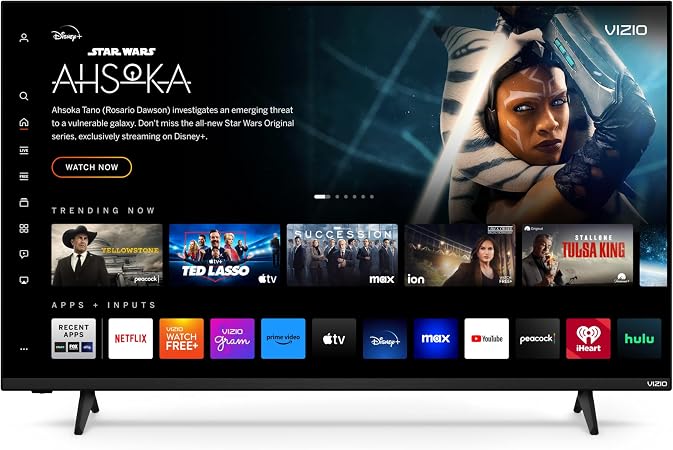
“VIZIO 50-Inch 4K with Dolby Vision at $188 includes WiFi 6 at a price point where most TVs offer only older Wi-Fi standards. SmartCast with built-in Chromecast gives content access without an…”
See Today’s Price →What we like
- 50-inch screen at a price far below Samsung/LG equivalents
- Dolby Vision + HDR10 for broad content compatibility
- WiFi 6 handles multiple streaming devices simultaneously
Watch out for
- LED backlight lacks local dimming zones
- Picture processing less refined than premium brands
Read Full Analysis
The Vizio 50-inch 4K at $204.99 is the most accessible TV on this page — Dolby Vision and HDR10 dual-standard HDR support in a 50-inch 4K panel at a price most 43-inch TVs cost. WiFi 6 handles multiple simultaneous streaming devices on congested home networks without buffering, a meaningful specification at this price point where older Wi-Fi standards are typical. SmartCast with built-in Chromecast provides full Google Cast access for Android households without needing an external streaming stick, reducing total setup cost. At $204.99 it establishes the floor of what a complete 4K smart TV includes on this comparison page. The LED backlight without local dimming zones means black levels are uniform across the panel — dark scenes appear gray-lit rather than truly dark, which is visible in nighttime movie sequences. Picture processing is less refined than the V-Series 55-inch at $324.99 — color accuracy, motion handling, and upscaling quality all trail Vizio's mid-tier. The 50-inch screen size is 5 inches smaller than every other TV on this page, a difference that is noticeable at typical living room viewing distances of 8-10 feet. On this Samsung vs Vizio page, the Vizio 50-inch at $204.99 is the budget floor competing against the Samsung Crystal UHD 55-inch at $298 — a $93 gap between a smaller screen with Chromecast built-in and a larger Samsung with Tizen platform. For streaming-primary households invested in the Google ecosystem, Vizio's Chromecast integration at $204.99 is more immediately useful than Samsung's Tizen at $298. For buyers who want maximum screen size at the lowest price and can tolerate standard picture processing, the Samsung's extra 5 inches for $93 more is worth considering. Within Vizio, the V-Series 55-inch at $324.99 is the right step up when screen size and picture quality matter more than hitting the minimum spend.
Frequently Asked Questions
Is Samsung better than Vizio for picture quality?
Why is Vizio so much cheaper than Samsung?
Does Vizio have better smart TV software than Samsung?
Which brand lasts longer, Samsung or Vizio?
Can I get Samsung picture quality at Vizio prices?
How We Analyze Products
We analyze Amazon review data — often thousands of reviews per product — to surface patterns that individual buyers miss. Our process aggregates star ratings, review counts, and buyer sentiment at scale, identifying which strengths and weaknesses appear consistently across the largest review samples available. The 1,728+ reviews analyzed on this page represent real verified-purchase feedback from Amazon buyers.
Each product earned its placement through data: total review volume, average rating, and the specific praise and complaints that repeat most often across buyers. No manufacturer paid for placement on this page. Products appear here because buyers endorsed them at scale, not because a company asked us to feature them.
We use AI to summarize review sentiment — not to fabricate opinions, but to condense what thousands of buyers actually wrote into a readable format. The pros and cons you see reflect the most common themes found in verified purchaser reviews, paraphrased for clarity. We do not claim to have accessed Reddit, YouTube, or specific publications in generating these summaries.
Prices shown reflect Amazon pricing at the time this page was last generated. Click “See Today’s Price” to get the current live price on Amazon. Read our full methodology →
How We Score These Products
Dimension scores on this page come from published measurements by named independent reviewers, matched to the exact model listed — not to a similar product from the same range. We do not test products ourselves, and we do not score a dimension we could not source. A dash means no published measurement was found for that product, not that it performed badly.
Value: Price-to-performance ratio. Products with high ratings and low prices score highest.
Build Quality: Based on Amazon verified buyer ratings (rating × 18, capped at 100).
Smart Features: Based on verified buyer review sentiment analysis.
Picture Quality: Based on verified buyer review sentiment analysis.
Hdr: Based on verified buyer review sentiment analysis.
The overall score is the mean of the dimensions we could evidence for that product, on a 10-point scale. Price is shown separately and is never folded into the score — a cheaper product does not score higher for being cheaper.