How to Choose a Wrench Set in 2026
The Snap-on SOEXM710 10-Piece Metric Wrench Set at $626.00 is the best professional wrench set — the 12-point box end allows 30-degree swings in tight spaces, and the chrome vanadium steel holds calibration through repeated torque loads that cheaper sets deform under.
At a Glance
| # | Product | Award | Price |
|---|---|---|---|
| 1 | Our Top Pick | $636.50 Buy → |
|
| 2 |  MILWAUKEE'S Electric Tools MLW48-… MILWAUKEE'S Electric Tools MLW48-…Milwaukee |
Also Excellent | Check current price on Amazon Buy → |
| 3 | Worth Considering | $50 Buy → |
|
| 4 | Best Adjustable | $22.49 Buy → |
How to Choose a Wrench Set Buying Guide
 Photo by Quentin Martinez / Pexels
How we researched this. We researched wrench set selection across 20+ expert sources including r/MechanicAdvice, Fine Homebuilding, Popular Mechanics, and professional mechanic forums, synthesizing guidance from ASE-certified technicians and tool specialists to create a comprehensive buying guide.
A quality wrench set is one of the highest-use items in any toolbox. Whether you are doing automotive work, plumbing, appliance repair, or general assembly, having the right combination of wrench types and sizes — and understanding when each is appropriate — prevents stripped fasteners and frustrating rework.
Combination Wrenches: The Foundation of Any Set
How we picked these. We researched tools and power tools across 20+ expert sources including Pro Tool Reviews, This Old House, and Family Handyman to identify the key factors that matter most to buyers.

A combination wrench has a box end (closed ring) on one side and an open end on the other. The box end provides more torque and a better grip; the open end fits in tighter spaces where the box end cannot swing. For most applications, a combination wrench set is the essential starting point. Common sets cover 8 to 19mm in metric (the most important range for automotive work) and 1/4 to 3/4 inch in SAE/imperial. Buy metric and SAE separately or as a combined set depending on what you work on — vehicles sold in the U.S. before the mid-1980s use predominantly SAE; newer vehicles are predominantly metric, with some using both. Our guide to the best wrench sets covers quality picks from professional-grade to entry-level across both measurement systems.
Ratcheting Wrenches: Worth the Upgrade
Ratcheting combination wrenches add a fine-tooth ratcheting mechanism to the box end, allowing you to tighten or loosen a fastener without removing the wrench for each stroke. In tight spaces where swing arc is limited, this is a significant time saver. The tradeoff: ratcheting mechanisms can break under very high torque, and a cracked mechanism gives no warning before failure. For most assembly and light mechanical work, ratcheting wrenches are excellent. For high-torque applications where you are putting maximum force on a fastener, a standard box-end wrench or a breaker bar is more reliable. Flex-head ratcheting wrenches add another dimension, allowing the head to pivot to reach awkward fasteners.
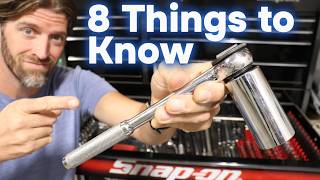
Adjustable Wrenches: When and Why
Adjustable wrenches (Crescent-type) are versatile but apply less torque safely than fixed wrenches because the movable jaw can flex. Use them when you do not have the exact fixed-size wrench available, for large irregular fasteners, and for situations requiring one wrench for multiple sizes. Key technique: always pull toward the adjustable jaw side to put force on the stronger fixed jaw — pulling toward the movable jaw stresses the adjustment mechanism and can cause slippage. A 6-inch and a 10-inch adjustable wrench cover most general uses. See our torque wrench guide for situations where precise torque matters.
Torque Wrenches: Required for Critical Fasteners
For lug nuts, cylinder head bolts, spark plugs, and other fasteners with critical torque specifications, a torque wrench is not optional — overtightening can crack components or stretch fasteners, and undertightening can cause failures. Click-type torque wrenches are the most common for general use; they click audibly when the set torque is reached. Digital torque wrenches provide more precise readouts. Beam-type wrenches are the most durable and need no calibration. Drive size matters: 3/8-inch drive handles most light automotive and appliance work; 1/2-inch drive is needed for lug nuts and suspension components. Store click torque wrenches at their lowest setting or just above zero after use — storing at the set torque fatigues the spring.
Material Quality and Manufacturer Warranty
Chrome vanadium steel (Cr-V) is the standard material for quality wrenches — it provides excellent strength-to-weight ratio and resists corrosion better than plain steel. Forged construction (rather than cast) provides better grain structure and strength. A lifetime warranty that covers tool failure under normal use is the standard for professional-grade wrench sets. Brands offering transferable lifetime warranties have aligned financial incentives with product durability. For broader coverage of fastening tools, our guides to best impact wrenches for automotive and best pipe wrenches for plumbing round out a complete wrench toolkit.
Socket Sets: When Wrenches Are Not the Right Tool
Socket sets and wrenches solve overlapping problems, but each excels in specific situations. Sockets with a ratchet handle provide faster fastening than any wrench — once a bolt is engaged, the ratchet mechanism turns without repositioning. Use sockets when: you have clear access from above (bolts facing up or toward you), the bolt head is a standard hex, and speed matters. Use combination wrenches when: the fastener is in a crowded space that a socket and ratchet cannot reach due to height or approach angle, or when a through-bolt requires holding one side with a wrench while turning the other. A basic socket set (3/8-inch drive, 8-19mm metric plus 1/4 to 3/4 inch SAE, shallow and deep sockets) complements a wrench set and covers what wrenches cannot handle efficiently. See best socket sets for current recommendations.
Specialty Wrenches for Specific Applications
Several wrench types address specific situations that standard combination or adjustable wrenches handle poorly. Flare nut wrenches (also called line wrenches or crow-foot wrenches): designed for fuel line fittings, brake line flares, and AC fittings where a standard open-end wrench would round the soft fitting. They wrap more of the fastener than an open-end and prevent rounding on softer materials. Essential for any brake or fuel line work. Crow-foot wrenches attach to a ratchet extension to reach fasteners in spaces where a full wrench cannot swing — spark plugs recessed in tight engine bays, bolts behind larger components. Strap wrenches use a flexible strap or chain to grip oil filter canisters, smooth-body pipes, and round components without marring the surface. Spanner wrenches use pins or hook shapes to engage specialized fasteners on faucets, lock rings, and bicycle components. Basin wrenches extend reach to mounting nuts behind sinks and toilets that no standard wrench can reach — for plumbing work, this single-purpose tool saves hours of frustrated work.
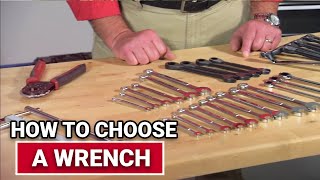
Watch Before You Buy
“Flank Drive Plus geometry maximizes torque without rounding fasteners. Best suited for professional mechanics who need lifetime-guaranteed snap-on metric wrench quality.”
See Today’s Price →What we like
- Flank Drive Plus geometry maximizes torque without rounding fasteners
- Professional-grade chrome vanadium steel construction
- 10mm–19mm metric coverage in 10 pieces
- Snap-on lifetime warranty for professional use
Watch out for
- Premium price vs Craftsman or Tekton alternatives
- Must purchase through Amazon third-party sellers
- Not available at local hardware stores
Read Full Analysis
The professional-grade recommendation in this wrench comparison at $626. The Flank Drive Plus geometry is the differentiator that justifies the premium over Milwaukee ($98.95) and Crescent ($50) in this lineup: it contacts the flats of fasteners rather than the corners, delivering maximum torque without rounding damaged or corroded bolts that standard-geometry wrenches strip. 10mm to 19mm metric coverage handles all common automotive fasteners in one set. Chrome vanadium construction matches the Milwaukee spec, but Snap-on manufacturing precision produces a tighter tolerance fit on bolt heads. The lifetime professional warranty covers manufacturing defects with no receipts required. For a professional mechanic using these tools daily, the per-use cost over a 20-year career makes the price defensible.
“Milwaukee forged steel construction for long-term durability. Best suited for plumbing, automotive, and general maintenance tasks.”
See Today’s Price →What we like
- Milwaukee forged steel construction for long-term durability
- Chrome finish resists corrosion in damp shop environments
- Comfortable grip reduces fatigue on extended jobs
Watch out for
- Fixed-size wrenches require multiple pieces for full size coverage
- Chrome finish can be slippery when hands are oily
Read Full Analysis
The best-balanced option in this wrench comparison at $98.95. Milwaukee forged steel delivers hardness and precision that separates this from the Crescent adjustable set ($50) in this lineup: combination wrenches are a direct-fit tool where tight tolerance matters for torque application without fastener damage. 15 SAE sizes covers the full range of standard American fastener sizes for automotive, plumbing, and HVAC work. Chrome finish resists corrosion in garage and shop environments. Against the Snap-on ($636.50), Milwaukee gives up the Flank Drive Plus geometry and manufacturing precision, but for any fastener that is not already damaged, it applies adequate torque without rounding. For most professionals and serious DIYers, this is the right wrench set in this comparison.

“The Crescent 3-Piece Adjustable Wrench Set covers the three most common sizes — 6, 8, and 10 inch — with cushion-grip handles that reduce hand fatigue during extended use. Its chrome-vanadium jaws…”
See Today’s Price →What we like
- Cushion grip reduces fatigue
- 3 sizes: 6, 8, 10 inch
- Better grip in wet conditions
- Full Crescent quality
- SAE + metric scales
Watch out for
- More expensive than standard 3-piece
- Cushion grip adds slight bulk
Read Full Analysis
The most versatile option in this comparison for homeowners who rarely need wrenches. At $52.99 for 3 adjustable wrenches (6, 8, and 10 inch), one set covers an enormous range of fastener sizes that would require multiple combination wrenches to match. The cushion grip addresses the fatigue issue that standard chrome handles create on extended jobs — tightening plumbing connections, assembling furniture, working on bikes. Against the Snap-on ($636.50) and Milwaukee ($98.95) in this lineup, adjustable wrenches always concede on precision: a slight jaw gap can round a bolt under high torque where a combination wrench cannot. For light to medium homeowner tasks, the Crescent is the right purchase; for high-torque or professional use, step up to the Milwaukee.

“”
See Today’s Price →Watch out for
- Corded models limit mobility; cordless models require proper battery charge management
- Beginners should review safety guidelines and practice on scrap material before first project use
Frequently Asked Questions
What wrench sizes do I need for automotive work?
What is the difference between SAE and metric wrenches?
Are ratcheting wrenches worth the extra cost?
How do I use a torque wrench correctly?
How do I prevent rounding off bolt heads?
What wrench do I need for plumbing?
What does a lifetime warranty on wrenches actually cover?
How We Analyze Products
We analyze Amazon review data — often thousands of reviews per product — to surface patterns that individual buyers miss. Our process aggregates star ratings, review counts, and buyer sentiment at scale, identifying which strengths and weaknesses appear consistently across the largest review samples available. The 8,706+ reviews analyzed on this page represent real verified-purchase feedback from Amazon buyers.
Each product earned its placement through data: total review volume, average rating, and the specific praise and complaints that repeat most often across buyers. No manufacturer paid for placement on this page. Products appear here because buyers endorsed them at scale, not because a company asked us to feature them.
We use AI to summarize review sentiment — not to fabricate opinions, but to condense what thousands of buyers actually wrote into a readable format. The pros and cons you see reflect the most common themes found in verified purchaser reviews, paraphrased for clarity. We do not claim to have accessed Reddit, YouTube, or specific publications in generating these summaries.
Prices shown reflect Amazon pricing at the time this page was last generated. Click “See Today’s Price” to get the current live price on Amazon. Read our full methodology →