How to Start Investing in 2026: A Beginner's Complete Guide
Start with a Roth IRA at M1 Finance — contribute up to $7,000 for 2025 (deadline: April 15, 2026). Invest in a simple 3-fund portfolio: US total market, international, bonds. Don't try to pick stocks until you have at least $10,000 in index funds.
At a Glance
How to Start Investing Buying Guide
 Photo by Towfiqu barbhuiya / Pexels
How we evaluated this guide. We researched beginner investment options including index funds, ETFs, robo-advisors, and brokerage account types, evaluating expense ratios, minimum investment requirements, tax-advantaged account priority (Roth IRA, 401k), and risk tolerance frameworks, cross-referencing Vanguard, Fidelity, and SEC investor education resources. This content is for informational purposes only and should not be considered financial advice.
Starting to invest before understanding the account structure is how most people end up in taxable accounts when they should be in tax-sheltered ones. A Roth IRA at M1 Finance lets you contribute up to $7,000 per year in after-tax dollars that grow completely tax-free, with access to individual stocks and ETFs on a fractional-share basis. SoFi Invest covers both self-directed trading and automated portfolios for hands-off beginners. The right decision sequence: capture any 401(k) employer match first (free money), fund the Roth IRA next, then return to max the 401(k) before investing in taxable accounts. This guide covers that sequence, the traditional vs. Roth tax tradeoff, and how to pick a starting allocation without overcomplicating it.
Affiliate disclosure: Some products featured are from partners who compensate us. This does not affect our ratings or editorial recommendations.
Great for: Anyone with a 5+ year timeline who wants to build wealth beyond savings account yields, and retirement investors
Not ideal if: You have high-interest debt — paying off 20% APR credit cards beats any expected market return
- You have money sitting in a savings account and want it to grow faster
- You have never opened a brokerage account and do not know where to start
- You want to understand index funds, ETFs, and Roth IRA without the jargon
- You are already actively investing and want advanced strategies
- You are looking for stock-picking advice or market timing — this covers passive investing
Quick Verdict: Our top pick is the M1 Finance Roth IRA (Best for Beginners) — consistently top-rated in its category.
<How to Start Investing in 2026: The Complete Beginner's Guide
If you have been putting off investing because it feels complicated or you think you need more money first, this guide will change your mind. The math is unambiguous: starting now — even with a small amount — beats waiting until you have the right amount. By the end of this guide, you will know exactly which account to open, what to invest in, and how to set it up so you never have to think about it again.
Why Starting Now Beats Starting Later — The Compound Interest Math
Compound interest is the only get-rich-slowly strategy that actually works. Here is the math that should make you open an account today:

- Starting at 25: $200/month at 10% average annual return = $1,274,564 by age 65
- Starting at 35: $200/month at 10% average annual return = $452,098 by age 65
- The cost of waiting 10 years: $822,466 — from the exact same monthly contribution
The 10-year delay costs over $800,000, but only $24,000 in actual contributions (10 years x $200/month x 12 months). That is the power of compounding: your money earns returns, and those returns earn returns, and over decades it snowballs into something extraordinary.
You do not need to invest $200/month to start. M1 Finance accepts deposits as small as $25 after the initial $100 minimum. What matters is getting started and making it automatic.
Roth IRA vs Traditional IRA: Which One Should You Choose?
An IRA (Individual Retirement Account) is a tax-advantaged account you open yourself — separate from any employer 401(k). There are two main types:
Roth IRA — Pay Taxes Now, Never Again
- Contributions go in after-tax (no deduction now)
- All growth is tax-free forever
- Withdrawals in retirement are completely tax-free
- Best for: younger investors who expect to be in a higher tax bracket later
- 2025 income limit: Single filers must earn under $161,000 to contribute the full $7,000. The limit phases out between $146,000 and $161,000.
- 2025 contribution deadline: April 15, 2026 — you can still fund your 2025 Roth IRA until tax day
Traditional IRA — Deduct Now, Pay Taxes Later
- Contributions may be tax-deductible (depends on income and whether you have a 401k)
- Growth is tax-deferred
- Withdrawals in retirement are taxed as ordinary income
- Best for: higher earners who need the deduction now, or those who expect lower income in retirement
For most people under 40 with moderate income, the Roth IRA wins. Tax-free growth over 30+ years is extraordinarily valuable, and the ability to withdraw contributions (not earnings) penalty-free provides a psychological safety net.
Reminder: If you have not contributed to a 2025 IRA yet, you have until April 15, 2026. That is $7,000 you can still put in — and every dollar benefits from tax-free compounding going forward.
Brokerage Account vs IRA: When to Use Each
Once you have maxed your IRA ($7,000/year for 2025), a taxable brokerage account is your next stop. Here is how to think about them:

| Account Type | Tax Treatment | Contribution Limit | Withdrawal Rules | Best For |
|---|---|---|---|---|
| Roth IRA | Tax-free growth | $7,000/year | Penalty-free after 59.5 | Retirement (primary) |
| Traditional IRA | Tax-deferred | $7,000/year | Penalty-free after 59.5 | Retirement (if high earner) |
| Taxable Brokerage | Capital gains taxes | No limit | Anytime | Goals before retirement |
Use a brokerage account when you are saving for a house down payment (5 to 10 year horizon), a sabbatical, early retirement, or any goal before age 59.5 where you cannot wait for retirement accounts.
The 3 Investing Foundations (In This Order)
Before you touch any investment account, make sure you have done these three things in order. Skipping any of them is a financial mistake:

- Build a $1,000 starter emergency fund. This stops you from having to sell investments when your car breaks down. Park it in a high-yield savings account (4 to 5% APY at most online banks). Do not invest a dollar until this exists.
- Get your full employer 401(k) match. If your employer matches 4% of your salary, you need to contribute at least 4%. A 100% match is a guaranteed 100% instant return — nothing in the market comes close. This is the highest-return investment available to most Americans.
- Max your Roth IRA ($7,000 for 2025). After the emergency fund and employer match, your Roth IRA is the best place for long-term money. M1 Finance and SoFi Invest both make this simple with automated investing.

M1 Finance Roth IRA
“M1 Finance occupies a unique middle ground between a traditional DIY brokerage and a full robo-advisor. You create 'Pies' — visual pie charts of your chosen stocks and ETFs with target allocation perc”
What we like
- Unique 'Pie' investing model — choose your stocks/ETFs, M1 automates contributions and rebalancing
- $250–$2,500 transfer bonus depending on balance transferred ($100K–$1M+)
- $0 trading commissions, $0 management fee
- $3/month IRA fee waived when total M1 assets exceed $10,000
- Expert Pies available — pre-built portfolios you can adopt
Watch out for
- $500 initial deposit required for retirement accounts (vs. $0 at Fidelity/Schwab)
- $3/month IRA fee before $10K threshold — $36/year hidden cost for new investors
- Not ideal for active traders — single daily trade window
- Less investment research and educational content than Fidelity or Schwab
Rates as of April 16, 2026. Terms apply. Verify on issuer site.
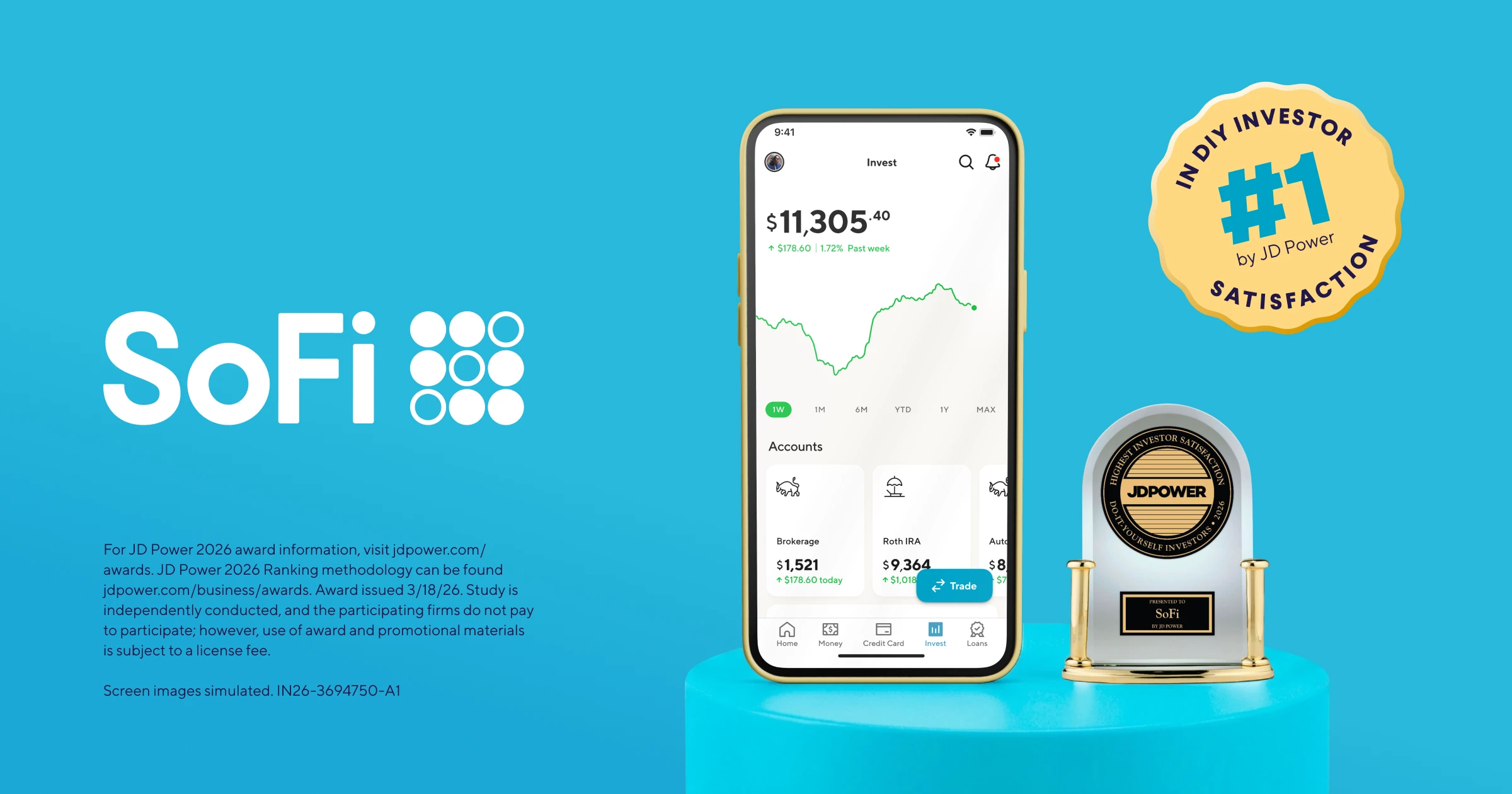
SoFi Invest
“SoFi Invest is the most integrated financial platform on this list. Your checking account, Roth IRA, stock portfolio, personal loan, and student loan refinancing all live in the same app. SoFi Plus me”
What we like
- 2% IRA contribution match through April 15, 2026 for SoFi Plus members
- All-in-one financial platform: banking, investing, loans, insurance, crypto
- $0 commissions on stocks and ETFs; automated robo-investing at 0.25%/yr
- Win $5–$1,000 in stock for new accounts funded with $50+
- 1% IRA transfer match through March 31, 2026 (up to $5M in transfers)
Watch out for
- Best features (2% IRA match) require SoFi Plus membership and direct deposit to SoFi Bank — creates ecosystem lock-in
- Automated investing robo-advisor charges 0.25%/yr — no free robo option
- $25 inactivity fee after 6 months without a trade
- Fractional shares start at $5 (higher floor than Robinhood's $1 or Public's $1)
Rates as of April 16, 2026. Terms apply. Verify on issuer site.
Frequently Asked Questions
How much money do I need to start investing?
What is the difference between a Roth IRA and a Traditional IRA?
What is an index fund?
Should I invest while paying off debt?
What happens to my investments if my broker fails? Am I protected?
Can I withdraw from a Roth IRA early?
How We Evaluate Financial Products
We compare financial products based on objective criteria: annual fees, APR ranges, rewards rates, sign-up bonuses, and key perks. We do not factor in issuer relationships or compensation when determining rankings. Products are ranked based on overall value for the target use case described on this page.
Rates and terms change frequently. We update these pages regularly, but always verify current rates directly on the issuer’s website before applying. APR ranges shown reflect the full possible range — your actual rate depends on your creditworthiness.
This content is for informational purposes only and should not be considered financial advice. We compare products; we do not advise on which product is right for your personal financial situation. Read our full methodology →