Roth IRA vs Traditional IRA: The Complete 2026 Guide
Choose a Fidelity Roth IRA if you expect your tax rate to be higher in retirement than today — Fidelity offers no account fees, $0 commission trades, and fractional share investing that lets you start with any dollar amount, making it the top-recommended platform for first-time IRA investors.
At a Glance
Roth IRA vs Traditional IRA Buying Guide
How we evaluated this guide. We researched Roth IRA and Traditional IRA tax treatment rules, 2026 contribution limits ($7,000; $8,000 age 50+), income phase-out ranges for Roth eligibility, required minimum distribution rules (age 73), and conversion strategies, cross-referencing IRS Publications 590-A and 590-B, Fidelity, and Vanguard retirement guidance. This content is for informational purposes only and should not be considered financial advice.
Affiliate disclosure: Some products featured are from partners who compensate us. This does not affect our ratings or editorial recommendations.
The One-Sentence Difference
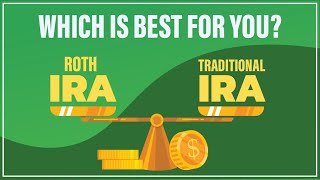
Traditional IRA: Pay taxes later. Roth IRA: Pay taxes now, never again on that money.
Both grow tax-deferred inside the account. The difference is when the IRS takes its cut: Traditional contributions may be deductible today but you owe ordinary income tax on every dollar you withdraw in retirement. Roth contributions are made with after-tax dollars, and qualified withdrawals in retirement — including all the growth — are completely tax-free.
2026 Contribution Limits (IRS-Confirmed)
- Under age 50: $7,500 combined limit (Roth + Traditional — cannot exceed $7,500 total across both)
- Age 50 and older: $8,600 (includes $1,100 catch-up contribution)
- This is a 2026 increase from 2025 limits — verify current year limits at IRS.gov
Roth IRA Income Limits (2026)
- Single / Head of Household: Full contribution allowed below $153,000 MAGI; phases out between $153,000–$168,000; no Roth contribution above $168,000
- Married Filing Jointly: Full contribution below $242,000; phases out $242,000–$252,000; eliminated above $252,000
- Married Filing Separately: Phase-out is $0–$10,000 (essentially eliminated)
- Traditional IRA: No income limit to contribute, but deductibility is limited if you or your spouse have a workplace retirement plan
Who Should Choose a Roth IRA
- Young earners (20s–30s): You're almost certainly in a lower tax bracket now than you will be at peak career earnings or in retirement. Lock in today's lower rate by paying tax now (Roth).
- People who expect higher taxes in retirement: If you'll have significant Social Security, pensions, or required minimum distributions pushing you into higher brackets, Roth tax-free withdrawals are more valuable.
- Those who want flexibility: Roth IRA contributions (not earnings) can be withdrawn any time, penalty-free. This makes a Roth a pseudo-emergency fund for financial emergencies.
- High earners who can do a backdoor Roth: If you're above the income limits, contribute to a non-deductible Traditional IRA and immediately convert it to a Roth (the "backdoor Roth"). Legal and IRS-acknowledged. Consult a tax advisor first.
Who Should Choose a Traditional IRA
- High earners in peak earning years: If you're in the 32%, 35%, or 37% bracket today and expect to drop to the 22% or 24% bracket in retirement, the Traditional deduction now saves more than the Roth future benefit.
- Those who need current-year tax relief: A deductible Traditional IRA contribution can reduce taxable income dollar-for-dollar, potentially keeping you in a lower bracket.
- Those ineligible for Roth: Above the Roth income thresholds and not doing a backdoor Roth strategy, Traditional is the default.
The Math: Why Tax Bracket Matters
Both account types grow at the same rate inside the account. The decision is purely about when you pay taxes. If your tax rate is the same now and in retirement, there's no mathematical difference. If your current rate is lower, Roth wins. If your current rate is higher, Traditional wins. Most financial advisors recommend a mix of both for "tax diversification" — having both taxable and tax-free retirement income gives you flexibility to manage your bracket in retirement.
Early Withdrawal Rules
- Roth IRA contributions: Can be withdrawn any time, any age, penalty-free and tax-free (you already paid tax on them).
- Roth IRA earnings: Tax and penalty-free after age 59½ and if the account has been open 5+ years. Otherwise 10% penalty + taxes on earnings.
- Traditional IRA: Withdrawals before 59½ trigger 10% early withdrawal penalty plus ordinary income tax. Required Minimum Distributions (RMDs) start at age 73.
Best IRA Providers in 2026
Fidelity, Vanguard, and Charles Schwab are the three most recommended IRA providers for most investors. All three offer $0 commissions on stock and ETF trades, no account fees, and extensive educational resources. Betterment and Wealthfront offer automated IRA investing if you prefer a hands-off approach. Avoid IRA providers that charge annual account fees or load fees on mutual funds — these erode returns over decades.

See also: Best Budgeting Apps to plan your contribution schedule, Best High-Yield Savings Accounts for your cash savings alongside retirement contributions, and our complete investing guide for next steps.
This content is for informational purposes only and should not be considered financial advice. Consult a qualified financial professional before making major financial decisions.
Rates as of April 2026. Refer to each provider's site for current terms.
Watch Before You Buy
Fidelity Roth IRA
“Zero fees, ZERO expense ratio index funds, fractional shares, and the best retirement planning tools available. The default choice for most IRA investors.”
What we like
- $0 account fees, $0 commissions on stocks and ETFs
- Access to Fidelity ZERO expense ratio index funds
- Fractional shares — invest as little as $1
- Best-in-class educational tools and retirement calculators
- 24/7 customer support by phone and chat
- Strong mobile app
Watch out for
- Some mutual funds require minimum investments
- Interface can be overwhelming for total beginners
- No robo-advisor for hands-off IRA management (Fidelity Go is separate)
Rates as of July 30, 2026. Terms apply. Verify on issuer site.
Vanguard Roth IRA
“The lowest expense ratios in the industry (avg 0.05%). If you're a long-term buy-and-hold index fund investor, Vanguard's cost savings compound significantly over decades.”
What we like
- $0 commissions on Vanguard ETFs and most stocks
- Lowest-cost index funds in the industry (avg 0.05% expense ratio)
- Trusted institution — founded on the index fund philosophy
- No account fees for most accounts
- Excellent for long-term buy-and-hold investors
Watch out for
- Interface is older and less intuitive than Fidelity or Schwab
- Some mutual funds require $1,000–$3,000 minimum
- No fractional shares for non-Vanguard ETFs
- Customer service phone waits can be long
Rates as of July 30, 2026. Terms apply. Verify on issuer site.
Betterment IRA (Roth or Traditional)
“Best for hands-off investors. 0.25% annual fee buys automated rebalancing, tax-loss harvesting, and goal-based retirement planning — worth it if you'd otherwise leave the account unmanaged.”
What we like
- Automated portfolio management with tax-loss harvesting
- Socially responsible investing (SRI) portfolio option
- No minimum investment
- Goal-based planning tools with retirement timeline projections
- Automatic rebalancing included
- Supports both Roth and Traditional IRA
Watch out for
- 0.25% annual management fee (or $4/month under $20,000)
- Less control over individual investments than self-directed accounts
- No individual stock selection
Rates as of July 30, 2026. Terms apply. Verify on issuer site.
Frequently Asked Questions
Can I have both a Roth IRA and Traditional IRA?
What is a backdoor Roth IRA?
Can I withdraw Roth IRA money early?
What happens to a Roth IRA when I die?
Is a Roth 401(k) the same as a Roth IRA?
When should I convert my Traditional IRA to a Roth IRA?
How We Evaluate Financial Products
We compare financial products based on objective criteria: annual fees, APR ranges, rewards rates, sign-up bonuses, and key perks. We do not factor in issuer relationships or compensation when determining rankings. Products are ranked based on overall value for the target use case described on this page.
Rates and terms change frequently. We update these pages regularly, but always verify current rates directly on the issuer’s website before applying. APR ranges shown reflect the full possible range — your actual rate depends on your creditworthiness.
This content is for informational purposes only and should not be considered financial advice. We compare products; we do not advise on which product is right for your personal financial situation. Read our full methodology →