Home ›
Kitchen › How to Choose a Coffee Maker: Every Brewing Method Compared
About This Guide
For effortless daily coffee: a drip maker like the Breville Precision Brewer. For espresso drinks: Nespresso for convenience or a semi-automatic if you want to learn. For the richest cup: French press. For batch iced coffee: cold brew. For control and ritual: pour over. French press and pour over cost the least over time; pod machines cost the most.
How we choose: Picks are compared on published manufacturer specifications, current prices, and Amazon customer ratings shown with their review counts. We do not test products ourselves and do not assign our own scores on this page.
Learn about our research process |
Last updated: August 2026
At a Glance
| # | Product | Award | Price |
|---|
| 1 |
|
Best Overall |
$118.99
Buy → |
| 2 |
|
Best Single-Serve Espresso |
$182.42
Used — not a new unit
Buy → |
| 3 |
|
Best French Press — Bodum CHAMBORD |
$39.69
Buy → |
| 4 |
|
Best Cold Brew Maker — OXO |
$59.97
Buy → |
How to Choose a Coffee Maker Buying Guide
 Photo by Chevanon Photography / Pexels
Quick Verdict: Our top pick is the Breville Precision Brewer Thermal 12-Cup Coffee Maker (Best Drip Coffee Maker) — SCA-certified to brew at the correct temperature (195-205°F) throughout the entire cycle — the detail that separates Priced at $118.99.
Budget Pick: The Bodum CHAMBORD French Press Coffee Maker 34 oz Chrome at $39.99 — The benchmark French press.
Quick verdict: For effortless great coffee every morning: get a quality drip maker like the Breville Precision Brewer. For espresso drinks (lattes, cappuccinos): get a Nespresso for convenience or a semi-automatic machine if you want to learn.
Who This Guide Is For
This guide is for you if:
- You want to stop spending $5/day at coffee shops and brew better coffee at home
- You're confused by drip, French press, espresso, pour over, and capsule options
- You've had a cheap drip machine for years and want to understand what an upgrade buys you
Skip this guide if:
- You already know your brewing method and just need the best machine
- You're a professional barista — this is for home brewers upgrading from budget equipment
The Daily Cost of Each Method
Before choosing a brewing method, understand what you're actually paying per cup over time — the upfront appliance cost is often the smallest part of your coffee spend:
| Method | Upfront Cost | Cost per Cup | Annual Cost (2 cups/day) |
|---|
| Drip (quality grounds) | $59.95–$250 | $0.15–$0.40 | $110–$290 |
| French Press (quality grounds) | $30–$60 | $0.15–$0.35 | $110–$255 |
| Pour Over (quality grounds) | $25–$80 + kettle | $0.20–$0.50 | $145–$365 |
| Nespresso (original capsules) | $100–$200 | $0.90–$1.10 | $655–$803 |
| Keurig (quality K-Cups) | $80–$180 | $0.50–$0.90 | $365–$656 |
| Semi-auto espresso (quality beans) | $200–$1,000+ | $0.30–$0.60 | $219–$438 |
| Cold Brew (concentrate) | $20–$60 | $0.25–$0.50 | $182–$365 |
Pod machines (Nespresso, Keurig) have the highest operating costs. French press and drip have the lowest. Espresso machines have high upfront cost but relatively low ongoing cost once you own good equipment and buy whole beans.
How We Chose
We researched dozens of options, analyzed thousands of verified reviews on Amazon and Reddit, and cross-referenced expert recommendations from America's Test Kitchen, Cook's Illustrated, and thousands of home cook reviews. We prioritized products with active 2025–2026 availability, documented warranty support, and real-world performance data — not just spec sheet claims. Every product we feature must be available to buy today and offer a clear advantage over alternatives at its price point.
Drip Coffee: The Right Choice for Most People
Drip coffee makers are the right choice if you want consistently good coffee without effort, morning after morning. They handle the grinding (if you add a grinder), the timing, the temperature, and the brew — you just press a button and come back 8 minutes later to a full pot.
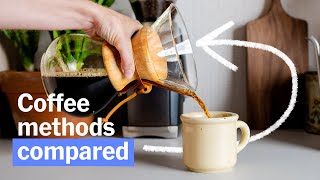
▶
French Press vs AeroPress vs Pour-over and More: Coffee Methods Compar
What Makes Great Drip Coffee
The quality range is enormous: a $20 Mr. Coffee is almost unrecognizable in cup quality compared to a $250 Technivorm Moccamaster. The key specs that separate good drip makers from bad ones: brew temperature (must hit 195–205°F — cheap makers brew at 170–180°F, which under-extracts and produces flat, sour coffee) and bloom time (a 30-second pre-infusion that lets CO₂ escape from fresh grounds before the main brew, dramatically improving flavor).
Best Drip Coffee Makers by Budget
The Breville Precision Brewer hits both specs for $120 and is SCA (Specialty Coffee Association) certified. The Technivorm Moccamaster ($350) is the gold standard. The Hamilton Beach Programmable is a fine $30 option if you use pre-ground coffee. See our full coffee maker rankings, best drip coffee makers, and coffee makers under $50. For offices: office coffee makers. Single-person households: coffee makers for one.
Add a burr grinder for a transformative quality upgrade. See the best coffee grinders — grinding fresh adds more to cup quality than upgrading the machine. The page covers all-in-one options.
French Press: The Richest Cup, the Lowest Cost
French press is the most efficient, lowest-cost way to make excellent coffee. Coarsely ground coffee + hot water + 4-minute steep + plunger = coffee with full body, natural oils intact, and complexity that drip machines strip out through paper filters.
Why French Press Tastes Different
Paper filters in drip makers absorb the coffee oils (cafestol and kahweol) that give coffee body and richness. French press is unfiltered, so all of those oils stay in the cup. This is both the attraction (rich, full-bodied coffee) and a health consideration — those oils raise LDL cholesterol in significant quantities. Moderate French press consumption (1–2 cups/day) is generally fine for healthy adults; people with cholesterol concerns should stick to filtered brewing.
Common French Press Mistakes
The technique mistakes that make French press bad: using boiling water (scalds the coffee — wait 30 seconds after boiling to pour), using fine-ground coffee (creates a muddy cup — use coarse grind), plunging too fast (stirs up grounds — plunge slowly over 20 seconds), and not timing the steep (4 minutes is the standard; 3 for lighter roasts).
The Bodum CHAMBORD ($40) is the benchmark. Frieling makes stainless versions for travel and campfire use. Our French press rankings cover every size and price point.
Espresso: The Commitment Method
Espresso is not just strong coffee — it's a different drink entirely. True espresso is brewed at 9 bars of pressure (about 130 psi), which forces hot water through tightly packed, finely ground coffee in 25–30 seconds. The result is a 1–2 oz concentrated shot with a distinctive crema (the orange-brown foam) that tastes nothing like diluted drip coffee.
Frequently Asked Questions
What's the difference between Nespresso and Keurig?
Nespresso makes espresso-style drinks (concentrated, crema-topped shots) from proprietary capsules. Keurig makes drip-style coffee and other beverages from K-Cups. Nespresso produces better coffee; Keurig has more beverage variety. If you want lattes and espresso drinks, Nespresso. If you want regular coffee with minimal effort, Keurig.
Do I need an expensive coffee maker to get great coffee?
No — a $40 French press or $25 pour-over dripper can make better coffee than a $200 drip machine if you use good beans and proper technique. The biggest quality multiplier is grinding fresh: a $50 burr grinder plus any brewing method produces coffee that most people can't distinguish from café quality.
How important is water temperature for coffee?
Critical. The ideal brewing temperature is 195–205°F (91–96°C). Brewing below 195°F (which many cheap drip makers do) under-extracts coffee, producing sour, weak, flat flavor. This is the #1 reason cheap drip makers make bad coffee even with good beans. The Breville Precision Brewer is SCA-certified to brew at the correct temperature throughout the entire cycle.
How much should I spend on a coffee grinder vs the machine?
In general, spend at least as much on your grinder as your machine, and ideally more. A $50 burr grinder ($150 is better) + a $30 French press makes better coffee than a $200 drip maker with a $20 blade grinder. Blade grinders chop coffee unevenly, creating both over-extracted (bitter) and under-extracted (sour) particles in every cup.
What's the cheapest way to make great coffee at home?
French press. A $30–$40 Bodum CHAMBORD + $12–$18/lb of quality whole beans + a $50 burr grinder (the Baratza Encore is the benchmark at $170, but cheaper options exist) = excellent coffee for $0.15–$0.25/cup. Total setup cost under $100 and the ongoing cost is the lowest of any method.
Is cold brew actually less acidic than regular coffee?
Yes — measurably. Cold brew has roughly 65% less acid than hot-brewed coffee. This is because heat accelerates the extraction of acidic compounds from coffee grounds. Cold water over a long steep period extracts the sweet, smooth compounds while leaving many of the harsh acids behind. People with acid reflux or sensitive stomachs often find cold brew much more tolerable.
Can I make espresso without an espresso machine?
Sort of. A Moka pot (stovetop espresso maker) brews at about 2 bars of pressure — not true espresso (9 bars) but produces a strong, concentrated coffee with some similar characteristics. AeroPress at high pressure with fine grind approaches espresso-style extraction. A Nespresso capsule machine is the best 'espresso without an espresso machine' option — genuine high-pressure extraction in a simple appliance.
How We Analyze Products
We analyze Amazon review data — often thousands of reviews per product — to surface patterns
that individual buyers miss. Our process aggregates star ratings, review counts, and buyer
sentiment at scale, identifying which strengths and weaknesses appear consistently across
the largest review samples available. The 46,399+ reviews analyzed on this page represent real verified-purchase feedback from Amazon buyers.
Each product earned its placement through data: total review volume, average rating, and the
specific praise and complaints that repeat most often across buyers. No manufacturer paid for
placement on this page. Products appear here because buyers endorsed them at scale, not
because a company asked us to feature them.
We use AI to summarize review sentiment — not to fabricate opinions, but to condense what
thousands of buyers actually wrote into a readable format. The pros and cons you see reflect
the most common themes found in verified purchaser reviews, paraphrased for clarity. We do not
claim to have accessed Reddit, YouTube, or specific publications in generating these summaries.
Prices shown reflect Amazon pricing at the time this page was last generated. Click
“See Today’s Price” to get the current live price on Amazon.
Read our full methodology →
Specialty Coffee Association brewing standards, temperature data from independent appliance testing, and per-cup cost analysis using SCAA recommended extraction ratios and current retail coffee prices (March 2026).
Product prices and availability are accurate as of the date/time of the most recent site update and are subject to change. Any price and availability information displayed on Amazon.com at the time of purchase will apply to the purchase of the product. Certain content that appears on this site comes from Amazon. This content is provided “as is” and is subject to change or removal at any time.
 CASABREWS CM5418 Espresso Machine…
 Nespresso Essenza Mini Coffee and…