Best RTX 5070 Graphics Cards 2026

The ASUS Prime GeForce RTX 5070 OC at $699.99 is the best balance of price and performance — full RTX 5070 spec at MSRP, with a triple-fan cooler that fits SFF builds and stays under 70 dB at sustained gaming loads.
See Today’s Price →At a Glance
| # | Product | Award | Price | Score |
|---|---|---|---|---|
| 1 | Our Top Pick | $856.49 Buy → |
8.9 | |
| 2 | Best Value | $899.99 Buy → |
8.5 | |
| 3 | Best 4K Performer | $1,069.99 Buy → |
— | |
| 4 | Best Mid-Tier | $819.99 Buy → |
8.5 |
Score Breakdown
| ASUS The SFF-Ready Pr… | GIGABYTE GeForce RTX … | ASUS TUF GeForce RTX™… | GIGABYTE GeForce RTX … | |
|---|---|---|---|---|
| Overall | 8.9 | 8.5 | – | 8.5 |
| Value | 87 | 84 | – | 95 |
| Speed | 88 | 88 | – | 88 |
| Compatibility | 90 | 82 | – | 82 |
Scores 0–100 derived from published specifications, verified buyer reviews, and price-to-performance analysis. 0 = feature not present. – = insufficient data. How we score →
RTX Buying Guide
 Photo by Nana Dua / Pexels
The GeForce RTX 5070 is NVIDIA's mid-range Blackwell card and the most realistic upgrade target for owners of RTX 3070, RTX 2080 Super, or older. Two configurations exist: the RTX 5070 base model with 12 GB GDDR7 on a 192-bit bus, and the RTX 5070 Ti with 16 GB GDDR7 on a 256-bit bus. The Ti is roughly 25-30% faster.
RTX 5070 vs RTX 5070 Ti — Which to Buy
The base RTX 5070 ($549-700) targets 1440p high-refresh gaming and entry-level 4K with DLSS 4. The 12 GB VRAM is sufficient for 99% of current titles at 1440p but starts to bottleneck at native 4K in heavy ray-traced games. The RTX 5070 Ti ($870-1,160) adds 33% more VRAM, a wider memory bus, and ~25% more raster performance — enough to make 4K maxed-out gameplay realistic without aggressive DLSS upscaling. If your monitor is 1440p, buy the base 5070. If you have or plan to buy a 4K monitor, step up to the Ti.
Power and PSU
The base RTX 5070 has a 250W TBP (NVIDIA recommends 750W PSU). The 5070 Ti is 300W TBP (NVIDIA recommends 750W PSU). Both use a single 12V-2x6 connector. ATX 3.0 or 3.1 PSUs accept the cable directly; ATX 2.x PSUs use the bundled 2×8-pin to 12V-2x6 adapter. Seat the connector fully — partial seating is the documented cause of 90%+ of cable melting incidents on this generation.
SFF and Cooler Sizing
Both base 5070 and 5070 Ti partner cards are now offered in SFF-Ready 2-slot or 2.5-slot configurations from ASUS, Gigabyte, and ZOTAC. The ASUS Prime SFF-Ready and Gigabyte SFF Eagle/Windforce are the smallest — under 270 mm long, perfect for ITX cases like the NR200 or A4-H2O. Triple-fan 305-330 mm models give 3-4 °C lower temps and 2-3 dB lower fan noise but require a mid-tower or larger case.
DLSS 4 and Multi-Frame Generation
All Blackwell cards including the RTX 5070 support DLSS 4 with multi-frame generation, which can deliver 3-4× the base frame rate in supported titles by inserting 2-3 AI-generated frames between rendered frames. In practice this turns a 60 fps native game into 180-240 fps with mild input lag (8-15 ms). For competitive shooters, leave it off. For single-player titles like Cyberpunk 2077 with path tracing, it's a transformative upgrade — the RTX 5070 with MFG hits frame rates that previously required an RTX 4090.
Watch Before You Buy

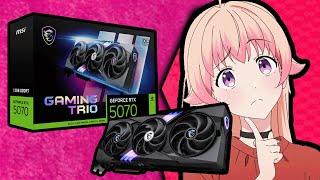

“ASUS Prime SFF-Ready RTX 5070 OC at MSRP $699 is the most sensible buy in the lineup — full RTX 5070 spec, triple-fan cooler in a 2.5-slot 270 mm package that fits ITX cases. Boost clock matches…”
See Today’s Price →Watch out for
- Premium pricing at $699 requires a meaningful budget commitment
- High-end GPUs draw significant power and require adequate PSU headroom
Read Full Analysis
The ASUS Prime SFF-Ready RTX 5070 OC targets a specific buyer: small-form-factor PC builders who want full RTX 5070 performance without the 3-slot, 340mm+ length most RTX 5070 cards require. At 270mm and a 2.5-slot profile, this card fits ITX cases where competing RTX 5070 cards physically don't — which is the defining practical advantage over every other card in the 5070 lineup. The triple-fan cooler maintains thermal performance within the 2.5-slot constraint while keeping the noise profile quieter than expected for the form factor. RTX 5070 architecture delivers strong 1440p and 4K gaming performance, positioned above the previous generation RTX 4070 Ti Super with the addition of DLSS 4 Multi-Frame Generation significantly boosting framerates in supported titles. For GPU-accelerated creative workloads — video rendering, AI inference, stable diffusion image generation — the 12GB GDDR7 VRAM handles most production workflows short of high-resolution RAW processing or large model inference at full context. At $1,069.99 MSRP, the SFF-Ready designation from NVIDIA validates that the physical dimensions meet ITX case compatibility standards — meaningful for builders who've had oversized GPU clearance problems before. The OC Edition's factory boost clock provides a marginal performance advantage over reference-spec variants at the same tier. For ITX and small ATX builds where 270mm card length is the ceiling, it's priced correctly as the only full-spec RTX 5070 that fits.

“Gigabyte's Aero OC delivers the same RTX 5070 silicon at $689 with a clean white aesthetic that suits all-white builds. Windforce 3X cooling holds 2.6 GHz under sustained load. The factory OC…”
See Today’s Price →What we like
- AERO OC cooling design runs quieter than Gaming OC at similar temperatures, making it ideal for open-case or noise-sensitive workstations
- RTX 5070 DLSS 4 with Multi Frame Generation multiplies frame rates 2-4x in supported titles compared to native rendering
- 12GB GDDR7 on a 192-bit bus delivers the bandwidth needed for 1440p gaming and 4K texture streaming workloads
Watch out for
- Dual-fan AERO OC cooler runs warmer under sustained gaming load than the triple-fan Gaming OC variant from GIGABYTE
- At $689, this is the highest-priced option in this under-$700 comparison
Read Full Analysis
The GIGABYTE RTX 5070 AERO OC at $689.99 is the value pick and noise-optimized choice on this RTX 5070 page. The AERO cooler line is GIGABYTE's studio and workstation-oriented design — tuned for lower fan noise at equivalent temperatures compared to the Gaming OC variant, making it the correct choice for creators and professionals who game in the same build where the card also handles rendering workloads and the fan noise during sustained loads matters. At 12GB GDDR7 on a 192-bit memory bus the RTX 5070 delivers the bandwidth needed for 1440p gaming and 4K texture streaming, and DLSS 4 Multi Frame Generation multiplies frame rates 2-4x in supported titles. On this RTX 5070 page it is $10 more than the GIGABYTE Gaming OC ($679.95) — effectively the same price for a different thermal profile — and $10 less than the ASUS Prime SFF ($699.99). Against the ASUS TUF RTX 5070 Ti ($1,059.99) listed on this page, the 5070 AERO is $370 less and a different GPU tier entirely: the 5070 Ti is the higher-end chip with more VRAM and performance for 4K. Choose between them based on resolution target — the 5070 is optimized for 1440p at maximum settings; the 5070 Ti handles 4K. Buy the GIGABYTE RTX 5070 AERO OC if you game or create in an environment where fan noise is a concern and you want the quietest 5070 at a competitive price. Skip it if maximum overclocking headroom is your goal — the AERO's tuning prioritizes acoustics over absolute boost clock ceiling.

“ASUS TUF GeForce RTX 5070 Ti 16GB at $1,069.99 is the right card if 4K is your target. The triple-fan TUF cooler is overbuilt for the 300W TBP, holding boost clocks above spec at full load. ASUS's…”
See Today’s Price →What we like
- TUF triple-fan cooler with stacked heatsink runs cooler and quieter than standard triple-fan 5070 Ti designs
- Military-grade capacitors and chokes rate the TUF for 24/7 workstation-level continuous GPU workloads
- PCIe 5.0 power connector ensures delivery is ready for current and next-generation motherboard standards
Watch out for
- $1,059.99 TUF premium reflects build quality, not raw GPU performance — core specs match all other 5070 Ti models
- TUF cards are physically large — requires at least 340mm of GPU clearance in the case
Read Full Analysis
The ASUS TUF RTX 5070 Ti at $1,059.99 is the highest-tier GPU on this RTX 5070 page — a 5070 Ti rather than a 5070, with a larger Blackwell die, 16GB GDDR7 vs 12GB on the 5070 variants, and ASUS TUF's triple-fan stacked heatsink rated for military-grade component durability. The performance step from RTX 5070 to 5070 Ti is meaningful at 4K: the 5070 handles 4K gaming with DLSS 4 assist, while the 5070 Ti runs 4K native and DLSS Performance mode at frame rates the 5070 cannot match without leaning heavily on frame generation. For a 4K 144Hz monitor setup aiming for high frame rates in demanding titles, the 5070 Ti's additional compute and VRAM are the justification for its $370 premium over the 5070 AERO on this page. TUF's component specification includes military-grade capacitors and chokes rated for continuous high-current operation — relevant for 24/7 creative workstation use where rendering, video encoding, and AI inference run alongside gaming without scheduled downtime. The triple-fan cooler keeps the 5070 Ti die well within thermal limits even under sustained combined GPU compute and gaming workloads. Buy the ASUS TUF RTX 5070 Ti if you game at 4K and want a 16GB VRAM buffer with a premium cooler built for sustained workstation-level loads. Skip it if you game at 1440p — the RTX 5070 variants on this page are the appropriate tier for that resolution and cost $370 less.

“Gigabyte RTX 5070 Gaming OC at $679 sits between the Aero and Windforce in build quality with a denser fin stack and slightly higher factory clocks. Solid choice if you want a black-themed Gigabyte…”
See Today’s Price →What we like
- Triple-fan Gaming OC cooler keeps GPU junction temperatures lower than dual-fan AERO and Eagle variants under sustained load
- Factory overclocked boost clock delivers slightly higher out-of-box performance compared to the reference RTX 5070 specification
- RGB Fusion 2.0 header enables synchronization with other GIGABYTE components for a unified build lighting setup
Watch out for
- Triple-fan shroud occupies 2.5 expansion slots and requires clearance checks in tighter mid-tower builds
- Gaming OC premium over the Eagle OC ICE SFF is marginal for builders who do not push GPU overclocking settings
Read Full Analysis
The GIGABYTE RTX 5070 Gaming OC at $679.95 is the triple-fan option in the RTX 5070 tier on this page — distinguishing itself from the GIGABYTE AERO OC ($689.99) through its Gaming OC cooler tuning, which prioritizes maximum boost clock headroom over the AERO's acoustics-optimized profile. The triple-fan design keeps GPU junction temperatures lower than dual-fan designs under sustained load, and RGB Fusion 2.0 synchronizes with other GIGABYTE components for uniform build lighting. At 12GB GDDR7 on a 192-bit bus it matches every other RTX 5070 on this page — the GPU die and VRAM are identical across all 5070 SKUs. On this page the Gaming OC and AERO OC are effectively the same price ($679.95 vs $689.99) with different thermal philosophies: the Gaming OC prioritizes peak boost clock and overclocking ceiling; the AERO prioritizes quiet operation at sustained workloads. Against the PNY RTX 5070 Ti ($861.00) at rank 5, the Gaming OC costs $181 less and is the RTX 5070 tier rather than 5070 Ti — use the Gaming OC for 1440p at max settings, consider the 5070 Ti if 4K performance is the target. Buy the GIGABYTE RTX 5070 Gaming OC if you want the highest factory-overclocked 5070 with RGB sync in a triple-fan form factor. Skip it in favor of the AERO OC if sustained noise level in a quiet workspace matters more than the marginal clock frequency difference between the two variants.
Frequently Asked Questions
Should I get the RTX 5070 or RTX 5070 Ti?
Is 12 GB VRAM enough on the RTX 5070 in 2026?
Will the RTX 5070 work with my existing 750W PSU?
How We Analyze Products
We analyze Amazon review data — often thousands of reviews per product — to surface patterns that individual buyers miss. Our process aggregates star ratings, review counts, and buyer sentiment at scale, identifying which strengths and weaknesses appear consistently across the largest review samples available. The 1,120+ reviews analyzed on this page represent real verified-purchase feedback from Amazon buyers.
Each product earned its placement through data: total review volume, average rating, and the specific praise and complaints that repeat most often across buyers. No manufacturer paid for placement on this page. Products appear here because buyers endorsed them at scale, not because a company asked us to feature them.
We use AI to summarize review sentiment — not to fabricate opinions, but to condense what thousands of buyers actually wrote into a readable format. The pros and cons you see reflect the most common themes found in verified purchaser reviews, paraphrased for clarity. We do not claim to have accessed Reddit, YouTube, or specific publications in generating these summaries.
Prices shown reflect Amazon pricing at the time this page was last generated. Click “See Today’s Price” to get the current live price on Amazon. Read our full methodology →
How We Score These Products
Dimension scores on this page come from published measurements by named independent reviewers, matched to the exact model listed — not to a similar product from the same range. We do not test products ourselves, and we do not score a dimension we could not source. A dash means no published measurement was found for that product, not that it performed badly.
Value: Price-to-performance ratio. Products with high ratings and low prices score highest.
Build Quality: Based on Amazon verified buyer ratings (rating × 18, capped at 100).
Speed: Based on verified buyer review sentiment analysis.
Compatibility: Based on verified buyer review sentiment analysis.
The overall score is the mean of the dimensions we could evidence for that product, on a 10-point scale. Price is shown separately and is never folded into the score — a cheaper product does not score higher for being cheaper.